

Freelancer Profit rating: 2.8/5. Usable again after the relaunch, but the 2024 shutdown and the unresolved trust record keep the score down.

This Bench bookkeeping review breaks down the monthly pricing for 2026 and how Bench Accounting changed. Bench shut down on December 27, 2024, then sold itself three days later. This bench bookkeeping review covers what changed, what the complaints say now, and whether a solo freelancer earning under $110,000 should hand them the books.

It was two days after Christmas. On December 27, 2024, roughly 12,000 small business owners opened their Bench accounts and found them locked. The notice said the platform was no longer accessible, effective immediately, and pointed people to a different software product called Kick. Bench also told customers to file a six-month extension with the IRS (Form 4868 for sole proprietors) and go find a new bookkeeper.
Three days later, the company was sold. An HR tech firm called Employer.com bought Bench and said the service would continue. So Bench is back. The harder question is whether you should trust it with a year of your financial records.
Most reviews of Bench either skip the shutdown or bury it at the bottom. That’s a problem, because the shutdown is the single most important fact about this company in 2026. You’re not buying the Bench that won awards in 2019. You’re buying a brand that went bankrupt, locked people out during tax season, and now runs under owners who had never touched a bookkeeping service before.
A clean bookkeeping setup starts with a separate business bank account — see our Mercury Bank review for freelancers.
This review is built from the BBB complaint file, Trustpilot and Capterra reviews from before and after the shutdown, court filings, and the original IRS and vendor sources. The verdict at the end names the exact income ranges and business types where Bench still makes sense, and the ones where it doesn’t. You can read more about how these reviews get put together on the methodology page, the same approach we apply across all our freelancer finance tool reviews.
Bench pricing in 2026
| Bench plan | Monthly cost |
|---|---|
| Bookkeeping Grow | $199 / month (or $1,910 billed annually) |
| Bookkeeping Core | $399 / month (or $3,830 billed annually) |
| Core + Tax | $599 / month (or $5,750 billed annually) |
Bench vs Pilot — quick verdict: For most solo freelancers, Bench is the better fit; Pilot is built for venture-backed startups and usually costs more than a freelancer needs. See the full Pilot bookkeeping review for the numbers.
What actually happened to Bench in December 2024
Bench launched in 2012 as 10Sheet Inc, went through the Techstars NYC accelerator, then rebranded to Bench in 2013 after moving to Vancouver. It raised more than $113 million in venture funding over the years, backed by names like Shopify and Bain Capital Ventures, with a $60 million Series C in 2021. By late 2024 it employed around 650 people and called itself the largest bookkeeping service for small businesses in North America.
Then it collapsed. The December 27 notice gave customers until March 7, 2025 to download their financial data. People who had paid a year in advance suddenly couldn’t reach their loan statements, prior tax returns, or general ledgers. The timing landed at the start of tax season, the worst possible week to lose access to your books.
Ian Crosby, who co-founded Bench and ran it until December 2021, said publicly that the shutdown was predictable. He claimed the board pushed him out and took the company in a direction he disagreed with. Former employees later told reporters the company had burned roughly $135 million trying to use AI to replace human bookkeepers, which created delays and a backlog of unfinished books.
The shutdown timeline, day by day
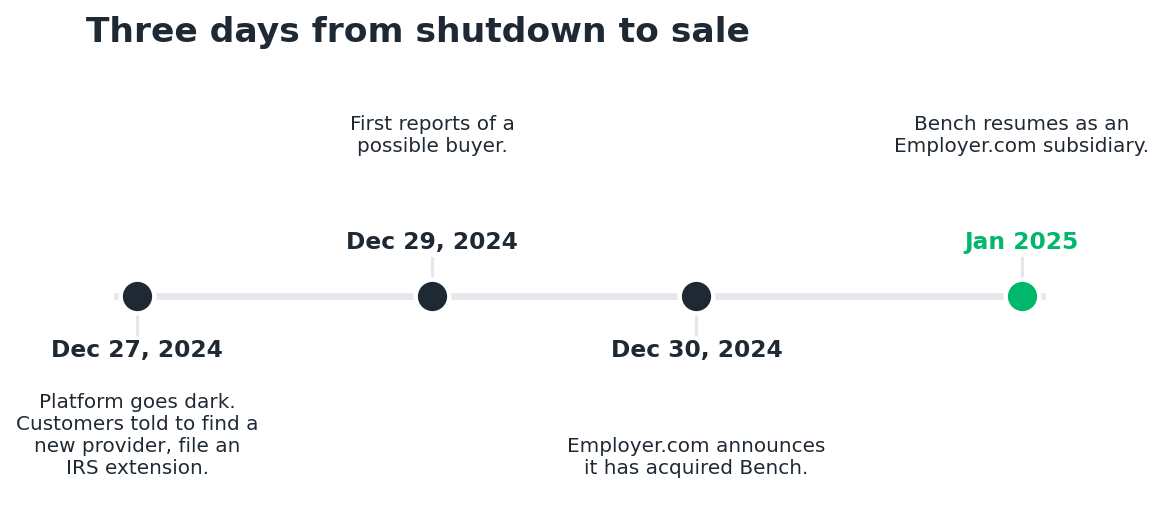
- December 27, 2024: Bench posts a service closure notice. The platform goes dark. Customers are told to find a new provider and file IRS extensions.
- December 29, 2024: First reports of a possible buyer surface.
- December 30, 2024: Employer.com announces it has acquired Bench and will revive the platform.
- January 2025: Bench resumes operations as a subsidiary of Employer.com.
Who owns Bench now, and do they know bookkeeping?
Bench is now owned by Employer.com, a San Francisco company run by Jesse Tinsley. Tinsley also runs Recruiter.com and BountyJobs, and he bought the Employer.com domain in November 2024 for about $450,000. Employer.com builds workforce software for payroll and onboarding. Before this deal, it had no bookkeeping operation of its own.
That matters for you. A bookkeeping service lives or dies on the quality and continuity of its bookkeepers, not its marketing. When the new owner says service will continue, the real test is whether the people doing the work stayed. Bench’s chief people officer said the company began calling back many, but not all, of its former employees. Not all is doing a lot of work in that sentence.
After the acquisition, Employer.com folded Bench’s operations into its wider back-office portfolio, next to a tax product called Mainstreet. So the company you sign up with in 2026 is one piece of a larger HR software roll-up, not a standalone bookkeeping firm with a single focus.
Did Bench honor prepaid services after the acquisition?
This is the part other reviews leave out, and it’s the part that should decide your trust. Tinsley publicly pledged to honor prepaid Bench services even though the new company wouldn’t collect that revenue. In practice, some customers say that’s not what happened.
In March 2025, a Bench customer named Qorum filed a lawsuit alleging that Bench required payment to release a 2023 tax return the customer had already paid for under the old ownership. The filing accused Tinsley of negligent misrepresentation over the promise to honor prepaid work. Another customer told TechCrunch a Bench representative said “Bench 2.0” had no affiliation with prior obligations.
Employer.com’s chief marketing officer, Matt Charney, disputes this. He says the company has honored prepaid services and that it delivered Qorum’s return without extra payment. Qorum’s founder says he was first required to keep his subscription active to get the return at all. You can weigh those accounts yourself. What’s not in dispute is that customers seeking refunds for prepaid services the old Bench never delivered were told to contact the bankruptcy trustee or request a chargeback through Stripe.
One more friction point soured the handover. To retrieve their own books, former customers had to click a consent button authorizing Employer.com to make the data available. Several customers complained that the only path to their records ran through that button.
What Bench costs in 2026
Bench doesn’t publish clear self-serve pricing. You get a quote after an onboarding call, and the number depends on your transaction volume and complexity. That alone is a strike against it. When a company won’t show you a price before it has your contact details, you’re the one at a disadvantage.
Reported 2026 prices vary so widely across review sites that it’s worth seeing them side by side. Here’s what different sources list for the same service in early 2026. No competitor review pulls this together, and the spread is the point.
| Source (date) | Bookkeeping only | Bookkeeping + tax | Billing note |
|---|---|---|---|
| Pasquesi Partners (Nov 2025) | $249/mo annual | $399/mo annual | Premium tier adds tax |
| G2 (2026) | $249/mo entry (Essential) | Not listed | Listed as “Bench by Employer.com” |
| Capterra / GetApp (Mar 2026) | $349/mo flat rate | Not listed | Single advertised rate |
| CoCountant (Apr 2026) | $299/mo annual, $399/mo monthly | $699/mo annual | Annual is prepaid |
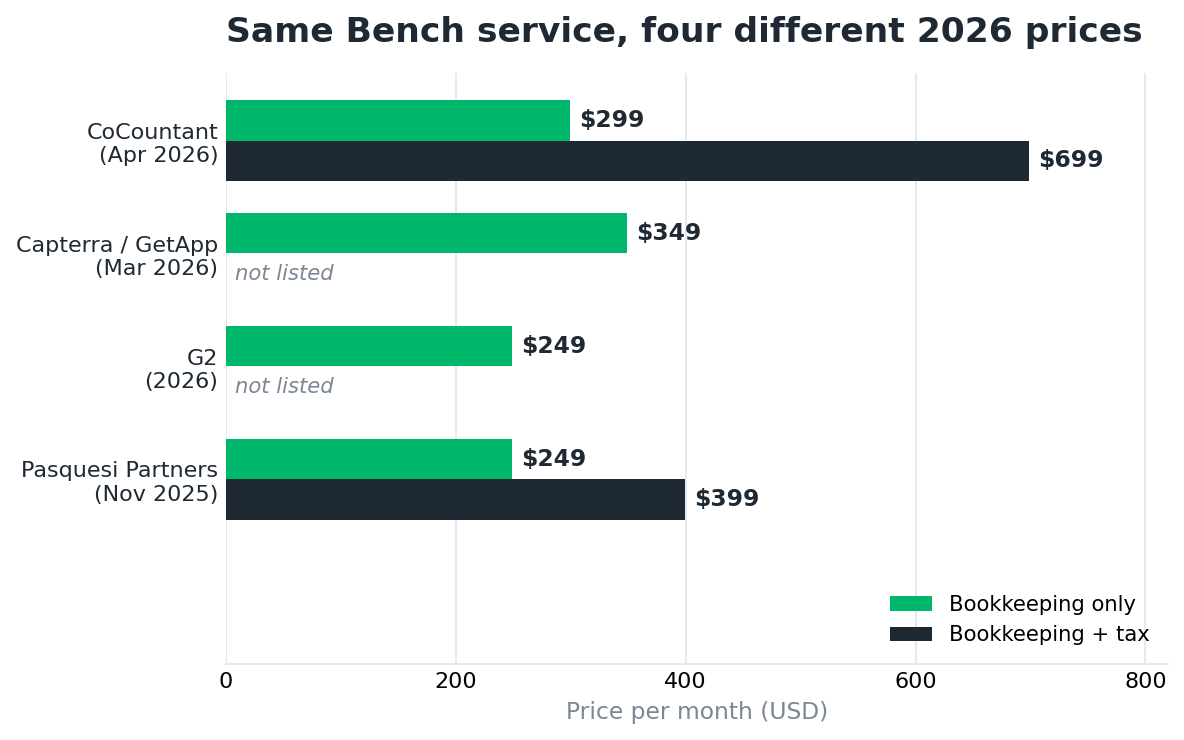
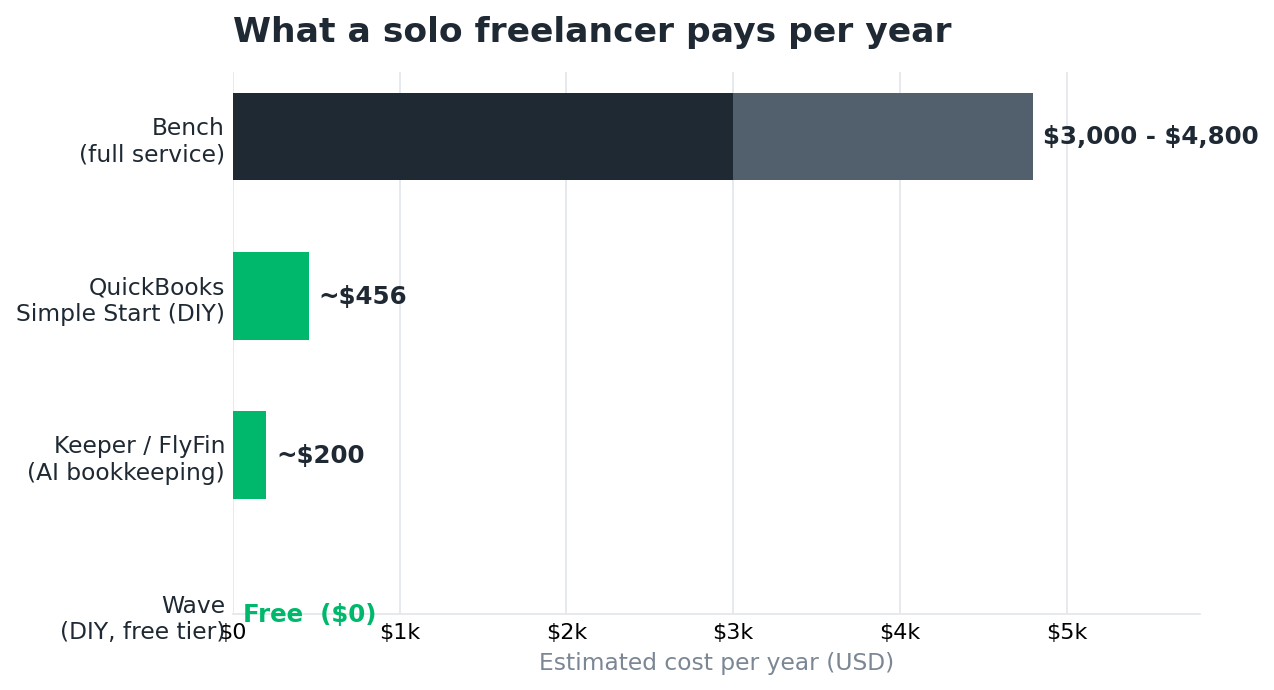
Read that table again. For the same product, in the same quarter, the bookkeeping-only price runs from $249 to $399 a month depending on who you ask, and the tax bundle runs from $399 to $699. A solo freelancer is looking at roughly $3,000 to $4,800 a year for bookkeeping, before any tax add-on.
There are add-ons on top. Catch-up bookkeeping is charged separately if you’re behind, and it can run into the thousands. A specialized bookkeeping add-on for things like property or cash revenue tracking sits around $83 a month in some quotes. Read the checkout screen carefully, because the headline number and the final number aren’t always the same.
For context, that’s full-service bookkeeping pricing. A freelance copywriter billing $68,000 a year, with one business checking account and maybe 40 transactions a month, is paying agency-level fees for a level of complexity she doesn’t have. Compare that against the options in the best accounting software for freelancers guide, where the software-only route costs a fraction of this.
What freelancers complained about before and after the shutdown
The shutdown didn’t create Bench’s problems. It exposed them. The same complaints show up in 2022 reviews and in 2025 reviews, which tells you the issues are structural, not a one-off bad year.
Bookkeeper turnover
The most consistent complaint, before and after, is churn in who handles your account. One Trustpilot reviewer reported going through five different bookkeepers in 2024 while their books ran four months behind. Capterra reviews echo it. High turnover and late monthly bookkeeping come up again and again. Every time your bookkeeper changes, you re-explain your business, and the lag grows.
Late tax filings and penalties
Bench bundles tax filing on its higher tiers, and the filing complaints are serious. Capterra and Software Advice reviews describe missed deadlines, penalties, and errors that customers only caught after hiring a separate firm to check. One BBB reviewer in February 2026 said their 2024 taxes still weren’t done, and that the 2023 return hadn’t been finished until August 2025. If you’re buying Bench partly to stop worrying about deadlines, that pattern should give you pause.
Service got worse after the acquisition, not better
Here’s the misconception worth correcting. The natural assumption is that the acquisition fixed things, because the platform came back online. The reviews from after the deal say otherwise. A Trustpilot reviewer in June 2025 wrote that after the Employer.com acquisition, the service had only gotten worse, and that they spent two months just trying to cancel their account. Coming back online and being good aren’t the same thing.
The ratings do not agree, and that is a clue
Bench’s scores are all over the map, and the gaps tell you something. The newer G2 listing under “Bench by Employer.com” shows a 4.2 out of 5, but from only 77 reviews. That’s a small, fresh sample for a company this size. Bench is also not BBB accredited, has a record of failing to respond to multiple complaints, and carries a very low customer review score there. When a polished new profile rates four stars and the long-running independent file rates one, trust the larger sample and the older file.
The data lock-in problem nobody warns you about
Bench runs on its own proprietary platform. It connects to Stripe, Square, Shopify, PayPal, and Gusto, but it doesn’t sync with QuickBooks or Xero, and it has no native export to a standard accounting format. During the shutdown, that design turned into a trap. People couldn’t pull a clean general ledger into another system, so leaving meant rebuilding their books by hand or paying a migration specialist.
Think about what that means going forward. If you put two years of records into Bench and you ever want to switch, your accountant can’t just import a file. The closed platform is convenient while you stay and expensive the moment you want to leave. For a freelancer who values flexibility, that’s a real cost, even if it never shows up on an invoice.
Bench’s standard plan also runs on a cash basis and doesn’t offer accrual bookkeeping. For most solo freelancers, cash basis is fine. If a lender or investor ever asks for accrual financials, you’ll need them restated, which means more work and more money. If you want the broader picture on keeping books that hold up, the guide on consistent accounting records walks through it.
Bench before the shutdown versus Bench now
Pull it all together and the difference between the old Bench and the current one comes down to ownership, stability, and trust. Here’s the side-by-side.
| Factor | Bench before December 2024 | Bench in 2026 |
|---|---|---|
| Owner | VC-backed independent company | Subsidiary of Employer.com, an HR tech roll-up |
| Track record | 12+ years, award reputation | Restarted after a bankruptcy and shutdown |
| Tax service | Outsourced to Taxfyle | In-house tax team on the bundle |
| Data access | Always on (until it wasn’t) | Restored, still no QuickBooks or Xero export |
| Prepaid trust | Standard subscription | Active lawsuit over honoring prepaid work |
| BBB standing | Mixed | Not accredited, unanswered complaints |
Who Bench is actually good for in 2026
A fair review should tell you who Bench actually fits. There’s a narrow profile where it works. You run a simple cash-basis business under roughly $300,000 a year, you have no employees, you genuinely don’t want to touch your books, and you accept the platform risk and the price. If that’s you, and you go in with eyes open about the cancellation friction, Bench can deliver clean monthly statements, a year-end financial package, and 1099 reporting through a tidy dashboard.
For most readers of this site, it’s the wrong tool. A freelance illustrator making $72,000 with one bank account doesn’t need a $3,600-a-year managed service. A UX designer at $95,000 with a single subcontractor is closer to the line, but still likely overpaying for what amounts to monthly categorization. An ecommerce seller is a poor fit too, because Bench has been flagged for weak cost-of-goods-sold tracking.
A five-minute decision framework
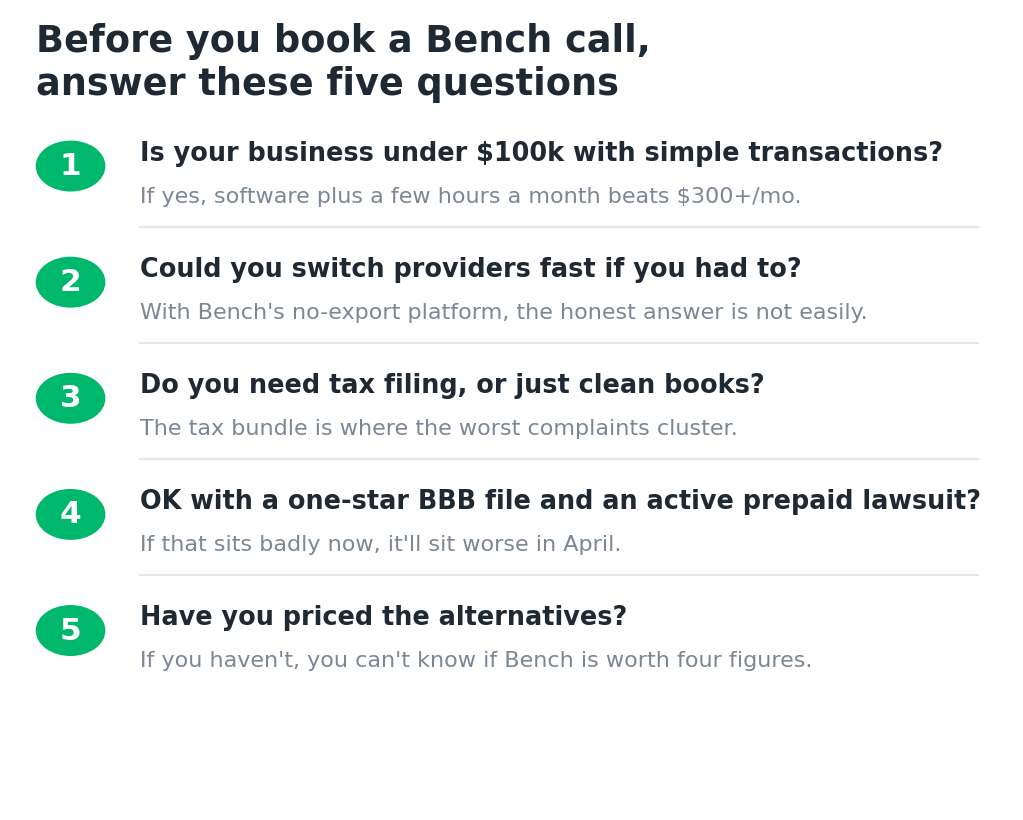
Run these five questions before you book a Bench call. Answer them honestly and the decision usually makes itself.
- Is your business under $100,000 with simple transactions? If yes, software plus a few hours a month likely beats $300-plus a month.
- Could you switch providers in a hurry if you had to? With Bench’s no-export platform, the honest answer is not easily.
- Do you need tax filing, or just clean books? The tax bundle is where the worst complaints cluster, so don’t pay for it lightly.
- Are you comfortable with a one-star BBB file and an active lawsuit over prepaid work? If that sits badly with you now, it’ll sit worse in April.
- Have you priced the alternatives? If you haven’t, you can’t know whether Bench is worth four figures a year to you.
Bench alternatives worth considering
If Bench isn’t the fit, here’s where a freelancer at your income usually lands. A vendor’s own review will never tell you to go elsewhere, so this is the part worth reading twice.
- Do it yourself with software. Tools like Wave or QuickBooks cost a fraction of a managed service and keep your data in a standard, exportable format. Start with our freelancer accounting software roundup.
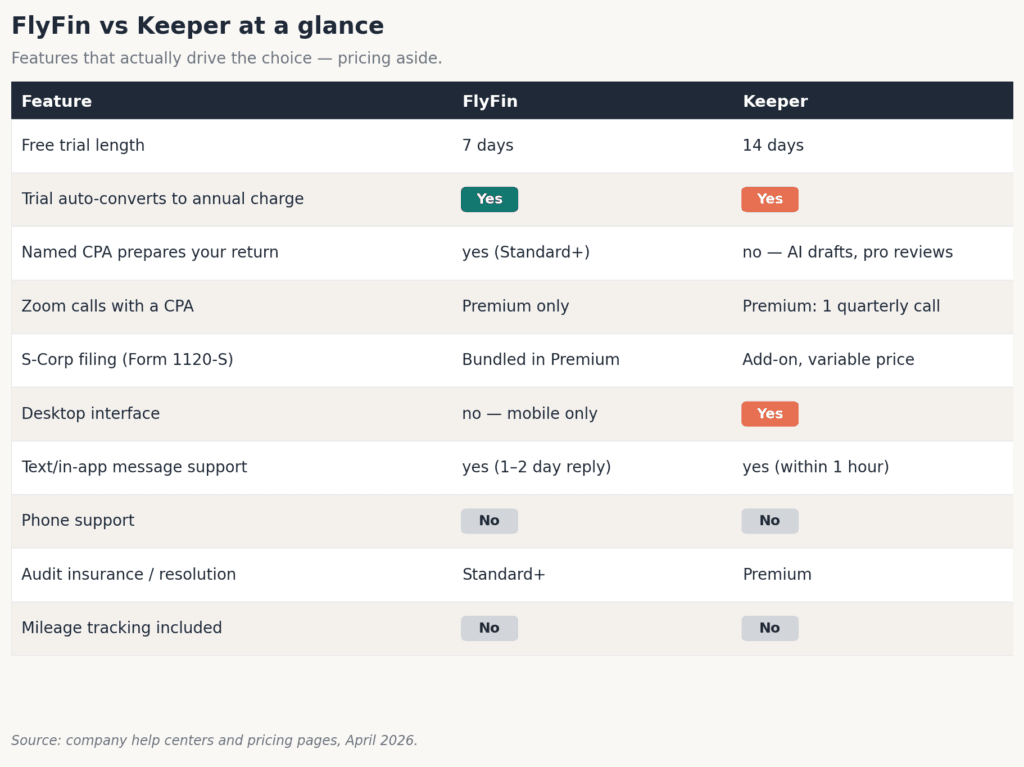
- Use an AI bookkeeping tool. If categorizing transactions is the part you hate, apps like Keeper and FlyFin automate most of it for far less than $300 a month. See the AI bookkeeping for freelancers guide, the Keeper review, and the FlyFin review.
- Hire a different full-service provider. If you want hands-off help and you’re past the DIY stage, the head-to-head in the best bookkeeping service comparison looks at Bench against Pilot and 1-800Accountant, including which one fits which business. Merritt Bookkeeping is the budget pick if you want a human at a lower flat rate.
- Get the system right first. Before paying anyone, a separate business account and a clean expense process solve half the problem. The expense tracking guide covers the setup.
Before you pay anyone $300 a month, run this 10-minute check

The free Freelancer Bookkeeper Check is a one-page worksheet that tells you in ten minutes whether you need a full-service bookkeeper, an AI tool, or just better software. It includes the five questions above, a cost calculator that compares a managed service against the DIY route at your income, and a switch checklist so you never get locked into a platform you can’t leave. Enter your email and it lands in your inbox.
Frequently Asked Questions
Is Bench still in business in 2026?
Yes. Bench shut down on December 27, 2024, was acquired by Employer.com three days later, and resumed operations in January 2025 as a subsidiary of that company. The platform is online and taking new customers. The brand survived, but it now runs under new owners who came from HR and payroll software rather than bookkeeping, and the post-acquisition reviews are mixed at best.
Did Bench go bankrupt?
Bench Accounting ceased operations and customers seeking refunds for prepaid services were directed to the bankruptcy trustee for Bench Accounting Inc. The assets and platform were then acquired by Employer.com in a fire-sale deal at the end of December 2024. So the original company effectively wound down, and a new owner restarted the brand. If you paid the old Bench in advance for work it never finished, your recourse runs through the trustee or a Stripe chargeback, not the current company.
How much does Bench cost in 2026?
Bench doesn’t publish fixed prices and quotes you after a call. Bench’s published pricing as of August 2026 puts bookkeeping at $199 a month (Grow) to $399 a month (Core), and the bookkeeping-plus-tax bundle (Core + Tax) at $599 a month, with discounts for annual billing. Catch-up bookkeeping for a backlog is billed on top and can reach the thousands. For a solo freelancer, expect roughly $3,000 to $4,800 a year before any tax add-on.
Can I export my data out of Bench?
Not into a standard format easily. Bench runs on a proprietary platform with no native QuickBooks or Xero export. You can download reports and source documents, but rebuilding your books in another system usually means manual work or paying a migration service. This is why several customers got stuck during the shutdown. If data portability matters to you, treat the lock-in as a real cost before you sign up.
Is Bench good for freelancers?
For most solo freelancers earning $45,000 to $110,000, no. The price matches full-service bookkeeping, while a single-owner business with simple transactions rarely needs that much help. You’d usually do better with software, an AI bookkeeping tool, or a cheaper provider. Bench fits a narrow profile: a simple cash-basis business that wants fully hands-off books and accepts the platform risk and the cost.
What are the best Bench alternatives?
It depends on what you want. For DIY books, Wave or QuickBooks keep your data exportable for far less. For automated categorization, Keeper and FlyFin handle most of it cheaply. For another full-service option, Pilot openly targeted Bench customers after the shutdown and built an import flow for them, while Merritt Bookkeeping is the lower-cost human option. The comparison in the best bookkeeping service guide lines these up by business type and budget.
Should I trust Bench with my taxes after the shutdown?
Be cautious. The tax bundle is where the heaviest complaints sit, including missed deadlines, penalties, and returns finished many months late. One reviewer reported their 2023 return wasn’t completed until August 2025. If you owe penalties because a filing was late, you’re the one who pays the IRS, not the service. Read the contract on who’s responsible for missed deadlines before you hand over your tax work.
The single action to take this week: if you’re weighing Bench, run the five-question framework above and price two alternatives at your income before you book a sales call. You’ll usually find the answer in your own numbers.
This article is informational and not tax or legal advice. Tax laws, IRS thresholds, and software pricing change often, and the pricing and complaint figures here reflect sources available as of May 2026. Verify current rules at IRS.gov and confirm any company’s current pricing, contract terms, and standing before you commit. For decisions specific to your situation, consult a qualified CPA.

About the author
Gareth is the founder of Freelancer Profit and a Dubai-based entrepreneur with a business consulting and leadership coaching background. He built the site to give freelancers honest, independent reviews of finance and tax tools, every one researched from official documentation, current pricing, and hundreds of real user reviews across Trustpilot, the BBB, and the app stores. It’s independent research, not professional tax advice, so check your own situation with a CPA.