
Updated October 22, 2026: Cut this guide to about half its length so the answer, the four factors and the calculator come first. The worked examples, the full-time-job section and the safe harbor rules stay. Earlier updates: October 21 folded in the former side-income guide; October 3 re-ran every percentage through the 2026 model used in the state-by-state guide (the corrected band for $45k to $110k is 19% to 32%); September 22 added the IRS underpayment rates for Q3 and Q4 2026 (7%, IR-2026-98); August 14 corrected the 1099-K and 1099-NEC thresholds under the One Big Beautiful Bill Act.
How much should freelancers set aside for taxes? The honest answer sits between 19% and 32% of your net freelance income. The gap between those two numbers is more than $10,000 a year on $80,000 of income. Below is the math that decides where you land, plus a calculator built on the 2026 IRS figures.

The “set aside 25 to 30 percent” line you have read on every freelancer blog is a starting point, not a finish line. Your real number depends on four things: your federal bracket, self-employment tax, your state, and the deductions you actually qualify for. Miss by three points on $80,000 and you owe about $2,400 in April. Everything below uses the IRS 2026 figures from Revenue Procedure 2025-32, including the changes the One Big Beautiful Bill Act made in July 2025 (the QBI deduction is now permanent and the standard deduction stepped up), so older posts quoting 2024 numbers or a “QBI sunset” are out of date. If you also hold a day job, skip to the W-2 plus 1099 section; a salary changes the math.
The short answer to how much should freelancers set aside for taxes
For most US freelancers earning $45,000 to $110,000 of net business income, set aside 20% to 31% of every freelance dollar that lands in your account. Where you sit inside that band depends on your state, your filing status, and how clean your books are.
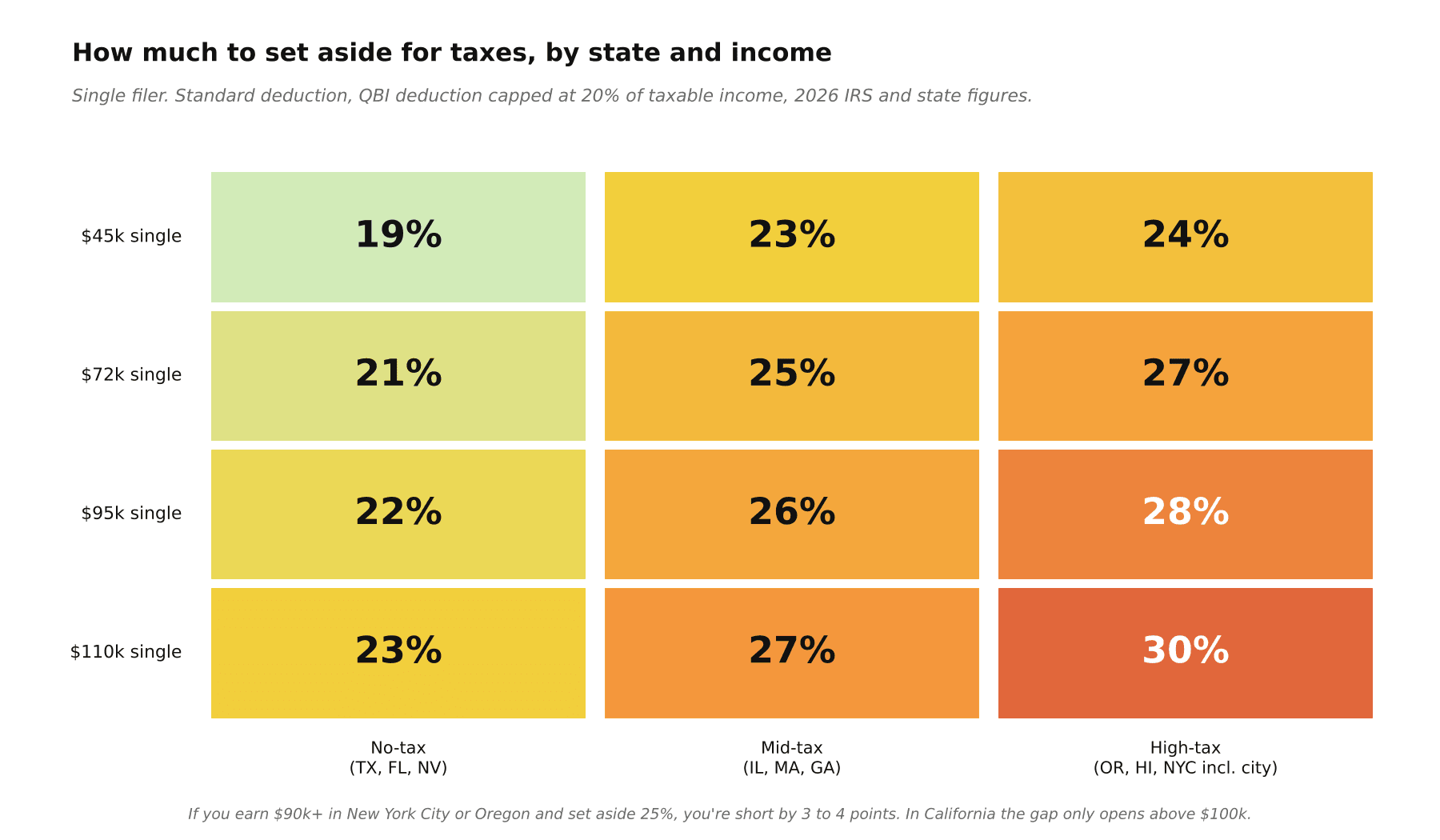
If you’ve been setting aside 25% in New York City or Oregon at $90,000+ of income, you have been short by three to four percentage points. That is real money. On $90,000 in Brooklyn, four points works out to $3,500. California gets a pass at $90,000 (25.4%), but by $120,000 you’re at 29%.
Why one percentage cannot work for everyone
Your total tax bill is three taxes stacked on top of each other. Each one responds to different things:
- Self-employment tax: 15.3% on 92.35% of net earnings, flat up to the $184,500 Social Security wage base for 2026, owed by anyone with $400 or more of net self-employment income. It ignores your state, filing status and deductions.
- Federal income tax: 10% to 37% on taxable income, which the standard deduction, retirement contributions and the QBI deduction all shrink.
- State income tax: 0% in nine states to over 13% at the top in California. The state-by-state guide runs every state through the same model.
And here’s something the round-number advice never mentions. Your marginal federal rate jumps the moment your taxable income clears $50,400 (single) or $100,800 (married filing jointly), because that is where the 22% bracket starts in 2026. Cross that line and your set-aside percentage needs to step up with it.
The four factors that move your real number
1. Your federal tax bracket (and where you sit inside it)
The 2026 federal income tax brackets for a single filer:
- 10% on taxable income up to $12,400
- 12% on income from $12,401 to $50,400
- 22% on income from $50,401 to $105,700
- 24% on income from $105,701 to $201,775
- 32% on income from $201,776 to $256,225
- 35% and 37% above that

Married filing jointly, the brackets double until you hit the higher tiers. Source: IRS Revenue Procedure 2025-32.
2. Self-employment tax (the part W-2 employees never see)
As a W-2 employee you paid 7.65% in payroll tax and your employer matched it. As a freelancer you pay both halves, 15.3%, before income tax even shows up. Two details soften it: the tax applies to 92.35% of net earnings rather than the full amount, and half of it is deductible when you work out federal income tax. It is still the largest single line on most freelancers’ returns.
For 2026 the 12.4% Social Security portion stops once combined wages and self-employment income pass $184,500; above that only the 2.9% Medicare portion continues, plus 0.9% Additional Medicare Tax above $200,000 single or $250,000 joint. To see your own SE tax broken out with a per-invoice set-aside, run the self-employment tax calculator.
3. Your state’s income tax
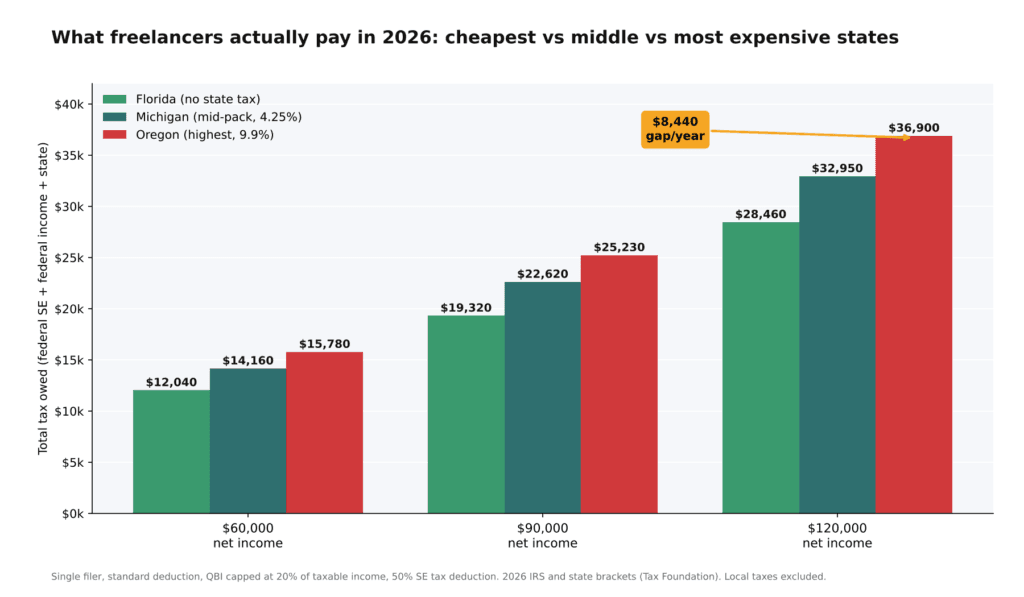
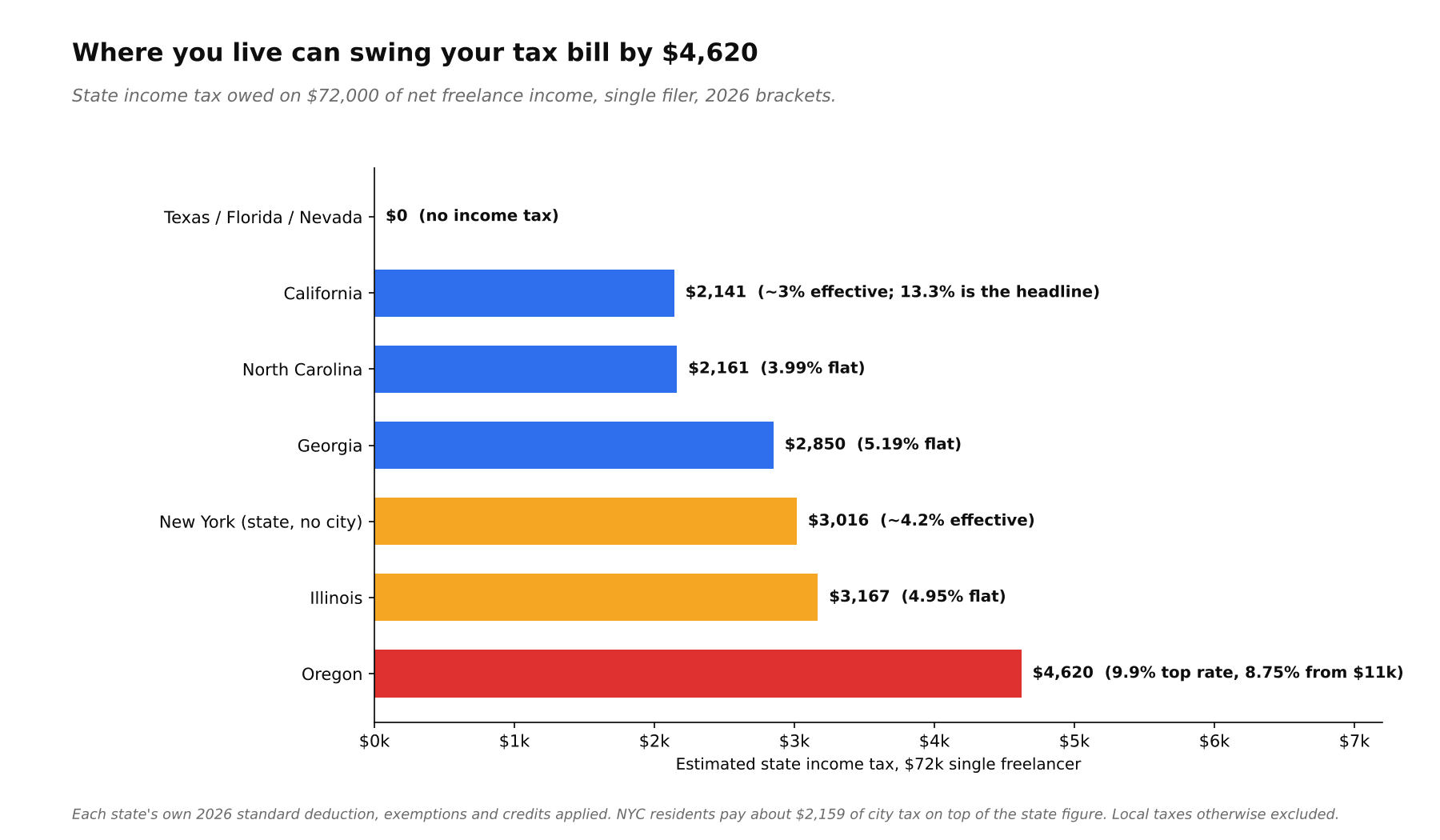
Where you live moves the number by 6 to 8 points. Nine states have no income tax (Texas, Florida, Nevada, Washington, Tennessee, South Dakota, Wyoming, Alaska and New Hampshire). Oregon, Hawaii, Delaware, Minnesota, DC and New York City (state plus city) sit at the high end. California’s 13.3% headline rate only bites past six figures; at $90,000 it is mid-pack.
For a $72,000 single freelancer, here’s what state tax adds:
4. Deductions you actually qualify for
The big three are the standard deduction, the QBI deduction and retirement contributions. Each cuts taxable income, which cuts federal tax, which cuts your percentage. The deductions guide covers the rest.
- Standard deduction (2026): $16,100 single, $32,200 married filing jointly, $24,150 head of household, no itemising needed.
- QBI deduction (Section 199A): up to 20% of qualified business income, now permanent, on Form 8995, with a new $400 minimum for anyone with at least $1,000 of active QBI. Below the $201,750 single or $403,500 MFJ phase-in you get the full 20% rate, but the deduction is capped at 20% of taxable income before QBI. For a solo freelancer on the standard deduction that cap is the number that applies: on $60,000 of net income it takes about $7,900 off taxable income, not the headline $12,000.
- Half of self-employment tax: deducted automatically on Schedule SE.
- Retirement contributions: a SEP IRA can take 20% of net SE income off taxable income and a Solo 401(k) can go higher. See Solo 401(k) vs SEP IRA.
Calculate your real number
The calculator uses the 2026 figures: the $184,500 wage base, 15.3% on 92.35% of net earnings, the 2026 brackets, the QBI deduction and the 2026 standard deductions. Estimates only; verify with a CPA before you file.
Freelancer Tax Set-Aside Calculator (2026)
Enter your numbers. Estimates only. Verify with a CPA before you file.
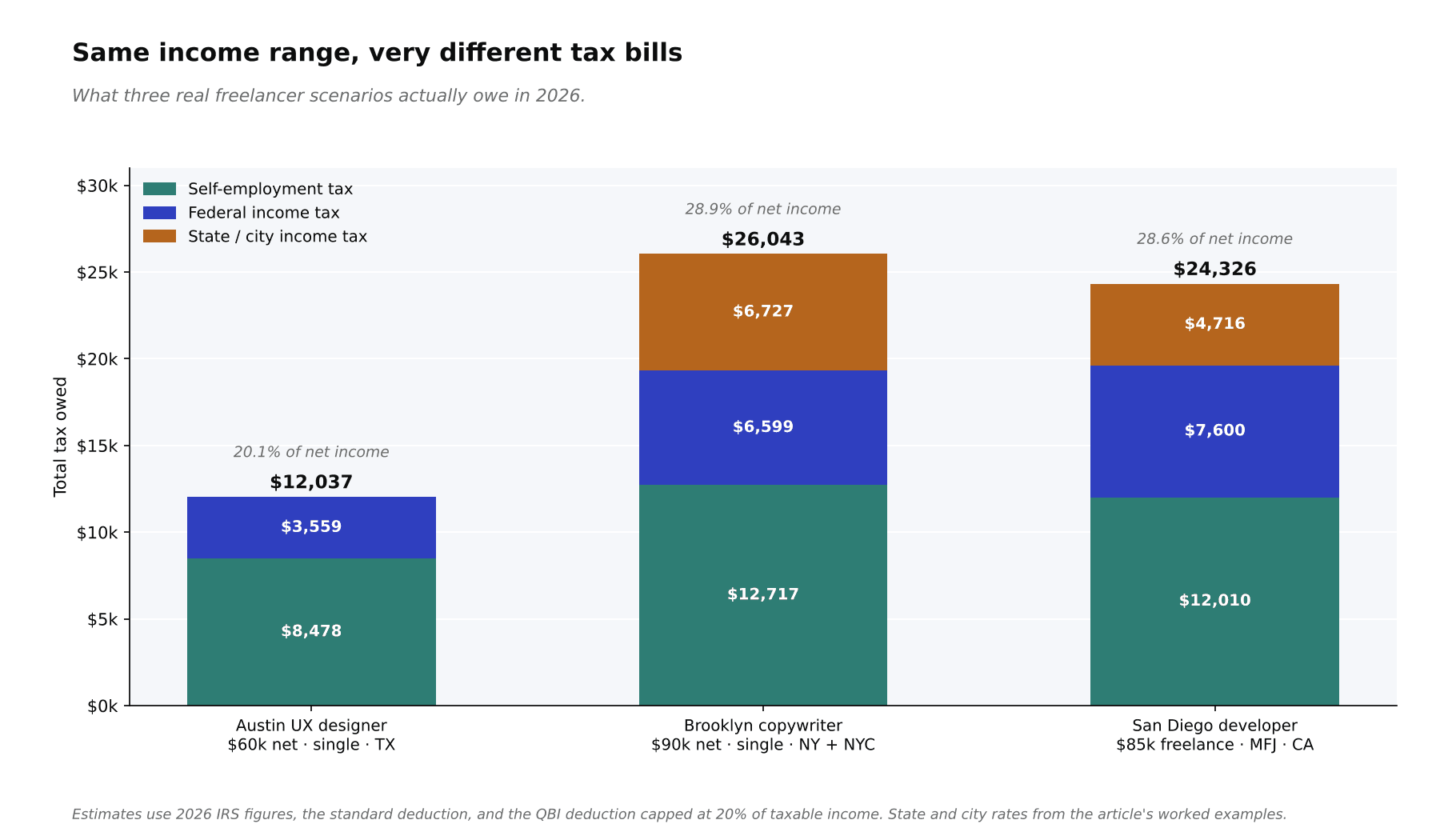
Three real examples worked out
A freelance UX designer in Austin, $60,000 net, single filer
- SE tax: $60,000 × 92.35% × 15.3% = $8,478
- AGI after half-SE deduction: $55,761
- After standard deduction ($16,100) and QBI deduction (about $7,932): taxable income around $31,729
- Federal income tax: roughly $3,560
- State tax: $0
- Total: $12,038. Set aside 20% of net income, or about $1,000 a month.
A freelance copywriter in Brooklyn, $90,000 net, single filer
Same setup, different state. New York runs progressive state tax that lands around 4.4% effective at $90,000, and New York City adds its own income tax on top.
- SE tax: $12,717
- Federal income tax (after standard deduction and 20% QBI): roughly $6,600
- NY state and city tax (combined effective ~7.5% on this income): roughly $6,730 ($3,920 state, $2,810 city)
- Total: $26,040. Set aside 28.9% of net, or about $2,170 a month.
A freelance developer plus W-2 spouse in San Diego, $85k freelance + $70k W-2, MFJ
- SE tax on $85,000: $12,012 (the spouse’s W-2 does not change it, and combined income sits under the $184,500 cap)
- Joint AGI about $148,994; after the $32,200 joint standard deduction and QBI on the freelance portion, taxable income around $101,000
- Federal income tax about $11,600, most of it already covered by the spouse’s withholding; the share attributable to the freelance income is around $7,500
- California tax on the freelance income: about $4,800
- On the freelance income alone: set aside about 28.6%, or $2,025 a month. When one of you has steady W-2 income, raising that W-4 withholding is a cleaner buffer than quarterly payments.
If you also have a full-time job: the W-2 plus 1099 math
Everything above assumes freelancing is your only income. Add a salary and two things change: your employer withholds on the salary and nothing else, so freelance profit arrives with no tax paid on it, and that profit stacks on top of the salary, so it is taxed from your top marginal rate with self-employment tax from the first dollar. A $70,000 W-2 plus an $18,000 side gig can leave you owing about $5,500 in April that nobody pulled from a paycheck. Here is the math and the three ways to close the gap.
The $70k salary plus $18k side gig example, line by line
Take a freelance designer with a $70,000 W-2 job and $18,000 of net freelance profit after expenses, filing single for 2026. Here’s what the side income actually costs.
- Self-employment tax: $18,000 × 92.35% = $16,623, taxed at 15.3% = about $2,543. Half of that ($1,272) comes back as an income tax deduction.
- QBI deduction: the 20% qualified business income deduction (Section 199A, made permanent by the One Big Beautiful Bill Act in July 2025) knocks roughly $3,300 off the taxable amount.
- Income tax: after the half-SE and QBI deductions, about $13,400 gets taxed at the 22% marginal rate = roughly $2,944.
A higher salary lowers the self-employment tax on your side income
On Schedule SE you subtract your W-2 Social Security wages from the $184,500 wage base before applying the 12.4%, so the higher your salary, the more of your side income escapes the Social Security portion. Once salary alone passes $184,500, side profit owes only the 2.9% Medicare portion.
| Day-job salary | SE tax on $20,000 of side profit (2026) |
|---|---|
| $60,000 | ~$2,826 |
| $190,000 | ~$536 |
Set aside by the bracket your salary already fills
| Federal bracket your salary already put you in | Set aside for federal tax (per freelance payment) |
|---|---|
| 12% bracket | ~25% |
| 22% bracket | 30%–32% |
| 24% bracket | 33%–35% |
Adjust your W-4 instead of paying quarterly
Almost nobody with a day job uses this: you can cover the whole side-income tax bill through W-2 withholding and skip quarterly payments. The IRS treats withholding as paid evenly across the year no matter when it left your paycheck (the Form 2210 default rule), so money withheld in December counts the same as money withheld in March, while a missed quarterly payment starts its own penalty clock.
You do it on Form W-4, Step 4(c), the line labeled “Extra withholding.” Whatever dollar amount you put there gets taken from every paycheck on top of your normal withholding. The steps:
- Estimate the federal tax on your side income from the bracket table above.
- Divide it by the paychecks left in the year.
- Put that amount in Step 4(c), hand the new W-4 to payroll, and reset it in January.
For the designer owing about $5,500 with 24 paychecks left, that is roughly $230 per paycheck in Step 4(c). The IRS Tax Withholding Estimator at irs.gov runs the per-paycheck figure if you would rather not.
The route breaks only when side income is large relative to salary: a $50,000 paycheck cannot carry the tax on $80,000 of freelance profit, and at that point you need quarterly payments or a mix of both.
Does an S-corp make sense for side income?
For almost everyone with a day job, not yet. The S-corp saving is the 15.3% self-employment tax on profit taken as distributions, and the big piece of that is the 12.4% Social Security portion your salary is already eating into: at a $150,000 salary you have $34,500 of Social Security room left, and above $184,500 your side income owes no Social Security tax at all, so the election is chasing the 2.9% Medicare portion. Against that sit a reasonable-salary payroll, a separate Form 1120-S, $500 to $1,500 a year in payroll and filing costs, and a smaller QBI deduction, because S-corp salary is not qualified business income. The election starts to make sense around $80,000 and up of side profit with meaningful Social Security room left. The entity comparison runs the break-even.
Run this in five minutes
- Find last year’s total tax: Form 1040, line 24. If prior-year AGI was over $150,000 your target is 110% of it, otherwise 100%.
- Project this year’s withholding from your latest pay stub, scaled to a full year.
- Compare. If projected withholding already beats the target, stop: no quarterlies this year, pay the small balance at filing.
- If it falls short, estimate tax on the side profit from the table above and either raise Step 4(c) on your W-4 or make quarterly payments. With side profit smaller than salary, the W-4 route is simpler.
- Move the set-aside into a separate account today.
The safe harbor rule (the only real way to avoid penalties)
The IRS does not technically care if you owe money in April. They care that you’ve paid enough during the year to satisfy one of two safe harbor tests.
- Pay 90% of this year’s tax through quarterly payments and withholding. Hard, because you do not know the final number until the year ends.
- Pay 100% of last year’s total tax, 110% if prior-year AGI was over $150,000. This is the one most freelancers should aim for.
If your 2025 total tax was $18,000, paying $4,500 each quarter in 2026 ($18,000 ÷ 4) puts you in the safe harbor regardless of how much you make this year. You might still owe in April, but the IRS won’t charge you the underpayment penalty.
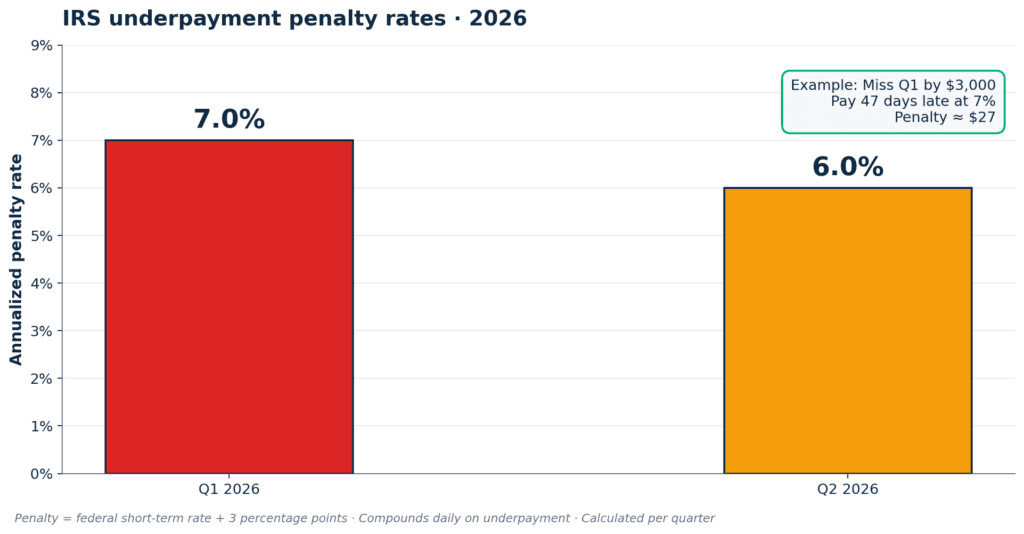
The penalty is the federal short-term rate plus three points, charged quarter by quarter on the shortfall: 7% for Q1 2026, 6% for Q2, and 7% for Q3 and Q4 (IR-2026-98), so about $260 on a $5,000 underpayment for nine months. Annoying, not catastrophic. The real damage is paying the balance and the penalty together in April. If you are reading this after September 15 with a shorted payment, pay the gap now rather than waiting for January 15.
Common mistakes that cost you money
- Setting aside on gross instead of net. Tax is on net: on $100,000 billed with $25,000 of expenses, set aside on $75,000.
- Forgetting self-employment tax and setting aside only the income tax rate.
- Assuming no 1099 means no tax. For 2026 clients only issue a 1099-NEC at $2,000 or more and platforms only issue a 1099-K above $20,000 and 200 transactions; every dollar is still taxable. If a form surprises you, see what to do with a 1099-NEC.
- Mixing business and personal in one account, so deductions get lost and you over-set-aside defensively. The expense tracking setup fixes it in an hour.
- Not recalculating in July, and again in early October with year-to-date income, before the January 15 payment.
- Keeping the tax money in everyday checking. Open a separate “Taxes” savings account and transfer the percentage from every payment the day it lands; the cash flow section covers the wider system.
Get the freelancer tax setup checklist
One PDF: the accounts to open, the percentages to set aside, the 2026 deadlines and the Schedule C and Schedule SE line items. Drop your email and it lands in your inbox in two minutes.
Frequently Asked Questions
Is 30% always safe?
Thirty percent covers most single freelancers earning $60,000 to $110,000 in any state, California included. It overshoots in Texas or Florida under $70,000 (20 to 21% is enough) and falls short in New York City or Oregon above $100,000 (30 to 32%). The calculator gives your actual number.
Do I have to make quarterly payments?
Yes, if you expect to owe at least $1,000 after withholding and credits. The 2026 deadlines are April 15, June 15, September 15 and January 15, 2027 (skippable if you file and pay in full by February 1, 2027). Pay free through IRS Direct Pay at irs.gov/payments, the IRS2Go app, or EFTPS if you also pay business taxes. The quarterly estimates guide walks through the form.
Do business expenses lower my self-employment tax?
Yes. SE tax is calculated on net earnings, so every legitimate deduction cuts the SE base by 15.3 cents on the dollar as well as lowering income tax. A missed expense is taxed at the full freelancer rate of around 30%.
What if my income is wildly different each month?
Set the percentage aside from every payment the moment it lands: at 28%, a $4,000 payment means $1,120 into the tax account that day. If most of your income arrives late in the year, the annualised income installment method (Form 2210, Schedule AI) recalculates the quarterly amounts to match and avoids the penalty.
This guide on how much should freelancers set aside for taxes is informational and reflects 2026 IRS figures from Revenue Procedure 2025-32 and the One Big Beautiful Bill Act. Tax laws change. Verify everything against IRS.gov or work with a CPA before you file. Nothing here is tax, legal, or financial advice.

About the author
Gareth Noble is the founder of Freelancer Profit. He has run a corporate training and facilitation consultancy for 20+ years (clients include Amazon, P&G and Emirates), invoices his own clients, and is the author of Why Your Team Sucks. He is not a CPA. Every guide here is built from IRS primary sources, vendor pricing pages and hundreds of real user reviews across Trustpilot, the BBB and the app stores, and is independent research, not professional tax advice, so check your own situation with a CPA.