



Concrete 2026 rate ranges by experience level and project type, plus the math that shows why $75 an hour can net you less than a salaried $70,000 job.

You’re three years into freelancing. You charge $45 an hour. Most weeks you’re busy, you turn down the odd project, and your bank account still never moves. You searched for freelance graphic design rates at 11pm because a prospect asked your number and you froze.
Here’s the problem with nearly every article you found. They say “it depends.” They hand you a $15 to $150 range and call it a guide. The range is real. It just tells you nothing about where you sit inside it, or why you keep landing at the bottom.
This piece gives you actual numbers. Hourly rates by experience level. Project rates by type. What changes when your client sits in San Francisco rather than Sheffield. And the arithmetic behind why a $75 hourly rate does not mean a $156,000 income, which is the most expensive misunderstanding in this whole field.
In the pricing-transparency threads on r/graphic_design and r/freelance, designers keep circling the same two admissions: they want real numbers instead of vague advice, and many had no idea what their work was worth. So here are the numbers, with sources you can check.
How much do freelance graphic designers actually charge?
The headline averages mislead because they blend two different markets. On open bidding platforms, graphic designers on Upwork average around $25 an hour, with public rates running from $15 to $150. That low average reflects global competition, not the US rate for skilled work.
Look at designers who price off the platforms and the number jumps. Adobe analysed 1,000 Upwork profiles and found freelance graphic designers charging an average of $49.65 an hour. Payscale’s 2026 data puts the median freelance graphic designer at roughly $36 an hour, climbing to about $70 for experienced designers with branding skills and $107 at the 90th percentile.
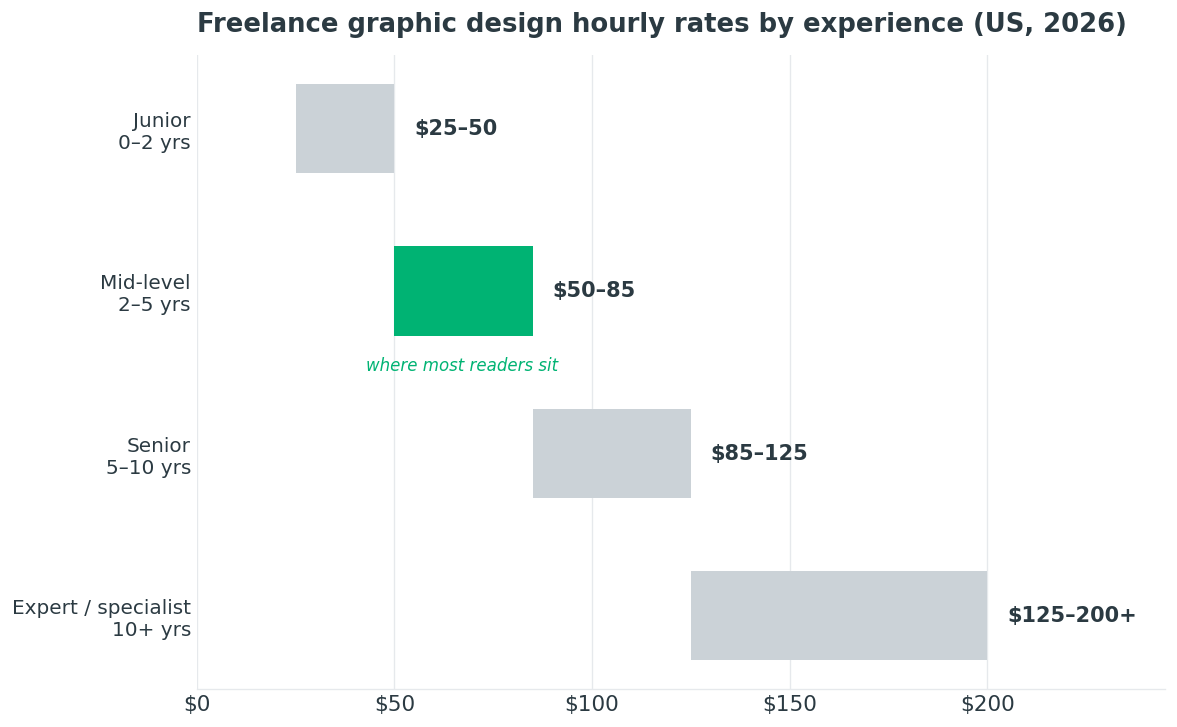
Here is what those figures look like once you sort them by experience. Treat the platform average as the floor you are climbing off, not a target.
| Experience level | Realistic US freelance hourly rate | What you can charge it for |
|---|---|---|
| Junior (0 to 2 years) | $25 to $50 | Production work, social graphics, simple layouts, supervised projects |
| Mid-level (2 to 5 years) | $50 to $85 | Full projects start to finish, direct client work, light brand systems |
| Senior (5 to 10 years) | $85 to $125 | Brand identity, art direction, complex multi-deliverable work |
| Expert / specialist (10+ years) | $125 to $200+ | Brand strategy, naming, positioning, designers clients seek by name |
Where most readers land on freelance graphic design rates
If you are two to five years in and earning somewhere between $45,000 and $110,000, your defensible rate is $50 to $85 an hour. A freelance illustrator pulling $72,000 a year on roughly 1,000 billable hours is already charging about $72 an hour, whether they know it or not. The trap is simple. You charge $45 because that is what you charged in year one, and you never move it.
What should I charge per project?
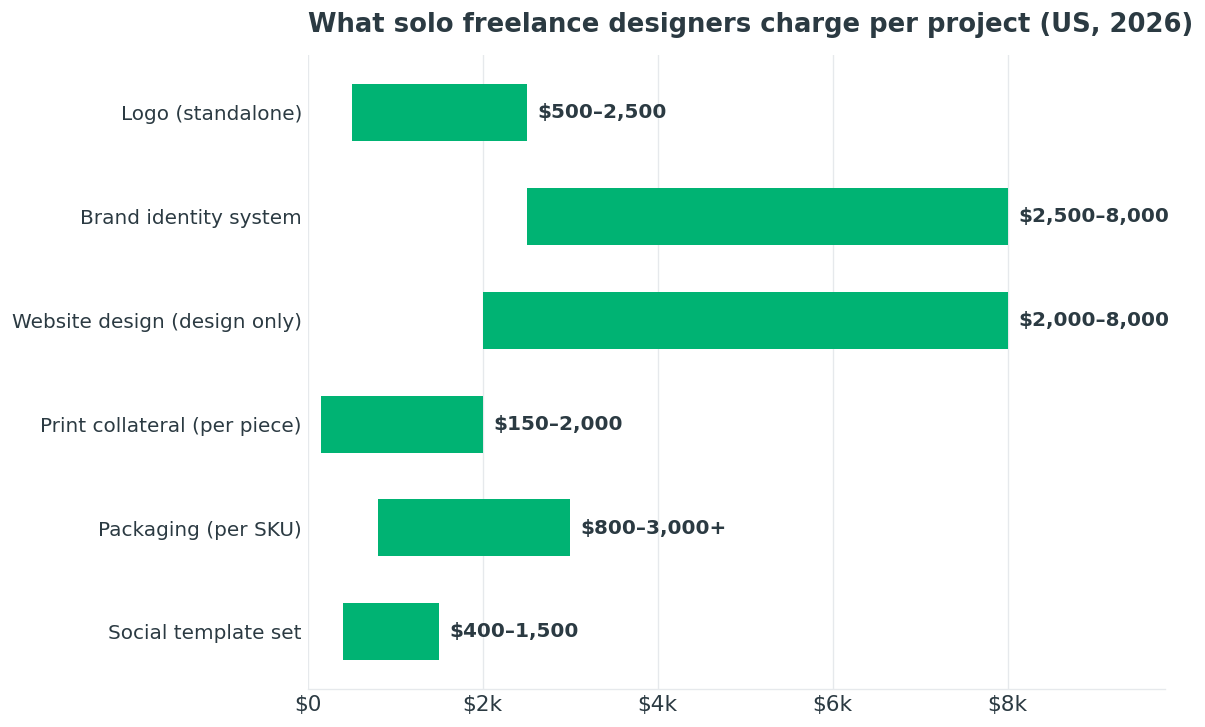
Most experienced designers do not bill hourly for defined work. They quote a fixed project price, because hourly billing punishes you for getting faster. The ranges below are for a solo freelancer with a solid portfolio, not an agency. Agency pricing for the same work routinely runs two to ten times these figures.
| Project type | Solo freelance range (US) | What clients expect inside it |
|---|---|---|
| Logo (standalone) | $500 to $2,500 | Concepts, revisions, final files in vector and raster formats |
| Brand identity system | $2,500 to $8,000 | Logo, colour palette, typography, basic guidelines, core collateral |
| Website design (design only) | $2,000 to $8,000 | Layouts and a design system, no development unless quoted separately |
| Print collateral (per piece) | $150 to $2,000 | $150 to $400 business card, $200 to $500 flyer, $500 to $2,000 brochure |
| Packaging (per SKU) | $800 to $3,000+ | Dieline work, print-ready artwork, mockups; scales fast with SKU count |
| Social template set | $400 to $1,500 | A set of editable templates, often sold as a monthly retainer instead |
Why the logo number swings so wildly
A logo can cost $50 or $50,000 for the same five-letter wordmark. The difference is rarely the drawing. It is research, strategy, how many people will see the mark, and what the brand is worth. This is value-based pricing in practice: you charge for the result the mark delivers, not the hours you spent on it. Looka puts the typical small-business logo at $250 to $1,000, while Fiverr notes design studios start around $2,500 and high-end agencies reach $50,000 to $100,000. As a solo freelancer, $500 to $2,500 covers most real clients without you working for free.
How usage rights change what you charge
Two clients can buy the same logo and pay very different prices, because they are buying different usage. A local bakery putting a mark on a shopfront and a few menus is not the same as a national brand printing it on packaging shipped to 40 states. Price for reach, print runs, and exclusivity. If a client wants full ownership and unlimited use, that is a buyout, and it costs more than a standard licence. Spell out exactly what the fee covers in writing before you start work.
Why does where I live change my rate?
Geography still moves the number, but less than it used to, and not the way you might expect. AIGA’s Design Census found designers in California earning around $94,858 against roughly $56,613 in Ohio, with rural designers earning less than those in creative hubs. That survey is from 2019 and lumps salaried and freelance designers together, so read it as direction, not gospel.
Here is the part the old salary data misses. When you freelance remotely, your client’s location sets your ceiling, not yours. A designer in rural Ohio doing brand work for New York and San Francisco clients can charge metro rates while paying Ohio rent. That gap is the biggest pricing advantage remote work hands you, and most designers never take it.
- US metro clients pay the rates in the tables above and expect them. Quoting $30 an hour to a funded startup reads as inexperience, not value.
- US rural and small-business clients sit lower, often 20 to 40 percent below metro budgets, but you keep more of it because your costs are lower.
- International clients on open platforms drive the brutal end of the market. Rates of $5 to $20 an hour are common on the cheapest platforms because you are competing globally on price.
Why most freelance designers undercharge
A recurring admission in the design subreddits is that the designer simply did not know what their work was worth, usually paired with a rate that turns out to be roughly half of what the math supports. The cause is almost always the same arithmetic error.
Designers assume their hourly rate equals their income. It does not. You do not bill 2,080 hours a year. After admin, pitching, unpaid revisions, sick days, and gaps between projects, a full-time freelancer realistically bills 1,000 to 1,200 hours. The other half of your week earns nothing.
Run your own floor rate before you quote anyone again. The method is simple and it is the same one Bonsai and Dribbble teach:
- Decide what you want to take home. Say $60,000.
- Add what an employer used to cover: health insurance (around $7,000 a year for a solo policy), retirement savings ($6,000), and business costs like Adobe Creative Cloud at about $660 a year, hardware, and accounting ($8,000). That is $81,000.
- Gross up for self-employment tax of 15.3 percent and income tax. You land near $95,000 of revenue.
- Divide by realistic billable hours: $95,000 / 1,100 = about $86 an hour.
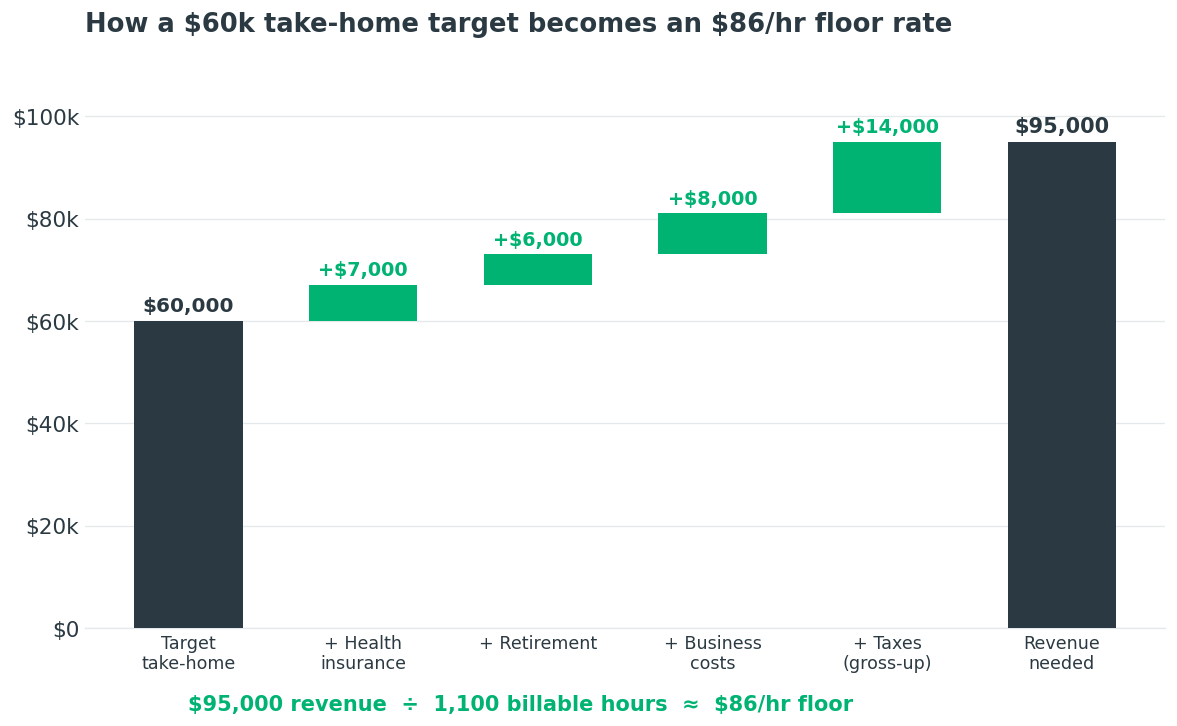
To take home $60,000 you need to bill roughly $86 an hour, not $50. Every dollar below that floor comes out of your own pocket. That is the math behind the undercharging, and you can run it on yourself in five minutes. Our tax set-aside calculator handles the self-employment-tax step if you would rather not do it by hand.
Does $75 an hour actually beat a $50-an-hour salaried job?
This is the comparison designers argue about endlessly, so here it is with the numbers on the table. Take a freelancer billing $75 an hour and a salaried designer earning $70,000, which sits above the BLS median of $61,300 for graphic designers in May 2024. Assume the freelancer bills 1,000 hours, the realistic figure, not 2,080.
| Line item | Freelancer at $75/hr | Salaried at $70,000 |
|---|---|---|
| Gross before tax | $75,000 (1,000 billable hours) | $70,000 |
| Business expenses | -$7,000 | $0 (employer covers tools) |
| Payroll / SE tax | -$9,600 (15.3% full SE tax) | -$5,355 (7.65%; employer pays the rest) |
| Health insurance | -$6,000 (you buy it) | ~$1,800 (employer covers ~$6,500) |
| Retirement match | $0 (self-funded) | +$2,800 (4% employer match) |
| Paid time off | $0 (unpaid days) | ~15 paid days (worth ~$4,000) |
| Cash position before income tax | ~$52,400 | ~$62,800 plus ~$13,000 in benefits |
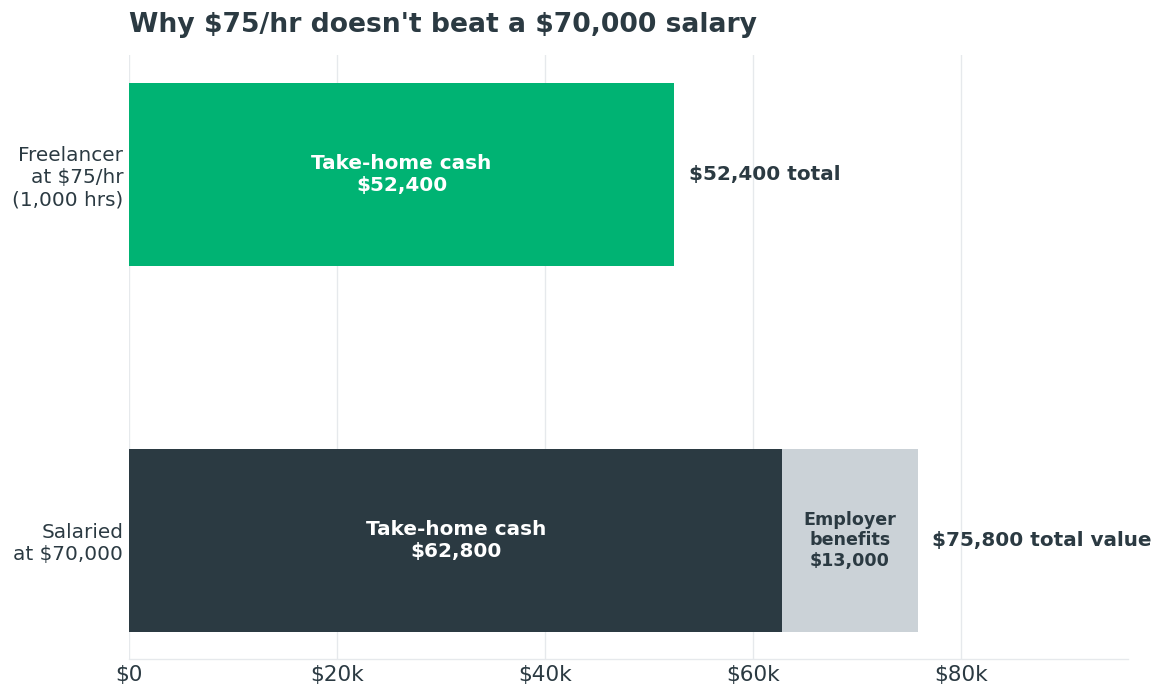
The freelancer billing $75 an hour ends up with roughly $52,400 in cash before income tax, and they fund their own retirement out of that. The salaried designer on $70,000 takes home more after taxes, because they pay only half the FICA and the employer covers the rest, then collects about $13,000 in employer-paid health, match, and paid leave on top.
So no, $75 an hour does not beat a $70,000 salary. To match that package you need to bill closer to $90 to $100 an hour, or push your billable hours from 1,000 toward 1,400. That is the whole case for raising your rate. The freedom of freelancing is not free. You buy it with the benefits a job would have handed you. If your income climbs past about $90,000, it is worth reading our guide on sole prop versus LLC versus S-corp, because an S-corp election can claw back some of that self-employment tax.
How to set your rate this week
Here is a framework you can run before your next quote. It takes about five minutes.
- Find your floor. Run the four-step calculation above. That number is the rate below which you lose money, full stop.
- Place yourself in the experience table. Mid-level at $50 to $85, senior at $85 to $125. If your floor sits above your band, your costs are too high or your hours too low. Fix that before you cut your rate.
- Quote projects, not hours, for anything you have done before. Estimate the hours, multiply by your rate, then quote the total as a fixed price. You keep the upside when you work fast.
- Take a deposit before you start. A 50 percent upfront payment on project work protects your cash flow and filters out clients who were never going to pay.
- Add 15 percent for the client you dread. Difficult clients, vague briefs, and rush jobs cost you in revisions. Price that in rather than absorbing it.
- Raise your rate on the next new client, not your existing ones. New prospects have no anchor. That is where you test a higher number with nothing to lose.
Get the freelance designer rate-setting worksheet
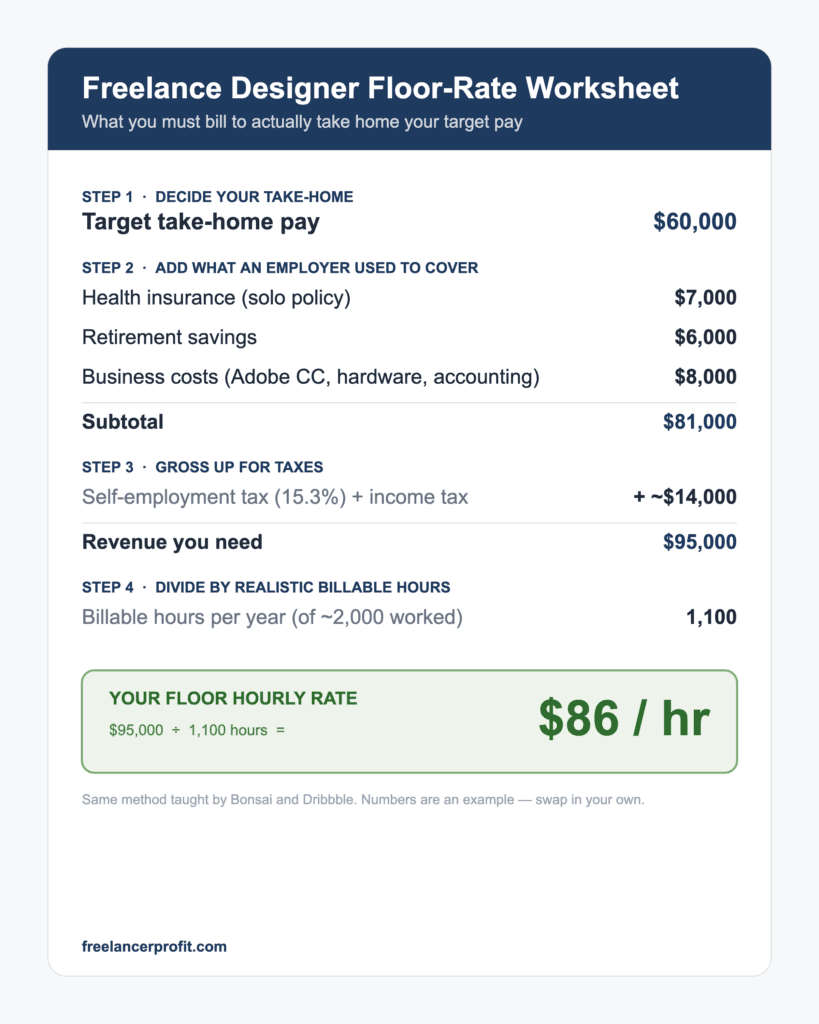
The worksheet does the floor-rate math for you. Enter your target take-home, your real expenses, your health and retirement costs, and your honest billable hours. It returns the minimum hourly rate that keeps you out of the red, plus your project-pricing equivalents. Same calculation as the worked example above, built so you never have to guess a number at 11pm again.
Frequently Asked Questions
What is a good hourly rate for a freelance graphic designer in 2026?
For a US designer with two to five years of experience and a real portfolio, $50 to $85 an hour is defensible. Junior designers sit at $25 to $50, seniors at $85 to $125, and specialists in branding or strategy command $125 to $200 and up. The Upwork average of around $25 an hour reflects global price competition, not the rate skilled US designers should accept off the platforms.
How much should I charge for a logo as a freelancer?
Most working freelancers charge $500 to $2,500 for a standalone logo with concepts, revisions, and final files. Beginners often start at $50 to $300, and top freelancers clear $5,000. The price reflects research and brand value, not the drawing time, which is why the same wordmark can cost $500 or $5,000 depending on who the client is and how many people will see it.
Why do I feel broke when I am charging $50 an hour and staying busy?
Because $50 an hour is not $50 times 2,080. You bill maybe 1,000 hours a year after admin, pitching, and gaps, so your real gross is around $50,000, not $104,000. Out of that you pay 15.3 percent self-employment tax, your own health insurance, and your own retirement, none of which a salaried job would have charged you for. Run the floor-rate calculation in this guide and the gap usually explains itself.
Should I charge hourly or per project?
Charge per project for work you have done before, and hourly only for open-ended or unpredictable work. Hourly billing penalises you for getting faster, since a logo that takes you four hours instead of twelve earns you less for being better. Estimate the hours, multiply by your rate, then quote a fixed total. You keep the gain when you work efficiently.
Do clients pay more if I am in a big city?
The client’s location matters more than yours when you work remotely. AIGA data showed California designers earning far more than designers in lower-cost states, but remote freelancing lets you charge metro rates while living somewhere cheaper. A designer in a small town serving funded startups can out-earn one in a city serving only local small businesses.
How do I raise my rates without losing clients?
Raise the rate on new prospects first, not existing clients. New clients have no anchor, so a higher number reads as your normal price. For current clients, give notice, tie the increase to a renewal or new project, and expect that a few will leave. The ones who walk over a 15 percent rise were the least profitable to keep, and the math usually works in your favour even with some churn.
What do I do about taxes once my rates go up?
Set money aside as you earn it, because no client withholds tax for you. Plan for roughly 25 to 30 percent of net profit between self-employment tax and income tax, and pay quarterly estimates on the IRS schedule to avoid penalties. See our guides on filing quarterly estimated taxes and the deductions freelancers miss, since every legitimate expense you track lowers the income your self-employment tax is calculated on. Designers in particular should review the design-specific write-offs most freelancers overlook, then see exactly how to report design income on your Schedule C with a worked $85k example.
One action this week: run the floor-rate calculation on your own numbers and write the result on a sticky note next to your monitor. The next time a prospect asks your rate, you read the note instead of freezing. The rest of our freelancer money and business guides walk through what happens after you land the work. If you want the tools side sorted too, our roundup of accounting software for freelance designers and our guide to tracking business expenses cover the parts of pricing that happen after the invoice goes out — and our pick of invoicing software for designers that actually handles tax makes sure the invoice itself does some of that work for you, and managing cash flow handles the gap between billing $8,000 and actually being paid it.
Rates and figures in this guide are drawn from public salary and pricing data and reflect the US market as of May 2026. Tax rules change, and the One Big Beautiful Bill Act signed on July 4, 2025 made the 20 percent qualified business income deduction permanent for sole proprietors, which can lower your income tax but not your self-employment tax. This is informational only and not tax or legal advice. Verify current figures at IRS.gov and confirm your own situation with a CPA. See our methodology for how these numbers were sourced.

About the author
Gareth is the founder of Freelancer Profit and a Dubai-based entrepreneur with a business consulting and leadership coaching background. He built the site to give freelancers honest, independent reviews of finance and tax tools, every one researched from official documentation, current pricing, and hundreds of real user reviews across Trustpilot, the BBB, and the app stores. It’s independent research, not professional tax advice, so check your own situation with a CPA.