

Updated August 14, 2026: Corrected the 1099-NEC reporting threshold to reflect the One Big Beautiful Bill Act change ($2,000 for 2026, up from $600).
There are 47 deductions you’re allowed to claim. Most freelancers miss enough of them to overpay $3,000 to $9,000 every year.

Tax deductions for freelancers are the single biggest reason most self-employed people overpay the IRS every year. The IRS isn’t doing this to you — you’re doing it to yourself by missing write-offs you’re legally allowed to claim.
The average freelancer without a tracking system misses 35 to 50% of eligible business expenses. In a 24% bracket, $15,000 in missed deductions means you just wired the IRS an extra $3,600 you didn’t owe. The self-employment tax sits on top of that.
The tax code lets business owners subtract what it actually costs to run a business. The IRS taxes profit, not revenue. Every dollar you spend earning your income is a dollar that shouldn’t be taxed at all. The problem is simple. Most freelancers don’t know which expenses count. They don’t track them through the year. By April they’re scrambling, claim the obvious ones, and watch a few thousand dollars worth slip through unclaimed.
This guide walks through 47 deductions for the 2025 and 2026 tax years, including the new provisions in the One Big Beautiful Bill Act signed July 4, 2025. Read it once. Then sit down with your accountant and go through it again with your numbers in front of you.
Before You Start: How Deductions Actually Work
A deduction reduces your taxable income. It does not cut your tax bill dollar for dollar. In a 24% bracket, $1,000 in deductions saves you $240. In a 32% bracket, the same $1,000 saves you $320. The higher your income, the more each deduction is worth.
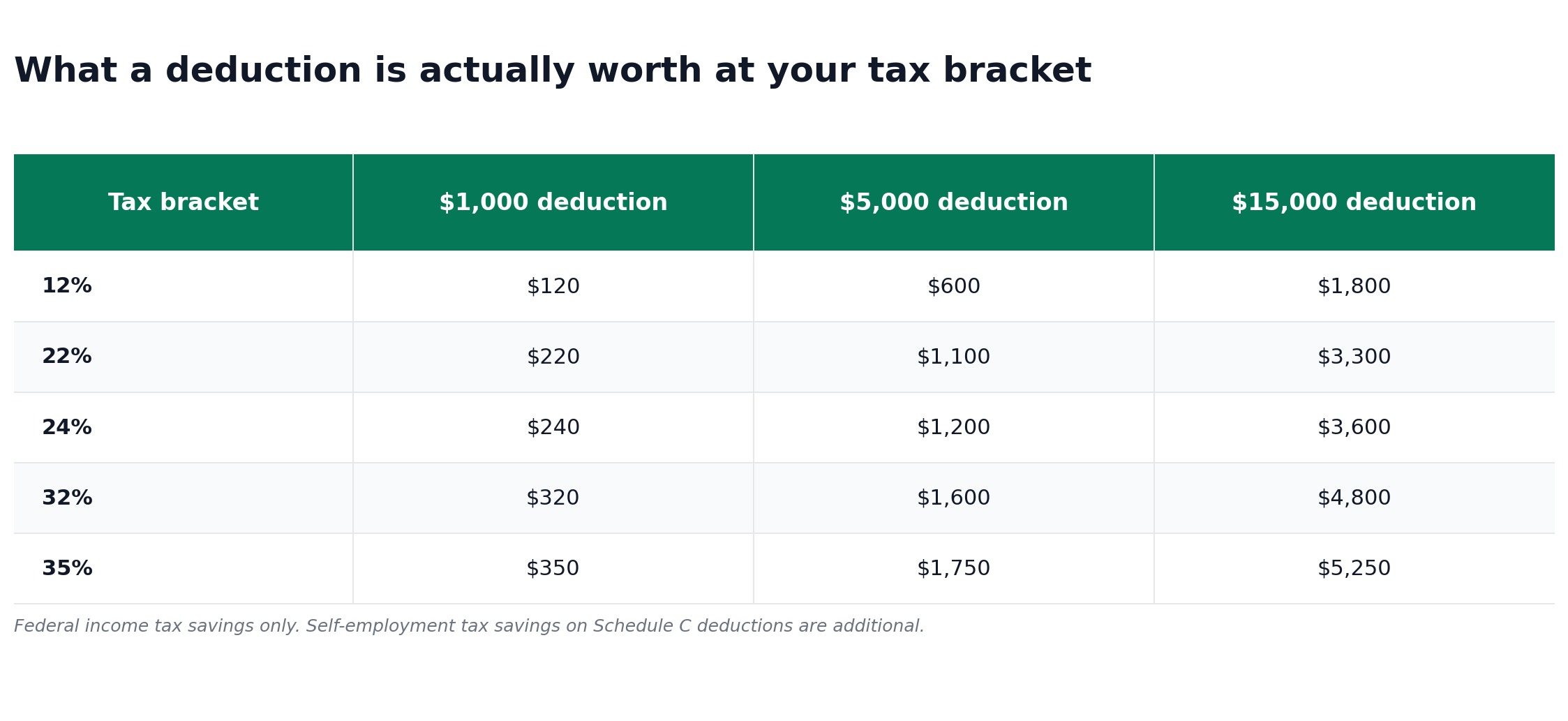
A credit works differently. A $1,000 credit cuts your tax bill by exactly $1,000, regardless of your bracket. Credits are usually worth more dollar for dollar, but freelancers have access to far more deductions than credits.
Most of your business deductions go on Schedule C, which attaches to your 1040. A few of the big ones, like retirement contributions and self-employed health insurance, are above-the-line deductions on Schedule 1. They reduce your adjusted gross income whether you itemize or not. The location on your return matters, and your accountant can confirm where each deduction belongs.
One quick note before the list. The 1099-NEC reporting threshold changed under the One Big Beautiful Bill Act. For 2026, your clients only have to issue you a 1099-NEC if they paid you $2,000 or more in the calendar year (up from $600). Starting in 2027, that $2,000 figure adjusts annually for inflation. Important: this only changes which forms get issued. You still owe tax on all freelance income regardless of whether you receive a 1099.
Part 1: Your Home and Workspace
1. Home Office Deduction
If you work from home and have a defined area you use regularly and exclusively for business, you can deduct part of your housing costs.
You have two options. The simplified method gives you $5 per square foot of dedicated workspace, capped at 300 square feet, for a maximum deduction of $1,500. The standard method calculates the percentage of your home used for business and applies that percentage to your actual rent or mortgage interest, utilities, insurance, and repairs.
If your apartment is 500 square feet and you use 100 square feet for an office, you claim 20% of your rent and utilities. Run both calculations. Take whichever number is bigger.
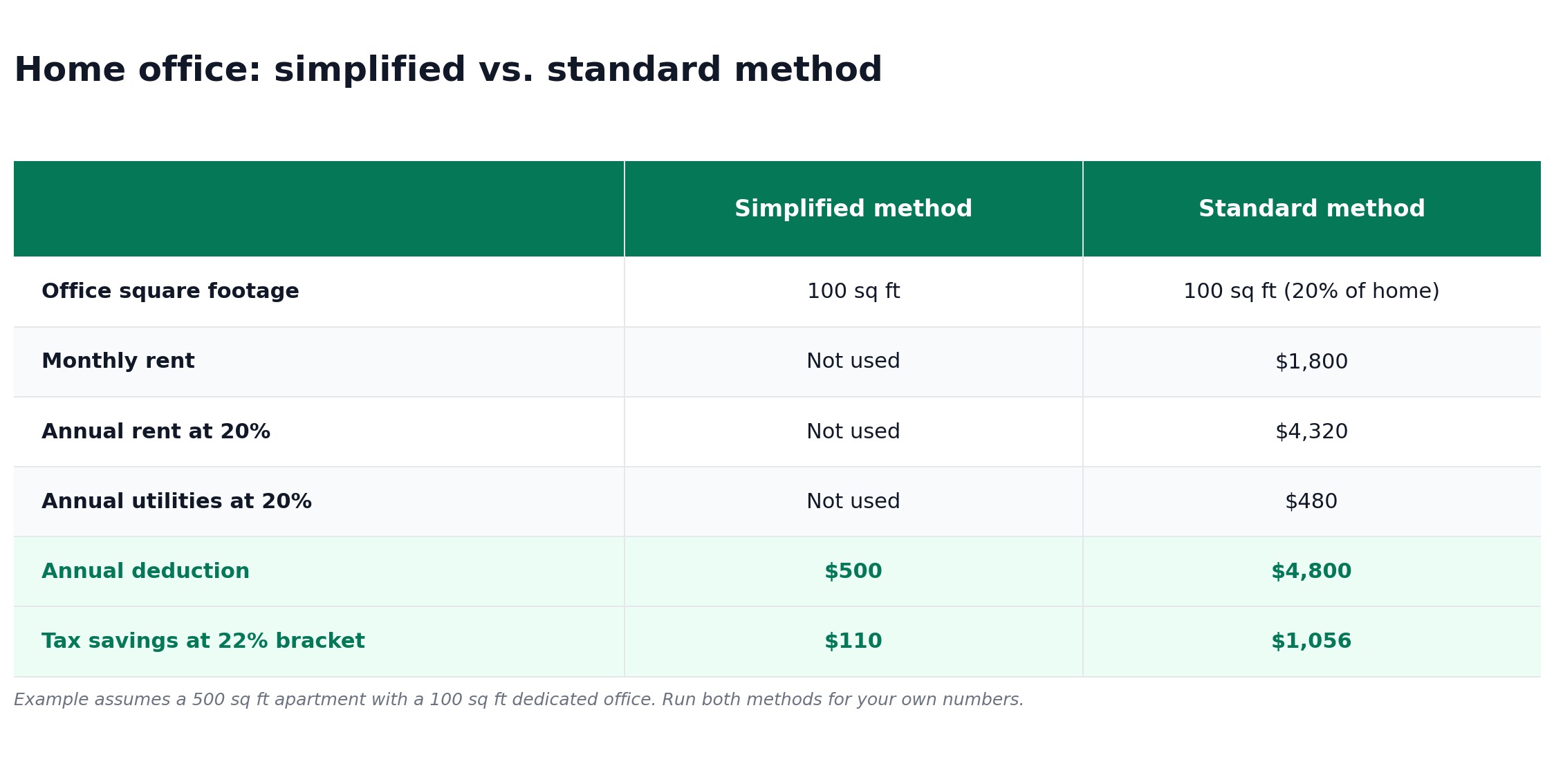 home office deduction method, showing a $500 versus $4,800 annual deduction for the same workspace.”/>
One thing trips people up here. The space has to be used exclusively for work. A desk in the corner of your living room where you also watch TV at night does not qualify. A dedicated room, or a clearly defined work area you only use for client work, does.
IRS Form: 8829 (standard method) or direct calculation on Schedule C (simplified method)
Records to keep: Square footage measurements, rent or mortgage statements, utility bills
2. Home Office Utilities (Electric, Gas, Water)
If you go with the standard method, the business-use percentage of your utilities comes off your taxes alongside the rent or mortgage. These aren’t a separate deduction. They’re built into the home office calculation. If your office is 20% of your total square footage, you deduct 20% of every electric and gas bill.
3. Coworking Space
Coworking memberships and day passes are 100% deductible as rent on Schedule C. Monthly plan, hot desk reservation, occasional drop-in day, all of it counts. The coworking deduction sits separately from your home office. If you work from home some days and a coworking space others, you can claim both.
Records to keep: Monthly membership invoices or day-pass receipts
4. Office Rent (Separate Office Space)
If you rent a dedicated office outside your home, you deduct the full cost. That includes monthly rent, parking at the office, and any renter’s insurance you carry on the space.
5. Office Furniture
Desks, chairs, shelving, filing cabinets, and any other furniture you use for work are deductible. For qualifying business property put into service after January 19, 2025, you can deduct 100% of the cost in the first year under the bonus depreciation provisions of the One Big Beautiful Bill Act. Before this change, you had to depreciate furniture over several years on a fixed schedule. Now you take the full deduction in year one.
If you also use the furniture personally, claim only the business-use percentage.
Records to keep: Purchase receipts, dates of purchase
Part 2: Equipment and Technology
6. Computer and Laptop
Your main work computer is fully deductible. If you also use it personally, claim only the business-use percentage. For most freelancers, somewhere between 80% and 100% is reasonable depending on how the machine actually gets used.
7. External Monitor(s)
Deductible at the business-use percentage.
8. Keyboard, Mouse, and Accessories
Standard peripherals come off as office supplies or equipment depending on the cost.
9. Webcam and Microphone
Particularly relevant if you do video calls, remote interviews, podcasting, or any client-facing video work.
10. Headphones and Headsets
Deductible if you use them for business calls, video meetings, or work that needs audio monitoring.
11. External Hard Drives and Storage Devices
Fully deductible as business equipment.
12. Printer and Ink
Printers and ongoing ink or toner costs are deductible. If you also print personal items, apply a business-use percentage.
13. Camera and Photography Equipment
For photographers, videographers, or any freelancer producing visual content for clients. Deductible at the business-use percentage.
Records to keep for all equipment: Purchase receipts, date of purchase, and a note on what percentage of use is business.
Part 3: Software and Subscriptions
14. Accounting and Invoicing Software
FreshBooks, Xero, QuickBooks, Wave, Zoho Books. Anything you pay for to run your business finances comes off in full.
15. Design and Creative Software
Adobe Creative Cloud, Figma, Canva, Procreate, or any other software you use to produce client work. Designers can see our freelance designer tax deductions guide for a category-by-category breakdown.
16. Project Management Tools
Asana, Notion, Monday.com, Basecamp, Trello, ClickUp. Whatever you use to keep client projects organized.
17. Communication Platforms
Slack, Microsoft Teams, Zoom, or any paid communication tool you use for client or team work.
18. Website Hosting and Domain Registration
Hosting fees and your annual domain renewal are 100% deductible.
19. Email Marketing Platforms
Mailchimp, ConvertKit, ActiveCampaign, or any email marketing tool you use for your business.
20. Cloud Storage Services
Google One, Dropbox, iCloud (the business portion), or any cloud storage you use for client files or business documents.
21. Stock Photo and Asset Subscriptions
Shutterstock, Adobe Stock, Envato Elements, or any subscription that supplies you with assets for client work.
22. SEO and Marketing Tools
Ahrefs, SEMrush, Surfer SEO, or any tool you use for client work or to market your own freelance business.
23. Password Manager and Security Tools
1Password, LastPass, or any security software protecting your business accounts.
The One Big Beautiful Bill Act keeps software and subscriptions clearly deductible. Each charge looks small on its own. Add them up across a year, and most freelancers are running $1,500 to $4,000 in subscription costs. All of it comes off if you actually track it.
Records to keep: Subscription confirmation emails, monthly billing receipts, or annual invoices.
Part 4: Professional Services
24. Accountant and Tax Preparation Fees
Everything you pay your CPA or tax preparer is deductible. Annual return preparation, quarterly tax planning sessions, bookkeeping support, all of it. The fee your accountant charges to prepare the return on which you claim this deduction is itself deductible.
25. Bookkeeper Fees
If you outsource your bookkeeping, the full cost comes off as a professional service.
26. Legal Fees
Fees you pay a lawyer for contract review, business structure advice, intellectual property work, or resolving a client dispute are deductible. Personal legal fees are not. Only fees tied directly to your business count.
27. Business Consultant Fees
If you hire a consultant to work on your operations, pricing, or marketing, those fees are deductible.
28. Virtual Assistant Fees
If you outsource admin work to a VA, those payments come off in full as a business expense.
29. Subcontractor Fees
Money you pay other freelancers or contractors for work on client projects is deductible. One thing to remember: the 1099-NEC reporting threshold changed under the One Big Beautiful Bill Act. For 2026, you only have to issue a 1099-NEC to a subcontractor if you paid them $2,000 or more in the calendar year (up from $600). Starting in 2027, that $2,000 figure adjusts annually for inflation. The threshold only changes which forms get issued — your deduction for the payment doesn’t depend on whether a 1099-NEC was sent.
Records to keep: Invoices from service providers, contracts, proof of payment.
Part 5: Vehicle, Travel, and Mileage
30. Business Mileage
The 2025 standard mileage rate is 70 cents per mile for business use. That covers driving to client meetings, conferences, office supply runs, post office trips, and any other drive made for a real business reason. It does not cover the commute from home to a fixed office, but most freelancers work from home and have no commute to exclude in the first place.
At 70 cents per mile, 6,000 business miles a year equals a $4,200 deduction. In a 22% bracket, that’s $924 in tax savings you’d otherwise hand over. Most freelancers underestimate how fast the miles add up.
One thing to know: You have to choose between the standard mileage method and the actual expense method in the first year you use a car for business. If you start with mileage, you can switch to actual expenses later. The reverse is not allowed.
31. Actual Vehicle Expenses
Instead of mileage, you can deduct what it actually costs to run your car for business. Gas, insurance, maintenance, repairs, and depreciation, multiplied by the percentage of miles driven for work. For high-mileage drivers or people with expensive vehicles, this method often produces a bigger deduction than the standard rate.
32. Parking Fees and Tolls
Fully deductible on business trips, regardless of which vehicle method you use.
33. Rideshare and Taxi Costs for Business Travel
Uber, Lyft, or taxi fares to a client meeting, conference, or airport are 100% deductible.
34. Business Flights
Flights for business reasons (client meetings, conferences) are 100% deductible. Save the boarding pass and write down the business purpose of the trip.
35. Hotels and Lodging for Business Travel
100% deductible for overnight business trips. If you tack on personal days at the end, claim only the nights tied to business.
36. Meals During Business Travel
50% deductible when you’re traveling away from home for business and the meal isn’t lavish or extravagant. Keep the receipt and jot down the business context.
Records to keep: A mileage log with date, starting point, destination, miles, and business purpose. Flight and hotel receipts. Meal receipts with the business context noted.
Part 6: Health and Retirement
37. Self-Employed Health Insurance Premiums
If you pay for your own health insurance, you can deduct 100% of the premiums for yourself, your spouse, and your dependents. Medical, dental, and vision all count. This is one of the biggest deductions freelancers miss, and it can add up to several thousand dollars a year. Two conditions: you need a net profit for the year, and you can’t be eligible for employer-subsidized coverage through a spouse’s plan.
This is an above-the-line deduction. It reduces your adjusted gross income whether you itemize or not.
38. Long-Term Care Insurance Premiums
A portion of long-term care insurance premiums is deductible. The amount depends on your age and the IRS sets the limit each year.
39. Health Savings Account (HSA) Contributions
If you’re on a high-deductible health plan, your HSA contributions are fully deductible and lower your AGI. The HSA is one of the best tax-advantaged accounts you have access to. Contributions go in pre-tax. Growth is tax-free. Withdrawals for medical expenses come out tax-free. After 65, withdrawals are treated like regular income, which makes it function like a traditional IRA. The 2025 limit was $4,300 for individual coverage and $8,550 for family coverage.
40. SEP IRA Contributions
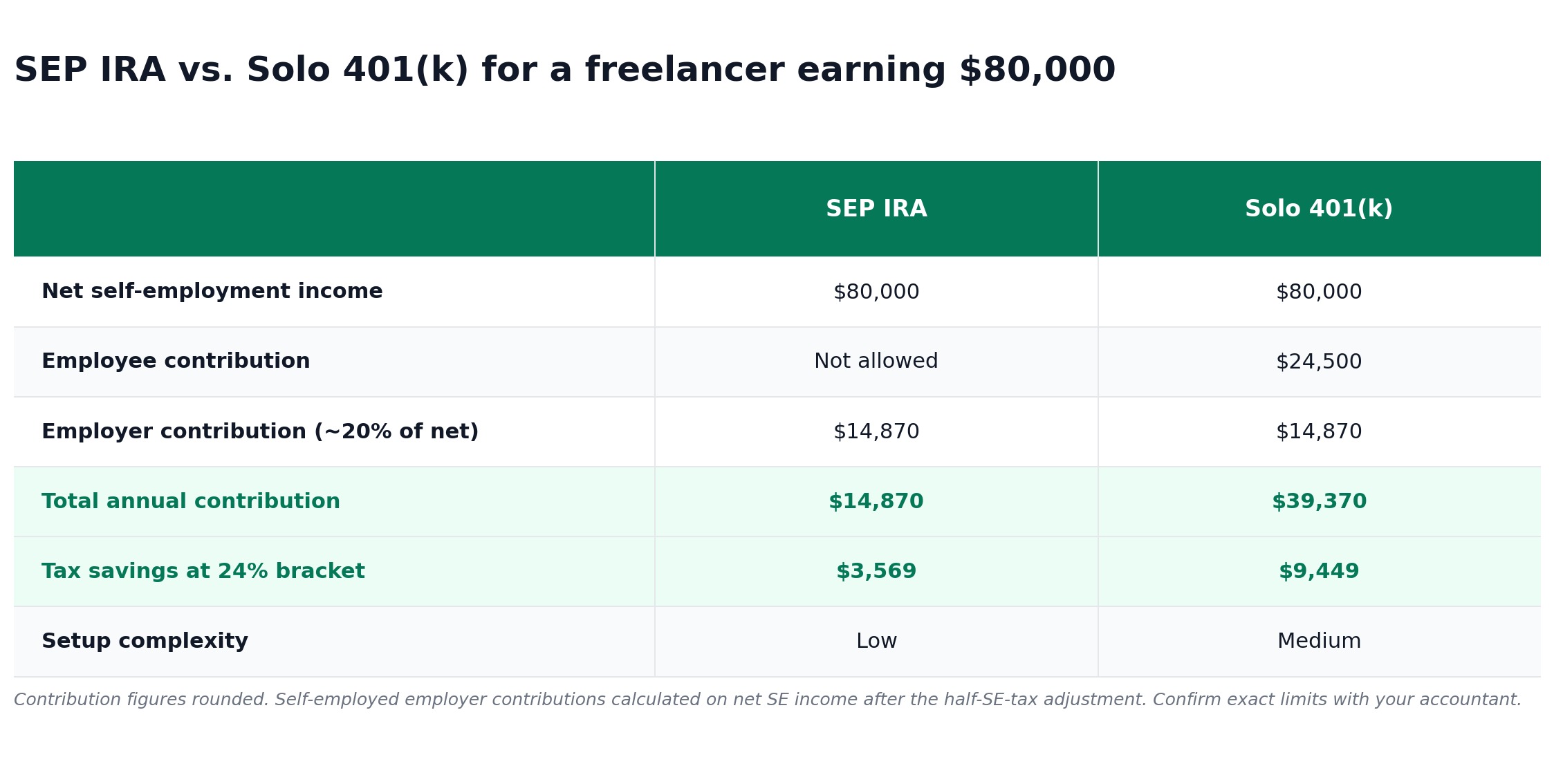
A SEP IRA lets you contribute up to 25% of net self-employment income, with a 2025 maximum of $70,000. The setup is simple. The administration is light. For freelancers with lower net income, a Solo 401(k) usually allows bigger contributions because of how the employee and employer pieces stack.
41. Solo 401(k) Contributions
You’re the employee of your own business, so you can contribute up to $24,500 in 2026 as an employee deferral. As the employer, you add another contribution of up to 25% of net adjusted self-employment income. The combined cap for 2026 is $72,000. That dual structure makes the Solo 401(k) the most powerful retirement vehicle most freelancers have access to once they’re earning above moderate income. The Solo 401(k) guide for freelancers walks through setup, limits, and deadlines.
For a freelancer earning $100,000 in net income who maxes out the Solo 401(k), the tax savings in a 24% bracket can clear $10,000 in a single year.
Records to keep: Retirement account statements, contribution receipts, IRS forms.
Part 7: Marketing and Education
42. Marketing and Advertising Expenses
Social media ads, Google Ads, business cards, brochures, website ad spend, professional photography for your site, branded merchandise, and any other direct marketing cost. All 100% deductible. If you run paid campaigns to bring in clients, every dollar goes on Schedule C.
43. Website Costs
On top of hosting and domain (covered above), website design, development, and ongoing maintenance costs come off as well. The fee you paid a developer to build your portfolio site is a business expense.
44. Professional Memberships and Associations
Dues paid to professional organizations tied to your work are deductible. Freelance unions, industry associations, professional bodies relevant to your services. All count.
45. Education and Professional Development
Freelancers spend a lot on staying current. The One Big Beautiful Bill Act keeps the deduction for training that maintains or improves skills in your existing line of work. Courses, workshops, certifications, books, and online subscriptions to industry publications all qualify if they tie back to what you already do for clients.
The test is direct: the education must connect to your current business, not a new career you’re considering. A copywriter taking a copywriting course or attending a content marketing conference: deductible. The same copywriter taking a photography course to maybe pivot careers: not deductible.
Part 8: Financial and Administrative
46. Bank Fees and Payment Processing Fees
Monthly business account fees, wire transfer fees, and payment processing fees from Stripe, PayPal, Square, or any similar platform are fully deductible. Track them every month. A freelancer invoicing $10,000 a month and accepting credit cards at 2.9% is paying more than $3,000 a year in processing fees alone. That’s a real number that needs to be on your Schedule C.
47. Business Insurance Premiums
General liability, professional liability (errors and omissions), and cyber liability premiums are fully deductible. They go on Schedule C, Line 15. If your premium covers more than one year, only deduct the portion that applies to the current tax year.
Additional Deductions Worth Knowing
Beyond the 47 above, a few more deductions trip freelancers up because they’re easy to miss.
The Self-Employment Tax Deduction
You pay 15.3% in self-employment tax on your net income. The IRS lets you deduct half of that as an above-the-line deduction when calculating your AGI. On $80,000 of net income, the SE tax runs about $11,300. You deduct $5,650 from your income before income tax is calculated. In a 22% bracket, that’s $1,243 back. It happens automatically when you file Schedule SE, but you have to know it’s there to make sure your accountant takes it.
The Qualified Business Income (QBI) Deduction
The One Big Beautiful Bill Act made the QBI deduction permanent. It lets many self-employed workers and small business owners deduct up to 20% of their qualified business income from taxable income. The full 20% is available when your taxable income (not AGI) is at or below $201,750 for single filers or $403,500 for joint filers in 2026. Starting in 2026, there’s a guaranteed minimum $400 QBI deduction if you materially participate in an active trade or business and have at least $1,000 of QBI.
On $80,000 of net self-employment income, the QBI deduction lowers your taxable income by $16,000 before income tax kicks in. In a 22% bracket, that’s $3,520 in your pocket. A lot of freelancers don’t claim it because it shows up on a different part of the return than the Schedule C expenses they’re used to looking at.
Tip Income Deduction (New for 2025)
For the first time, freelancers in tipped professions (hospitality, beauty, wellness) can deduct up to $25,000 in tip income from taxable income starting in tax year 2025. The deduction runs through 2028 and phases out for single filers with modified AGI above $150,000.
Unpaid Invoices as Bad Debt
If a client genuinely fails to pay an invoice and you have documented evidence the debt is uncollectable, you may be able to deduct the loss. The catch: you can only do this if you originally reported the income. Most freelancers use cash-basis accounting, which means they never recorded the unpaid invoice as income. Cash-basis filers can’t claim this deduction. Accrual-basis filers, who recognize income when it’s earned, can. This is nuanced. Have your accountant confirm which method you’re on before you try to claim it.
SALT Deduction (Updated for 2025)
The One Big Beautiful Bill Act raised the state and local tax cap to $40,000 for 2025, adjusted annually through 2029. This only applies if you itemize instead of taking the standard deduction, and the $40,000 cap starts to phase out above $500,000 in modified AGI. Most freelancers take the standard deduction and won’t be affected. If you live in a high-tax state and you itemize, ask your accountant whether SALT changes anything for you this year.
The Deductions Most Freelancers Miss
If you only have time for five things from this guide, make it these five. They are the deductions freelancers leave on the table most often, and they cost real money.
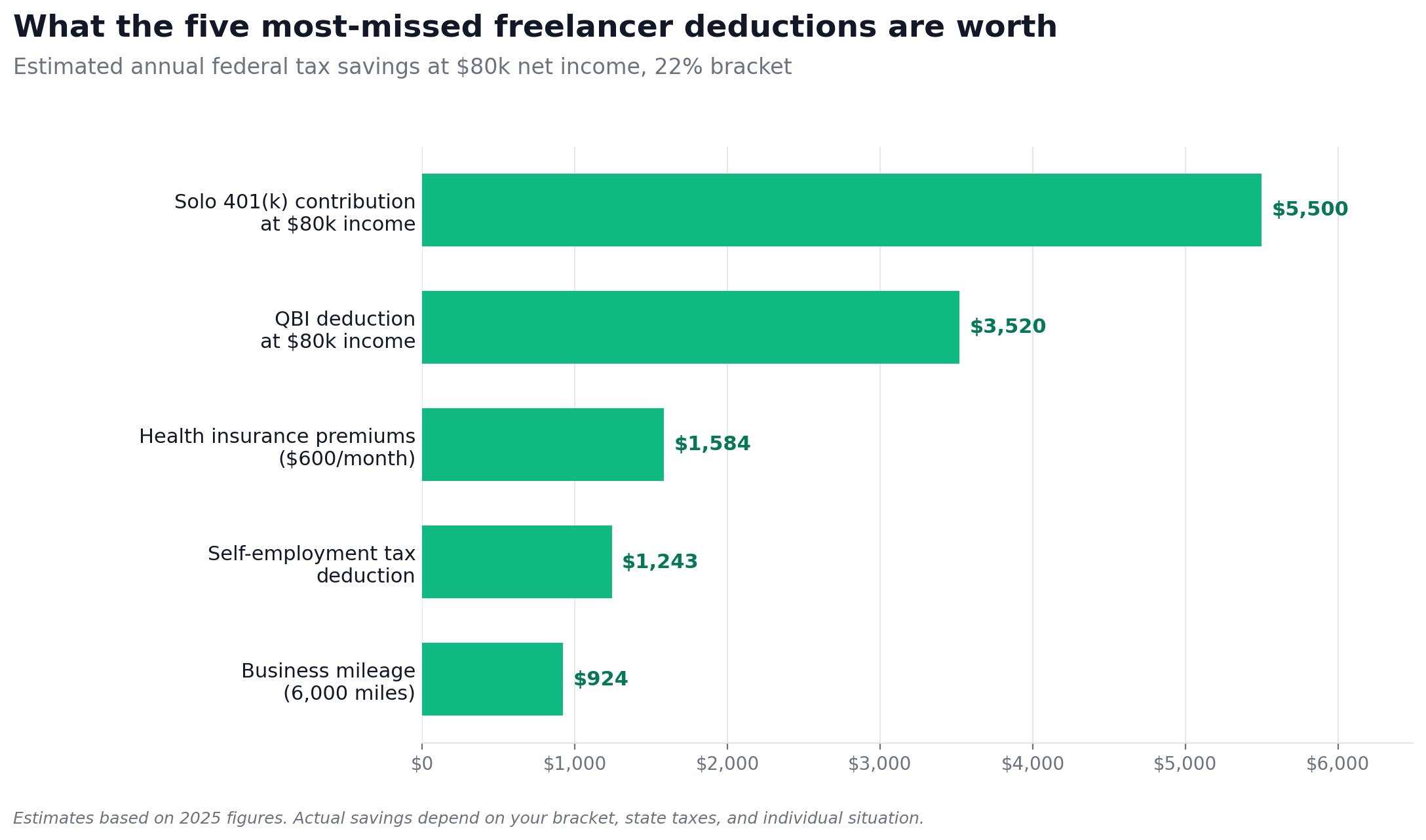
- The QBI deduction. It sits on a different form, and most freelancers don’t even know it exists.
- The self-employment tax deduction. It’s automatic if your accountant catches it, but nobody ever explains it.
- Health insurance premiums. A lot of freelancers pay these every month and never connect them to Schedule C.
- Mileage. Most people underestimate how much they drive for business and don’t keep a log to back it up.
- Retirement contributions. Setting up a SEP IRA or Solo 401(k) feels like a hassle, even though it’s the single biggest tool you have for cutting your tax bill legally.
How to Actually Claim All of This
Knowing the deductions is one thing. Claiming them takes documentation.
The IRS doesn’t disallow deductions because you took them. It disallows them because you can’t prove you were entitled to them. Every deduction on this list is defensible if you have the right records. Without records, even legitimate deductions become risky.
The system that works is straightforward. Keep every receipt, either the paper original or a clear photo. Connect your business bank account and credit card to your accounting software so the expenses come in automatically. Log mileage in real time using an app, not from memory in March. Spend 15 minutes a month reviewing your categories instead of doing 12 months of work in one panicked April weekend.
For the full setup, the expense tracking guide on this site walks through it step by step.
Get Your Free 47-Item Tax Deduction Checklist

Every deduction in this guide is in a printable checklist organized by category. Run through it once with your accountant when you set up your system. Run through it again every January before you file. Most freelancers find two or three deductions they weren’t claiming the first time they go through it properly.
Frequently Asked Questions
How long should I keep receipts and records?
Keep everything for three years from the date you filed the return on which you claimed the deduction. Keep records for seven years if you claim a loss, since the IRS can audit that far back in some situations. The simpler rule is to just keep everything for seven years so you don’t have to remember which document falls under which category.
What if I don’t have a receipt for an expense?
The IRS does not require a receipt for expenses under $75, but you still need some kind of documentation, usually a bank or card statement showing the vendor, amount, and date. For anything over $75, keep the actual receipt. For cash payments, write a dated note describing what you bought and the business reason for buying it.
Can I deduct my home office if I also use it occasionally for personal activities?
The IRS rule is the space has to be used regularly and exclusively for business. Even occasional personal use technically disqualifies the space under the exclusive use rule. This is one place to be honest rather than aggressive. A home office audit asks for documentation of the space and how you use it, and it’s not worth getting cute over.
What’s the difference between a deduction and a credit?
A deduction reduces your taxable income. A credit reduces your actual tax bill. In a 24% bracket, a $1,000 deduction saves you $240. A $1,000 credit saves you $1,000 regardless of your bracket. Freelancers have access to far more deductions than credits, but credits like the child tax credit or education credits are worth knowing about if you qualify.
Should I hire a tax professional?
If you’re earning more than $50,000 a year, a CPA who specializes in self-employed clients will almost always save you more than they cost. They know which deductions apply to your situation, can structure your retirement contributions properly, and can tell you whether forming an S-Corporation makes sense at your income level. A good accountant pays for themselves through the deductions and savings they catch that you’d have missed.
How does the QBI deduction interact with my other deductions?
The QBI deduction is calculated from your net qualified business income, which is your profit after Schedule C expenses. The more business expenses you deduct on Schedule C, the lower your QBI, which means a lower QBI deduction. This is not a reason to skip business deductions. Schedule C deductions reduce both self-employment tax and income tax. The QBI deduction only reduces income tax. Taking your legitimate business expenses always lowers your total tax bill, even if the QBI deduction comes down a little.
Start Here
Run through this list once before your next conversation with your accountant. Mark the deductions you’re already claiming. Circle the ones you’re not. The gap between those two lists is where your money is going.
The tools that make claiming these deductions easier are covered in the expense tracking guide and the invoicing guide on this site. Set up the system. Track through the year. Hand your accountant organized, categorized records. Knowing what to deduct combined with the records to prove it is where the real savings live.

Try the accounting software most freelancers in this guide are already using.
Start Your Free Trial with FreshBooksDownload the Free 47-Item Deduction Checklist, anchored to email capture form above
Tax laws change often. The information in this guide reflects 2025 and 2026 IRS guidelines, including provisions of the One Big Beautiful Bill Act signed July 4, 2025. Verify current rules at IRS.gov or with a qualified tax professional before filing. This guide is for informational purposes and does not constitute tax or legal advice.
About the author
Gareth is an entrepreneur based in Dubai and the founder of Freelancer Profit. He’s not a CPA or a bookkeeper. He built this site because he couldn’t find honest, thorough reviews of AI finance tools written for freelancers. Every guide is researched from real user reviews, official documentation, and expert sources.