


A straight answer on whether Pilot is worth it for a freelancer, with real 2026 pricing and the exact income and complexity thresholds where it starts to make sense. Most of you can stop reading after the verdict.

You typed “pilot bookkeeping review” into Google at 11pm because a thread on r/smallbusiness called it the service real companies use. Now you’re staring at a pricing page that opens at $99 a month and climbs past $5,000 a month for CFO work. Here’s the first thing to know: Pilot is built for venture-backed startups and growing companies that run accrual-basis books. It is not built for a solo freelancer filing a Schedule C. The second thing: most freelancers earning under roughly $100,000 will hand Pilot $1,200 to $5,000 a year for capabilities their simple 1099 income never touches.
This review tells you exactly where that line sits. It uses live pricing pulled from pilot.com on June 8, 2026, plus public user reviews on G2, Capterra, and Reddit. No affiliate incentives are steering the verdict. If Pilot is wrong for you, you’ll know inside two minutes.
The 30-second verdict
Skip Pilot if you’re a sole proprietor with straightforward 1099 income, you file a Schedule C, cash-basis accounting works for you, and you have no employees and no investors. That’s the large majority of freelancers. A $20-a-month tool plus a CPA at tax time costs a fraction of Pilot and does everything you need.
Consider Pilot only if you genuinely need accrual-basis books that lenders or investors expect, you carry meaningful accounts payable and receivable, you employ contractors or staff, or you’ve incorporated and want hands-off bookkeeping plus tax filing under one roof. Even then, you’re paying a premium tied to the startup market, so price the alternatives below before you sign anything.
- Skip Pilot if you earn under about $100k, run simple cash-basis books, file Schedule C, and have no payroll or investors.
- Maybe Pilot if you run an incorporated agency, need accrual books, carry real AP/AR, or want bookkeeping and tax bundled with a human team.
- Definitely Pilot if you’re a funded startup founder who calls yourself a freelancer but actually has a board, a cap table, and burn-rate questions.
For the full field of managed options, the best bookkeeping service for freelancers comparison ranks Pilot against Bench and 1-800Accountant across price and fit. This page answers the narrower question: is Pilot specifically worth it for someone like you.
What Pilot actually is in 2026
Pilot is a managed back-office service, not software you operate yourself. You connect your bank and card accounts, and Pilot’s team plus its AI categorize transactions, reconcile accounts, and close your books each month. Pilot calls itself the largest startup and small business accounting firm in the US, staffed by a US-based team of accountants, fractional CFOs, and tax specialists. Its named clients include OpenAI, Airtable, and Scale, which tells you who the product was designed around.
The core offering is monthly bookkeeping. On top of that, Pilot sells optional add-ons: tax preparation and filing, fractional CFO advisory, outsourced operations, R&D tax credit claims, and stock administration for companies issuing equity. Bookkeeping is the entry point, and almost every add-on requires an active bookkeeping subscription. That bundling matters when you price it, because you can’t buy Pilot’s tax service on its own.
Pilot’s books run on QuickBooks Online, and you can keep your QuickBooks account and historical data on the higher tiers. That’s a real point in its favor next to services that lock your records inside a proprietary platform you cannot export. More on that in the comparison section.
How much does Pilot cost in 2026?
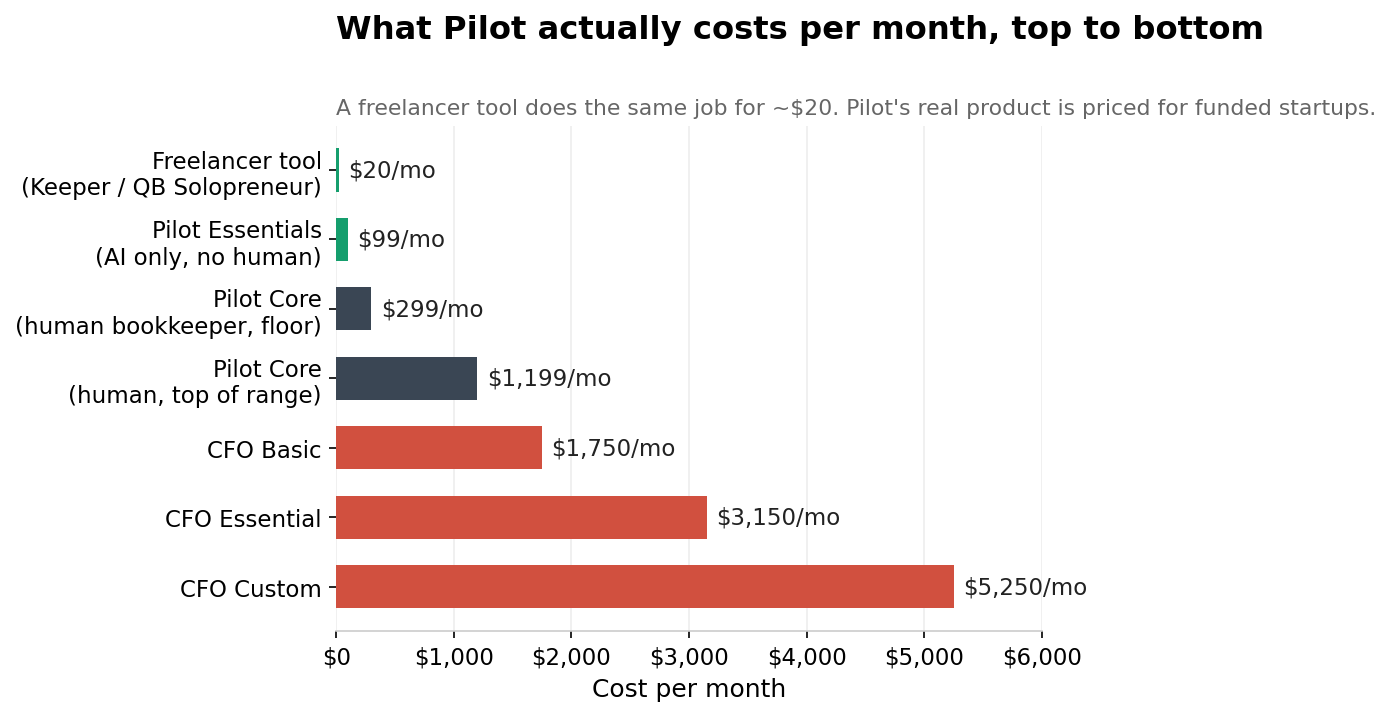
Here’s Pilot’s bookkeeping pricing as published on pilot.com on June 8, 2026. Verify it again before you publish or buy, because Pilot changed this structure within the last year, and the older $499-to-$839 monthly tiers that show up in many reviews are gone.
- Essentials, $99 a month. Covers up to $100,000 in monthly expenses. AI categorizes transactions, reconciles accounts, and closes your books. Cash-basis only. Standard chart of accounts. A year-end package for your tax preparer. Support is in-app messaging. No dedicated human bookkeeper at this tier.
- Core, quote-based, billed annually. Adds a US-based human bookkeeper who handles, explains, and reviews your books. Cash or accrual basis. Bill management for up to 10 vendor bills a month. Custom chart of accounts. Reports on the 10th business day. You have to contact sales for a number, and it scales with your monthly expenses.
- Custom, quote-based. Adds keeping your existing QuickBooks account, support for complex structures, full accounts receivable and payable, payroll administration, and access to CFO advisory.
The CFO add-on sits in a different price universe. Basic CFO support starts at $1,750 a month, the next tier at $3,150 a month, and the custom tier at $5,250 a month, all billed annually. Outsourced operations start at a $750 one-time setup and $500 a month. Stock administration runs $399 an hour, free for pre-seed founders. The R&D tax credit service charges 20 percent of the credit it recovers for you.
Read those CFO numbers again. A freelancer making $63,000 a year does not need a $1,750-a-month financial model. Those tiers exist for funded companies planning fundraises and board meetings. They tell you who Pilot is really selling to.
The $99 tier looks cheap until you see what it isn’t
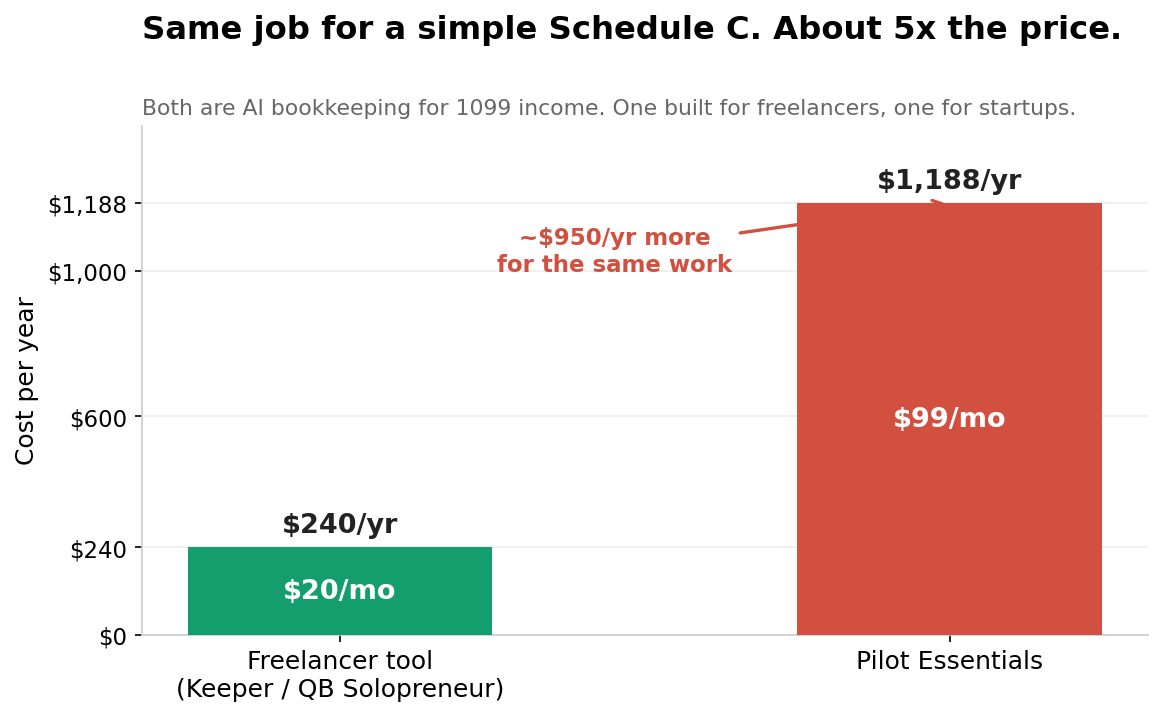
The $99 Essentials plan is the one that pulls freelancers in, so be clear on what it is. It’s AI bookkeeping with no assigned human, no tax filing, and chat-only support. For a freelancer with simple Schedule C income, that puts it in the same job as Keeper or QuickBooks Solopreneur, which cost around $20 a month and were built specifically for 1099 freelancers rather than startups. You’re paying about five times more for the same category of work, branded for a different buyer.
If what you actually want is a human doing your books, you need Core, and Core is quote-based and almost certainly several hundred dollars a month. The cheap headline number does not get you the human service most people picture when they imagine hiring a bookkeeper.
What you actually get
At the Core level and above, the deliverable is a monthly close: reconciled accounts and financial statements (profit and loss, balance sheet, and on higher tiers a cash flow statement) prepared by a real person and delivered through Pilot’s dashboard. You get a year-end package your tax preparer can use, and you can message your team with questions about specific transactions.
Reviewers on G2, where Pilot holds a 4.7 out of 5 across roughly 138 ratings, tend to praise the team’s responsiveness and the clean dashboard. The recurring caution, echoed in startup-focused reviews, is that Pilot uses a team-based model, so you may not work with the same bookkeeper or CFO over time. If you’re a freelancer who wants one consistent point of contact, note that before you commit.
One honest limitation: the $99 AI tier does not include a person reviewing your categorizations. AI miscategorizes transactions, especially the messy mixed personal-and-business spending most freelancers carry. Go that route and you still have to check the work, which undercuts the reason you paid for a managed service in the first place. Learning to track business expenses properly yourself often closes that gap for less money.
Where Pilot works well
Pilot earns its price in specific situations. If you’ve incorporated and run an agency with contractors or employees, you need accrual books, payroll administration, and proper AP/AR, and Pilot’s Custom tier handles all of it in one place. If a lender or an investor wants GAAP-compliant accrual financials, Pilot delivers them, and the controller support on Core helps with revenue recognition and COGS that a DIY tool will not touch.
It also fits the freelancer who is really a founder. Take a developer who left contracting, raised a pre-seed round, and now has a co-founder, a cap table, and a runway question. That person gets value from Pilot’s burn-rate reporting, R&D credit service, and the option to add CFO support later without switching providers. The integrated stack is a real advantage when your finances are genuinely complex.
Where Pilot falls short for freelancers
The mismatch is structural. Pilot’s paid human service is built around accrual accounting, and most freelancers file cash-basis. You count income when the client pays you and expenses when you pay them, which is simpler and perfectly legal for a Schedule C filer under the IRS gross-receipts thresholds. Paying for accrual machinery you never use is the core of the overspend.
The pricing also climbs with your monthly expense volume, so a growing freelancer gets charged more for the same essential service as their numbers rise. And the whole product points at startup metrics: burn rate, runway, board reporting. A solo writer making $58,000 has no use for any of that. The features that justify Pilot’s cost are the ones a freelancer will never open. Pilot’s human tiers are also billed annually and prepaid, so the same year-long commitment you’d flag as a risk with 1-800Accountant applies here too.
The mistake to avoid: paying for bookkeeping when you need tax help
Across Reddit threads in r/freelance and r/tax, the same confusion shows up again and again: people sign up for an expensive managed bookkeeping service because they’re scared of their taxes, then discover bookkeeping and tax filing are two different things. Bookkeeping organizes your records. Filing your return is a separate job. If your real problem is “I owe money I didn’t expect and don’t understand my return,” a $400 to $800 CPA at tax time solves that directly, and paying quarterly estimated taxes on schedule stops the surprise before it starts. Neither requires a $1,200-a-year subscription.
Skip Pilot if any of these is true
Run this list. Check even one of the first four and Pilot is the wrong tool. You’re about to overpay.
- You file a Schedule C as a sole proprietor. Your books are simple enough for a $20-a-month tool. You don’t need a managed accrual service.
- You earn under about $100,000 with low expense volume. The annual cost of any managed service eats a real share of your profit for work you can largely automate.
- You have no employees, no contractors on payroll, and no investors. There’s no AP/AR or compliance complexity for Pilot to manage.
- Cash-basis accounting is fine for you. It’s fine for nearly every freelancer. Accrual is the thing you’re paying Pilot for, and you don’t need it.
- You only want your taxes filed. Buy a CPA, not a bookkeeping subscription with a tax add-on bolted on.
If none of those apply, and you actually run accrual books with real complexity, keep reading. You’re in the narrow group for whom Pilot is a reasonable shortlist candidate.
The 5-minute decision framework
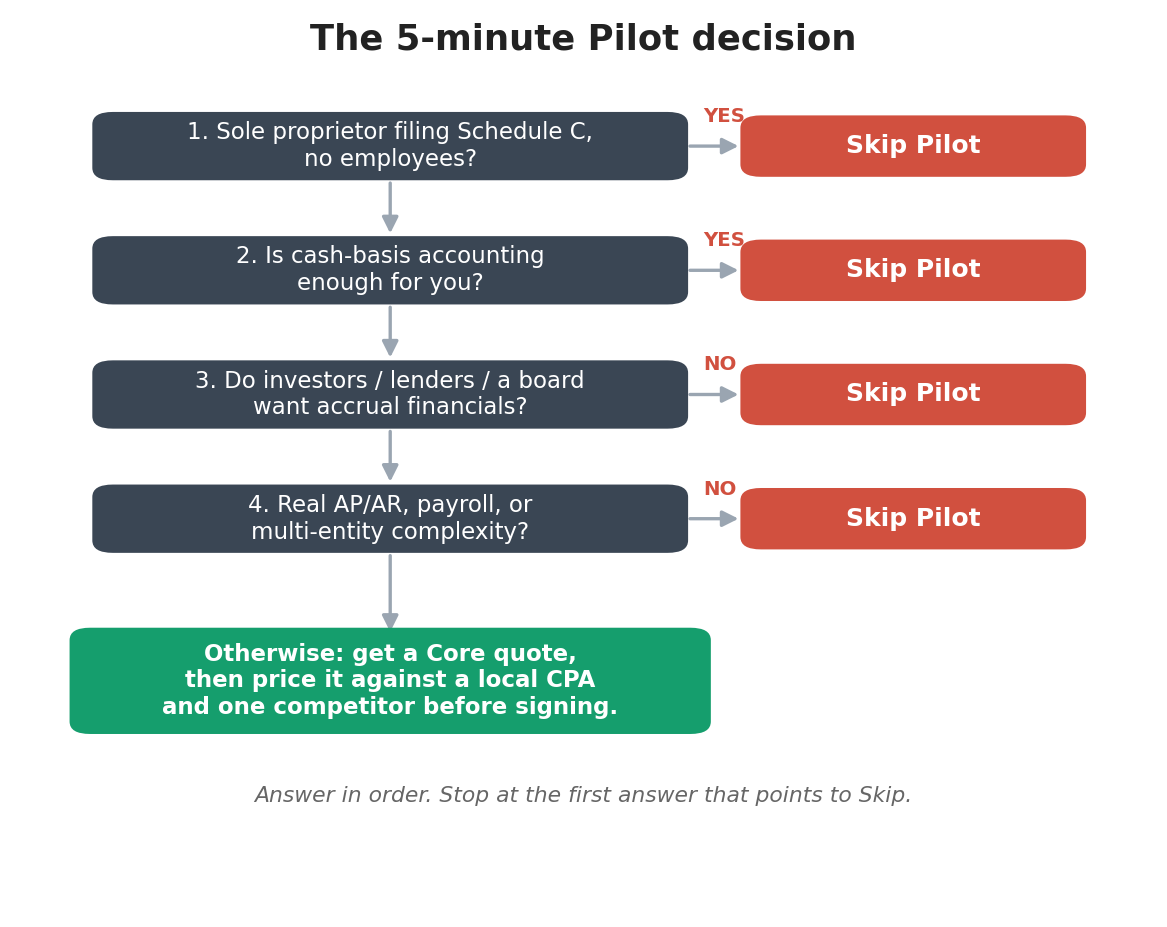
Answer these in order and stop at the first “yes” that points you away.
- Are you a sole proprietor filing Schedule C with no employees? If yes, skip Pilot. Use a freelancer tool plus a CPA.
- Is cash-basis accounting adequate for how you run and report? If yes, skip Pilot. You’re not the buyer.
- Do you have investors, lenders, or a board asking for accrual financials? If no, skip Pilot.
- Do you carry meaningful AP/AR, payroll, or multi-entity complexity? If no, skip Pilot.
- If you said yes to 3 or 4, get a Core quote, then price it against a local CPA firm and one competitor before signing.
Does Pilot do taxes? The tax add-on for freelancers
Pilot does file taxes, and in 2026 it added a tier aimed at the entity many freelancers actually use. The Single-Member LLC tax plan starts at $1,000 a year, billed annually, or $750 a year if you only just formed. It covers a federal and state income tax return, a free extension, quarterly safe-harbor payment calculations, the Schedule C for your LLC, reporting for one each of W-2, K-1, rental, and 1099 income, and your individual 1040. Email support runs year-round.
The catch is bundling. Pilot’s tax plans have to be purchased alongside Pilot Bookkeeping, so you can’t buy the $1,000 tax service by itself. Stack it on bookkeeping and you’re realistically looking at well over $2,000 a year combined. Compare that with an independent CPA who files a sole-prop or single-member LLC return for $400 to $800, and the bundle stops making sense for most freelancers.
If you’ve incorporated as an S-corp, Pilot’s partnership and S-corp tax plan starts at $2,000 a year. Whether an S-corp is even right for you comes down to the actual tax math, which the sole prop vs LLC vs S-corp guide works through with real numbers. Don’t let a tax-service price tag make the entity decision for you.
Pilot vs Bench vs 1-800Accountant
These three get compared constantly. The table below shows the real annualized cost for a freelancer making about $63,000 a year with modest expenses, alongside the DIY route, so you’re comparing total yearly spend rather than sticker prices. Pricing is current as of June 2026 and should be re-verified at publication.
| Option | Real yearly cost (≈$63k freelancer) | Human bookkeeper | Tax filing included | Data portability | Notable risk |
|---|---|---|---|---|---|
| Pilot Essentials | ~$1,188 ($99/mo) | No (AI only) | No | QuickBooks Online | You still check the AI’s work |
| Pilot Core + SMLLC tax | ~$2,500+ (quote + $1,000 tax) | Yes | Yes (bundled) | QuickBooks Online | Rotating team, startup-priced, annual prepay |
| Bench (Employer.com) | ~$2,988–$5,988 ($249–$499/mo) | Yes | Premium tier only | Proprietary, no export | 2024 shutdown, D- BBB, support delays |
| 1-800Accountant | ~$5,028 ($419/mo Enterprise) | Yes (top tier only) | Yes | Proprietary (ClientBooks) | Annual lock-in, 500+ BBB complaints |
| DIY: Keeper + CPA | ~$640–$1,040 | No | Yes (via CPA) | You own your data | You do light upkeep yourself |
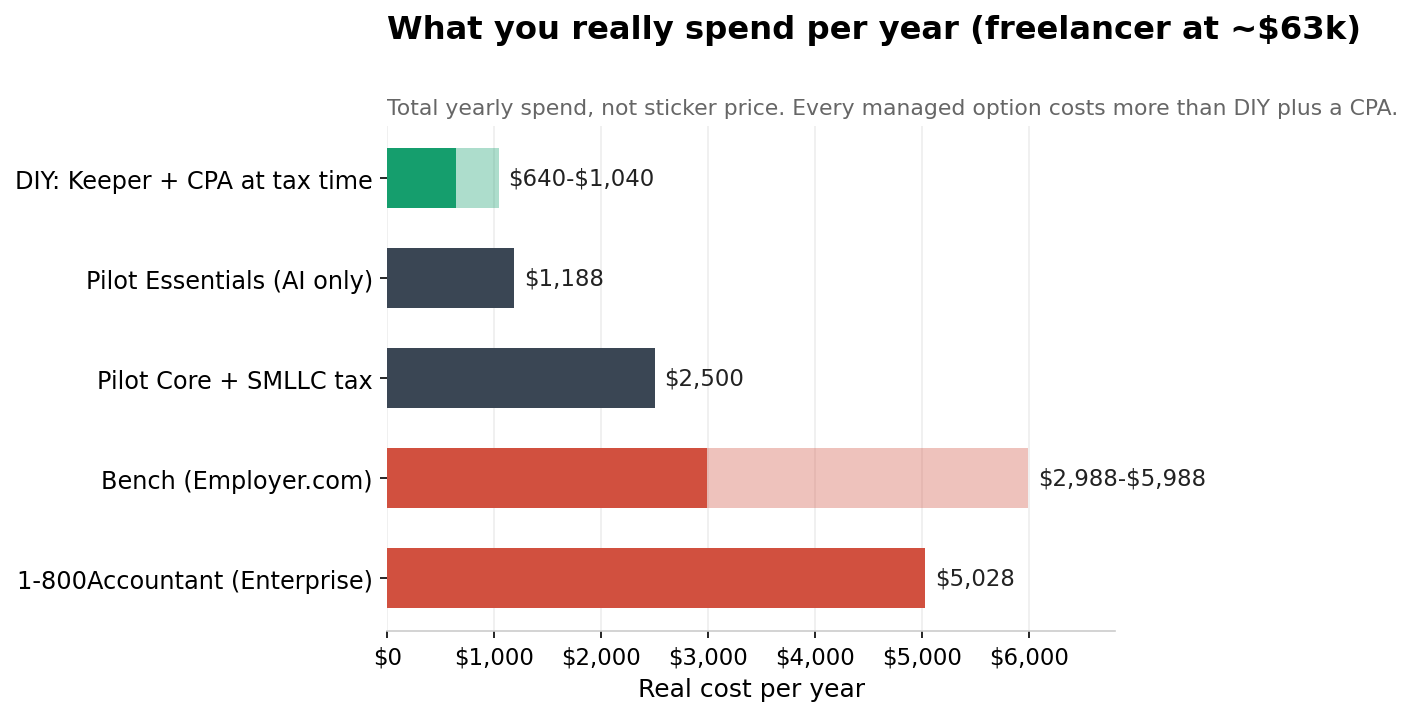
The honest verdict is not “Bench wins.” Bench shut down without warning on December 27, 2024, filed for bankruptcy in a Canadian court in January 2025 with more than $65 million in debt, and was acquired by Employer.com days later. It relaunched, and its Trustpilot score now sits at about 4.1 out of 5 across roughly 1,300 reviews, which is decent. But it carries a D- rating from the Better Business Bureau, is not BBB-accredited, and the cluster of complaints on BBB and in recent one and two-star reviews is consistent: late tax filings, bookkeeper turnover, and slow support. It also keeps your books in a proprietary platform you cannot export to QuickBooks. Given the shutdown, the bankruptcy, and the annual prepay, I can’t recommend it as a safe default for a freelancer who can’t afford to lose access to their books.
1-800Accountant has its own pattern of more than 500 BBB complaints over three years, an annual-billing structure that traps people who change their mind, and entry plans that are mostly tax advice rather than actual bookkeeping until you reach the $419-a-month tier. For most freelancers under $100k, the genuinely better answer is the bottom row: a freelancer tool you own plus a CPA at tax time, for around $640 to $1,040 a year. If you’ve ruled out the DIY route and want a managed service with portable data, Pilot’s QuickBooks-based model is the cleaner of the three managed options. That’s a narrow recommendation, not a glowing one.
Who should choose Pilot, and who should walk away
Choose Pilot if you’re running an incorporated business with accrual books, contractors or staff, real AP/AR, and people outside your business who need to read your financials. Choose it if you’re a funded founder who wants bookkeeping, tax, and the option of CFO support from one provider, and you value not switching vendors as you grow.
Walk away if you’re a solo freelancer with 1099 income and a Schedule C, which is most of the people reading this. Spend $20 a month on a tool built for you, learn to keep your own records, and hire a CPA for $400 to $800 when your return is due. You’ll keep $1,500 or more in your pocket every year and lose nothing you needed. The AI bookkeeping tools guide and the best accounting software roundup cover the tools that actually fit your income, and our freelancer software and service reviews compare those options side by side.
Free: the managed-vs-DIY cost checklist

Before you sign up for any managed service, run the one-page checklist. It walks you through the five skip-if questions, gives you the real annual-cost math for Pilot, Bench, 1-800Accountant, and the DIY route, and shows you the exact number you’d spend either way. Enter your email and I’ll send it straight over.
Frequently Asked Questions
How much does Pilot cost?
As of June 2026, Pilot bookkeeping starts at $99 a month for the AI-driven Essentials plan, which covers up to $100,000 in monthly expenses with no dedicated human bookkeeper. The Core plan, which adds a US-based bookkeeper and cash or accrual books, is quote-based and billed annually, scaling with your expense volume. Tax filing is a separate add-on that starts at $1,000 a year for a single-member LLC and must be bought alongside bookkeeping. CFO advisory runs from $1,750 to $5,250 a month. Always check pilot.com for current numbers before you commit.
Is Pilot good for freelancers?
For most freelancers, no. Pilot is built for accrual-basis startups and growing companies, and the majority of freelancers file a cash-basis Schedule C that doesn’t need a managed accrual service. If you’re a sole proprietor under about $100,000 a year with no employees, a $20-a-month tool plus a CPA at tax time will cost far less and cover everything you need. Pilot makes sense only if you’ve incorporated, run real accounts payable and receivable, employ people, or have investors who expect formal financials.
Pilot vs Bench: which is better?
Between the two managed services, Pilot is the safer pick on data and reliability. Pilot runs your books on QuickBooks Online, so you can take your records with you. Bench shut down abruptly in December 2024, filed for bankruptcy, and was acquired by Employer.com; since relaunching it carries a D- rating from the Better Business Bureau with documented complaints about late filings and support, plus a proprietary platform you cannot export. Its Trustpilot score is higher, around 4.1, but the data-portability and reliability risks are real. That said, most freelancers should choose neither and use a DIY tool with a CPA instead.
Does Pilot do taxes?
Yes, Pilot offers tax preparation and filing as an add-on. Its single-member LLC plan starts at $1,000 a year and includes federal and state filing, a free extension, quarterly safe-harbor payment calculations, your Schedule C, and your individual 1040. The plan must be purchased together with a Pilot bookkeeping subscription, so you can’t buy tax filing on its own. For a simple freelance return, an independent CPA at $400 to $800 is usually cheaper than Pilot’s bundled cost.
Does Pilot offer a free trial?
Pilot advertises a free trial for small businesses on its site, and you can start one before committing to a paid plan. A trial is worth using if you’re genuinely in the narrow group Pilot fits, because it lets you test the dashboard and the close process before you pay annually. If you already match the skip-if list above, a trial won’t change the math. You still don’t need an accrual managed service for simple 1099 income.
This article is informational only and not tax, legal, or financial advice. Pricing and tax rules change often. Verify current Pilot pricing at pilot.com and current tax figures at IRS.gov, and consult a CPA about your own situation. See our methodology for how these reviews are researched.
About the author
Gareth Noble is the founder of Freelancer Profit. He’s not a CPA or a bookkeeper. He spent 20 years coaching teams at companies like Amazon, P&G, and Emirates before building this site, because he couldn’t find honest, thorough reviews of finance tools written for freelancers. Every guide is researched from real user reviews, BBB complaints, official documentation, and primary sources.