

This guide compares the official Pilot bookkeeping pricing for 2026 against Bench and 1-800Accountant. A freelancer-first look at Bench, Pilot, and 1-800Accountant. Real pricing, real BBB data, the December 2024 Bench collapse, and the honest answer about whether any of them are worth $2,388 to $7,188 a year if you make $45k to $110k.
On December 27, 2024, Bench Accounting sent its 12,000 customers an email saying the service was closing. People who had paid annual fees of $2,000 to $7,000 lost access to their books two weeks before tax season. (Don’t get caught flat-footed — read our guide on how to avoid tax liability shock.) Some of them learned about it when journalists called for comment.
Three days later, an HR tech company called Employer.com bought Bench in a 72-hour deal closed over a holiday weekend. Bench filed for bankruptcy in a Canadian court on January 9, 2025. The service is back online under new ownership. Most of the original 600+ employees are not.
Whichever service you pick, it connects to your business checking account — see our Mercury Bank review for freelancers if you are still choosing where to bank.
That’s the company you’re deciding whether to hire. Before you compare features or pricing tiers, you need the full picture: what happened, what the data says now, and whether any of these three online bookkeeping services actually make sense for a freelancer pulling $45k to $110k a year.
Short answer first: for most freelancers reading this, the answer is no. Below, I’ll show you when it’s yes, and which one.
The 30-second answer
If you’re a solo freelancer with no employees, no inventory, under 100 transactions a month, and your books are mostly Stripe deposits and a credit card you only use for business, you don’t need any of these services. You need a $20 to $50 a month bookkeeping app and an hour with a CPA in March. You’ll save somewhere between $1,800 and $5,800 a year.
If you have employees, sub-contractors getting 1099-NECs, multi-state revenue, an S-corp election, inventory, deferred revenue, or you’re simply allergic to your books and your time is worth more than $100 an hour, a managed service might pay for itself. Of the three reviewed here, 1-800Accountant is the only one priced for freelancers. Pilot is built for venture-backed startups and you should ignore it. Bench is functional but carries real reliability risk after the 2024 collapse, and a customer review score that doesn’t match its marketing.
The detail behind that answer is below. Skip to whichever section matters to you.
Pricing as of May 2026, pulled from each vendor
I pulled these prices directly from each company’s website during the second week of May 2026. Pricing pages get updated quietly, so verify before you sign anything. Here’s what the published pages show today.
Bench Accounting current pricing
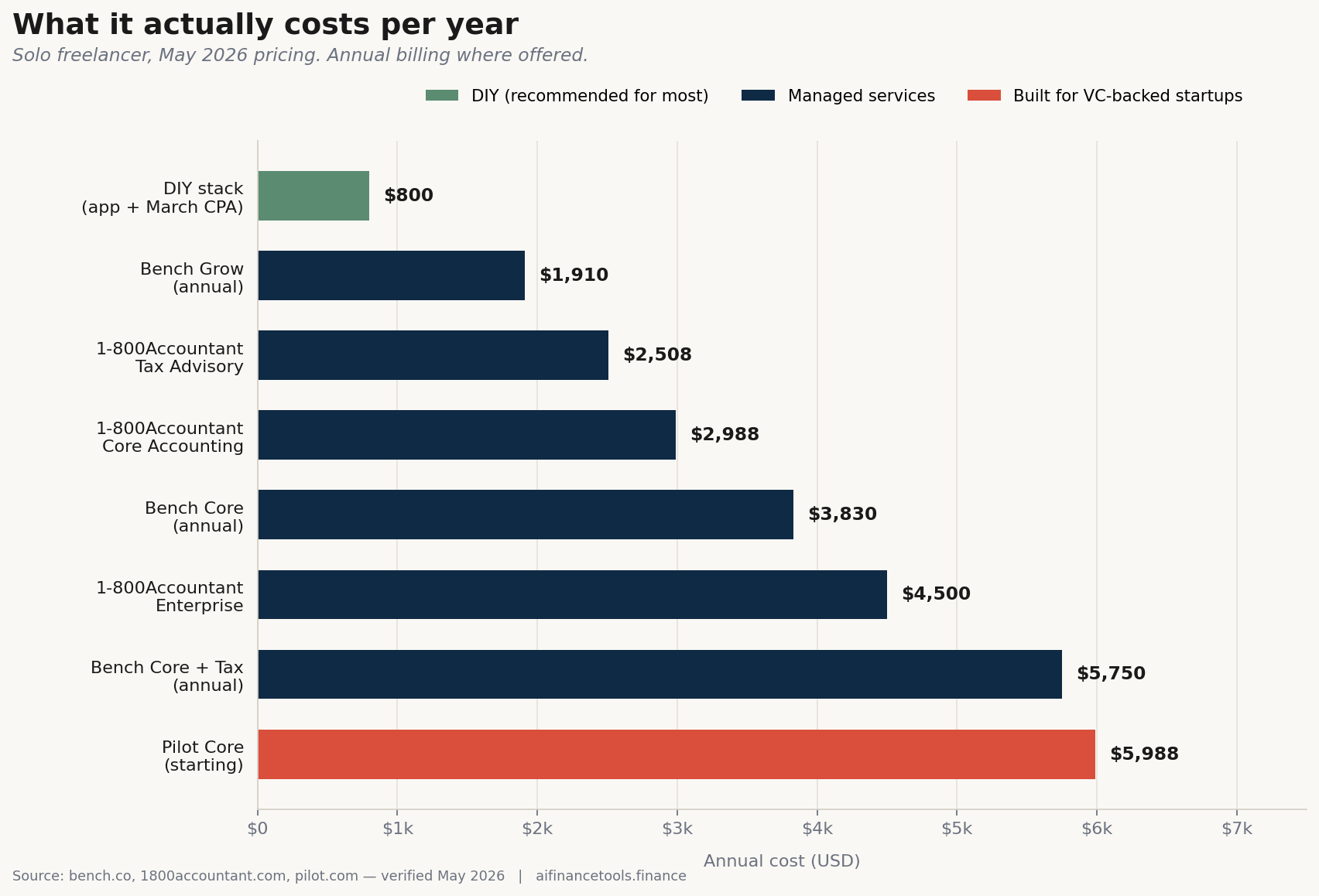
- Bookkeeping Grow: $199 per month billed monthly, or $1,910 annually ($159/mo equivalent). Cash-basis only. Pre-scheduled communication windows.
- Bookkeeping Core: $399 per month, or $3,830 annually ($319/mo equivalent). Adds unlimited communication.
- Bookkeeping Core + Tax: $599 per month, or $5,750 annually ($479/mo equivalent). Adds federal and state tax filing for sole proprietors and one business return for S-corps, C-corps, or partnerships.
- Bookkeeping Accrual: Starts at $1,175 per month. Adds AR, AP, deferred revenue, and accrued liabilities. Almost no freelancer needs this.
- QBO Certified Bookkeeper: $55 per hour plus $1,200 onboarding. Works inside your existing QuickBooks Online account.
- Add-on for S-corp/partnership personal filing: $59 to $69 per month.
- Catch-up bookkeeping: Quoted per month of backlog. Bench has run a promo offering up to $4,800 of catch-up free with an annual plan, which tells you what catch-up usually costs.
1-800Accountant current pricing
- Tax Advisory: $209 per month billed annually ($2,508 per year). Year-round CPA access, quarterly reviews, tax planning. No bookkeeping or tax filing.
- Core Accounting: $249 per month billed annually ($2,988 per year). Adds personal and business tax preparation and access to bookkeeping software.
- Enterprise Business: $375 per month billed annually ($4,500 per year). Adds a dedicated bookkeeper who maintains your books and produces monthly financial reports.
- Payroll add-on: $89 per month for the first employee, $39 per additional employee, plus a $200 setup fee.
- Entity formation: Free service, you pay state fees only.
Pilot current pricing
- Essentials: $99 per month. AI-driven categorization. No dedicated human bookkeeper. Not directly comparable to the other services here.
- Core: Starts at $499 per month for businesses with under $30,000 in monthly expenses, scaling to $899 per month. Accrual-basis bookkeeping with a dedicated finance expert.
- Select: Starts at $849 per month, capping around $1,149 per month. Adds controller-level support and faster delivery.
- Plus: Custom pricing, typically starting at $1,500 to $2,000 per month. For multi-entity businesses or complex revenue recognition.
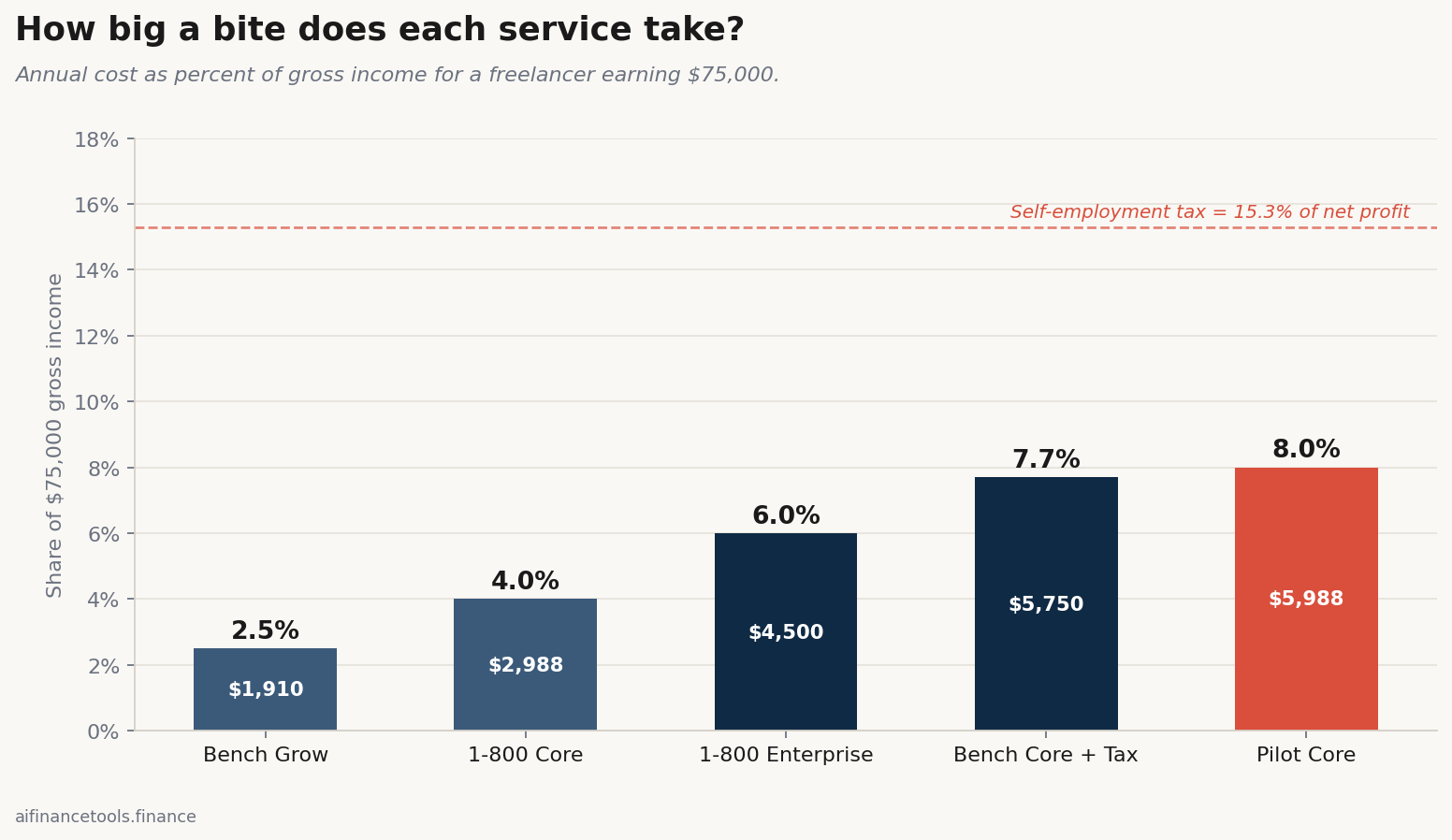
The annualized differences for someone earning $75,000 a year as a freelancer with one bank account, one credit card, and roughly 50 transactions a month:
- Bench Grow annual: $1,910. About 2.5% of gross income.
- 1-800Accountant Core Accounting: $2,988. About 4% of gross income.
- 1-800Accountant Enterprise: $4,500. About 6% of gross income.
- Bench Core + Tax annual: $5,750. About 7.7% of gross income.
- Pilot Core minimum: $5,988. About 8% of gross income.
For context, the standard 15.3% self-employment tax on $75,000 of net profit is around $10,597. So you’re looking at services that cost between 18% and 56% of what you owe in self-employment tax alone. Whether that math works depends on what they save you, not what they charge. How much to set aside for taxes is the related question worth running the numbers on before any of this.
The Bench shutdown and why it still matters in 2026
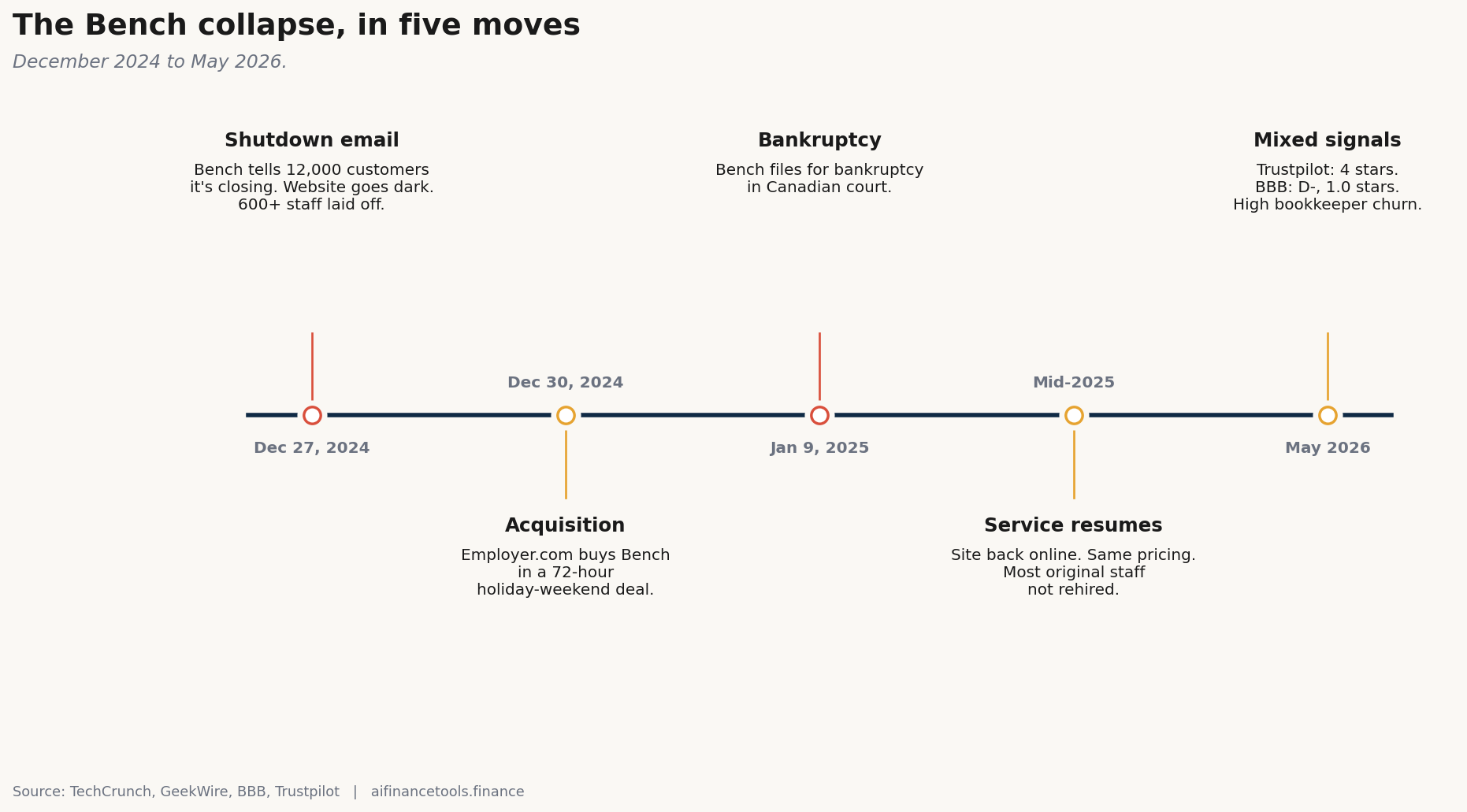
You can’t honestly evaluate Bench in 2026 without understanding what happened in December 2024 and January 2025. The short version above isn’t enough. Here’s the full timeline.
December 27, 2024: the shutdown
Bench told 12,000 small business customers the service was closing immediately. Their website went offline. Customers were locked out of their books. Over 600 employees were let go without severance, effective that day. The closure notice told customers to file for a six-month tax extension and find a new bookkeeper. The shutdown was triggered by a venture debt recall from Bench’s bank, according to reporting in TechCrunch and GeekWire.
One detail that matters: in the weeks before the shutdown, Bench had been pushing customers to switch from monthly to annual billing. Some who paid for a full year of service in early December 2024 had no service two weeks later.
December 30, 2024 to January 9, 2025: the acquisition
Employer.com, an HR tech holding company in San Francisco, announced a deal to acquire Bench. The acquisition was negotiated in roughly 48 hours. Employer.com’s CEO, Jesse Tinsley, had bought the Employer.com domain name a month earlier for $450,000 and had no prior experience in accounting. Bench filed for bankruptcy in Canadian court on January 9, 2025. Some former employees were rehired on 30-day contracts to maintain continuity in Canada.
2025 through 2026: the rebuild
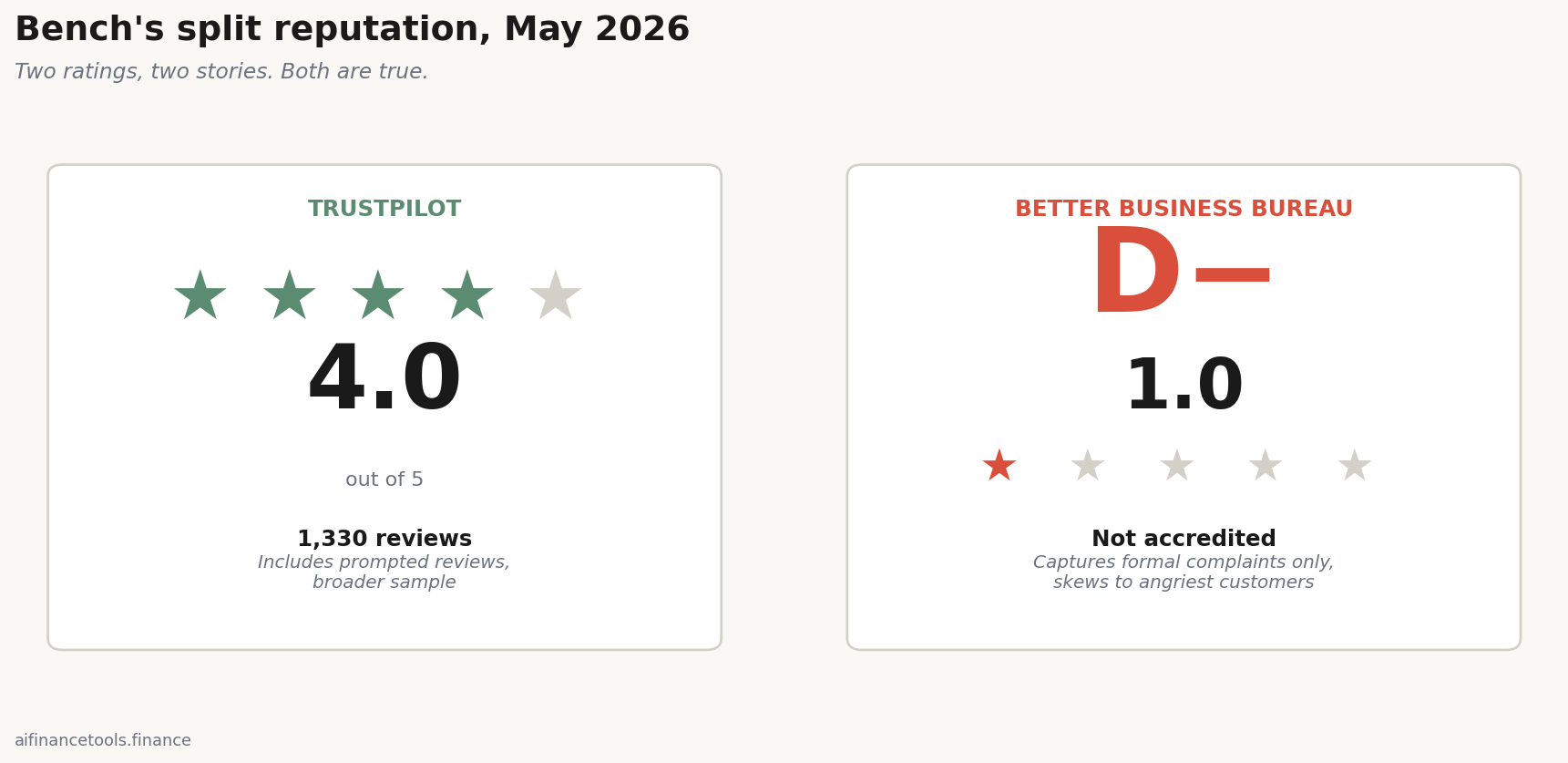
Bench is operating today. Pricing is the same as before. The website is up. They’re taking new customers. Trustpilot shows 1,330 reviews averaging 4 stars, with regular new positive reviews through March 2026. Many of those positive reviews are unprompted and recent, including ones written by customers who joined after the shutdown.
The Better Business Bureau tells a different story. Bench currently holds a D- rating, isn’t BBB-accredited, and has a 1.0-star customer review average there. The complaints filed since the acquisition tend to cluster around three themes: late or missed filings, unresponsive support, and frequent bookkeeper turnover. Reddit threads in r/Bookkeeping and r/smallbusiness document users having multiple bookkeepers in under two years.
The contradiction between Trustpilot at 4 stars and BBB at 1 star isn’t unusual for managed services. Trustpilot collects from a broader sample including prompted reviews. BBB collects almost exclusively from customers angry enough to file a formal complaint. The honest read: Bench works fine for many customers, and the customers it doesn’t work for tend to get burned badly.
What the shutdown changes for you in 2026
Three things you should know before signing up with Bench today:
- The platform is still proprietary. Bench’s software is theirs. You can export reports to Excel, but you can’t port your full transaction history to QuickBooks or Xero. If Bench fails again, you keep your reports but rebuild your books elsewhere from scratch.
- Pay monthly, not annually. The annual discount is 20%, which sounds attractive. Customers who paid annually in late 2024 are still trying to get refunds. On a $1,910 annual plan you save $478 a year compared to monthly. Decide if $478 is worth that risk.
- Download your data monthly. Export your P&L, balance sheet, and general ledger as Excel files on the first of every month. Store them somewhere outside Bench. This is good practice with any cloud service. With Bench, it’s mandatory.
Bench, Pilot, and 1-800Accountant compared on the things freelancers actually care about
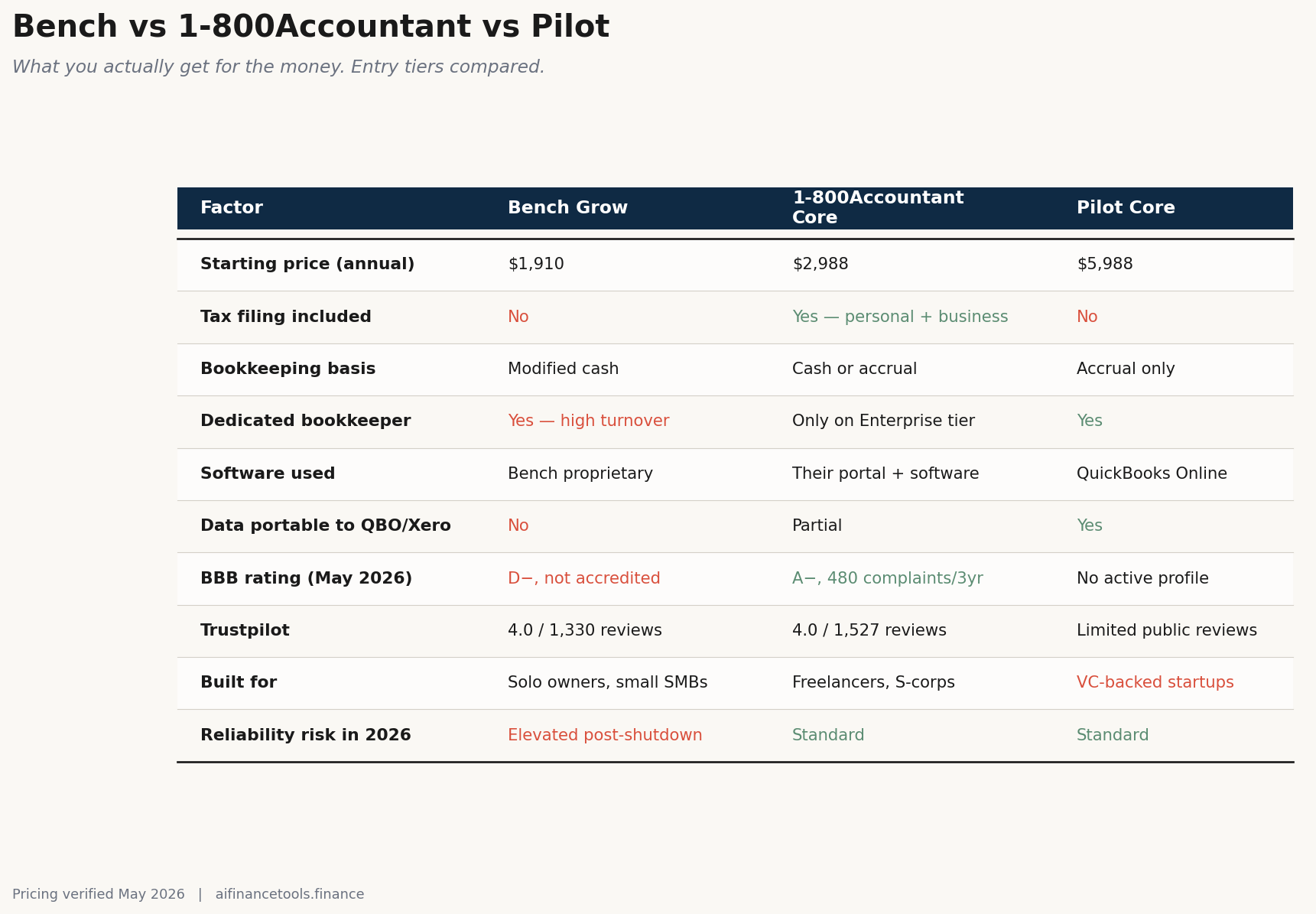
One note on the BBB complaint counts. 1-800Accountant has between 380 and 480 complaints in the last three years across BBB snapshots, with 261 closed in the last twelve months. That sounds bad in isolation. Adjusted for the fact that they service over 100,000 businesses, the complaint rate is roughly 0.4% per year. Bench’s BBB complaint volume is harder to read because the company effectively reset under new ownership in early 2025, so the 1.0-star rating is largely shutdown fallout.
Bench Accounting: who it actually fits
Bench’s pitch has always been hands-off bookkeeping for people who don’t want to think about their books. The proprietary platform is clean, the messaging interface is easy, and the monthly close (with P&L, balance sheet, and bank reconciliation done for you) is genuinely useful if you’ve never had financials before.
Where Bench works well
- Solo freelancer with multiple income sources. If you take payments through Stripe, PayPal, Shopify, and direct bank deposits, Bench’s integrations pull everything in and reconcile it monthly. Manual entry is rare.
- You want one monthly check-in and nothing else. The Grow plan limits communication to pre-scheduled touchpoints. If you don’t have ongoing questions, this is fine.
- You file as a sole proprietor and want bookkeeping plus tax handled. Core + Tax at $599 per month includes federal and state filing of your Schedule C. That’s roughly 10 to 15 hours of CPA time at standard rates, plus ongoing books. The math can work.
Where Bench doesn’t work
- You want accrual-basis books for any reason. The Grow and Core plans are modified cash basis. Accrual is a separate plan starting at $1,175 per month.
- You’re planning to apply for SBA financing, a business line of credit, or investor capital. Banks and investors want GAAP-compliant books from QuickBooks or Xero. Bench’s reports can technically be shared, but the format is non-standard and lenders sometimes push back.
- You want to keep your books in QuickBooks or Xero. Bench’s QBO Certified Bookkeeper service at $55 per hour plus $1,200 onboarding is a workaround, but at that point you’re paying a la carte and the math changes.
- You hate the idea of vendor lock-in. Given what happened in December 2024, this is a legitimate concern. You can leave Bench, but you can’t leave Bench with clean QuickBooks-ready data.
What real users complain about (after the shutdown)
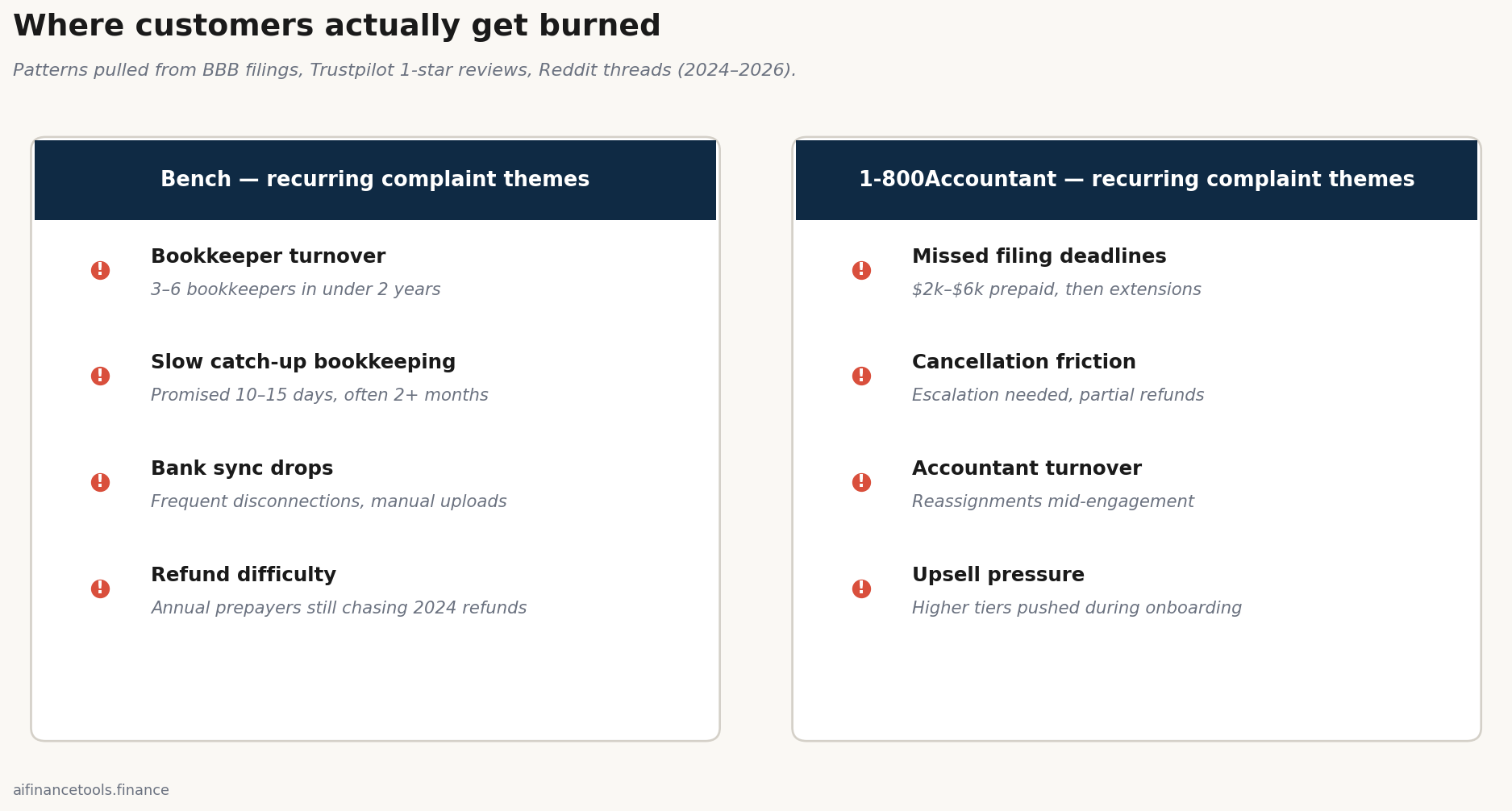
Pulling from BBB complaints, Trustpilot 1-star reviews, and Reddit threads in r/Bookkeeping and r/smallbusiness through early 2026, four themes recur. Bookkeeper turnover is the most common — multiple users describe having three to six different bookkeepers in under two years, each one re-asking about recurring categorizations the previous bookkeeper had already handled.
Catch-up bookkeeping turnaround comes second. One Capterra review from a Bench customer who signed up in September 2024 describes expecting books within the 10 to 15 days promised, and still having hundreds of miscategorized transactions two months later. Bank sync issues show up next: frequent disconnections requiring manual statement uploads, which defeats the point of automated bookkeeping. And refund difficulty after cancellation — customers who prepaid annually before December 2024 report ongoing issues recovering funds for service they didn’t receive.
1-800Accountant: who it actually fits
1-800Accountant is the only one of these three actively built and marketed for freelancers and solo self-employed workers. Their pricing reflects that. Tax Advisory at $209 per month annual, Core Accounting at $249 per month annual, Enterprise at $375 per month annual.
Here’s what you need to understand. The entry-level plans aren’t really bookkeeping services. Tax Advisory is a CPA on retainer with quarterly reviews. Core Accounting adds tax filing. Only Enterprise at $4,500 per year gets you an actual bookkeeper maintaining your books. So when you compare 1-800Accountant to Bench, you have to compare like-for-like.
Where 1-800Accountant works well
- You handle your own books but want a CPA on speed dial. Tax Advisory at $209 per month is reasonable for year-round tax questions, quarterly reviews, and someone who knows your situation by April. Pairs well with running your own quarterly estimated taxes.
- You’re forming an LLC or S-corp. Their entity formation service is free aside from state fees, and they handle the ongoing filings. If you’re trying to decide between structures, our sole prop vs LLC vs S-corp guide covers the math.
- You need tax filing for a more complex return. Core Accounting at $249 per month includes personal and business returns, which beats paying a CPA $800 to $2,500 per return ad hoc.
- You want one provider for tax, books, and payroll. If you have one employee and want everything under one roof, the combined cost can land under $500 per month.
Where 1-800Accountant doesn’t work
- You want hands-off bookkeeping at the entry price point. Tax Advisory doesn’t do bookkeeping. You’ll still need to track your own transactions in QuickBooks, Wave, or similar. (See our guide on how to track business expenses for freelancers.)
- You want monthly P&L and balance sheet without doing the data entry. That requires Enterprise at $375 per month, which puts you in the same price band as Bench Core at $399 per month.
- You expect consistent service quality. Their BBB complaint volume is high in absolute terms (480 complaints in three years), with recurring themes around missed tax deadlines, unresponsive accountants, refund disputes, and pressure to upsell. BBB filings show refund disputes ranging from $2,949 to $6,000 in 2024 and 2025.
What real users complain about
The patterns in 1-800Accountant complaints, pulled from BBB filings between 2024 and early 2026:
- Missed filing deadlines after large prepayments. Multiple complaints describe paying $2,000 to $6,000 upfront for tax preparation, then having to file extensions or file independently because the return wasn’t delivered by April 15.
- Cancellation friction. Users report being unable to cancel without escalation, and partial or denied refunds for services that were quoted but not delivered.
- Accountant turnover and inconsistent advice. Reassignment to different accountants mid-engagement, with each one needing to relearn the client’s situation.
- Upsell pressure. Several complaints reference being pushed into higher-tier plans or add-on services during onboarding calls.
The Trustpilot and BBB review averages are around 4 stars from over 1,500 reviewers each, so the positive cases exist and outnumber the negative. The negative cases tend to be expensive when they happen.
Pilot: why you can probably skip it
Pilot was founded for venture-backed startups. Their entire product, pricing, and marketing reflects that. The Essentials plan at $99 per month is software-only with no human bookkeeper, which isn’t what you’re shopping for if you’re considering a managed bookkeeping service. Core at $499 to $899 per month is built for startups with $30,000 to $200,000 in monthly expenses. Those are companies with payroll, multiple investors, and accrual-basis reporting requirements.
If you’re reading this and you make under $110,000 a year as a solo freelancer, Pilot isn’t for you. The Core plan starts at $5,988 a year. For that money, you’d get accrual-basis books designed for a company that has burn rate, CapEx, and investor reports. You don’t need any of that to file a Schedule C.
The narrow case where Pilot could make sense: you’re a freelancer who’s about to scale into an agency with 5+ employees, you’ve raised some kind of outside capital, and you need investor-ready financials within 6 months. In that case, Pilot is a real option. If you don’t meet all three criteria, look elsewhere.
The honest math: when none of these are worth it
Most freelancers reading this shouldn’t be paying for a managed bookkeeping service. The real cost-benefit question isn’t “how much does the service cost.” The question is “what does the service save me that I couldn’t get for less elsewhere.” There are three sources of value: time saved, tax saved, and confidence at filing time.
Time saved
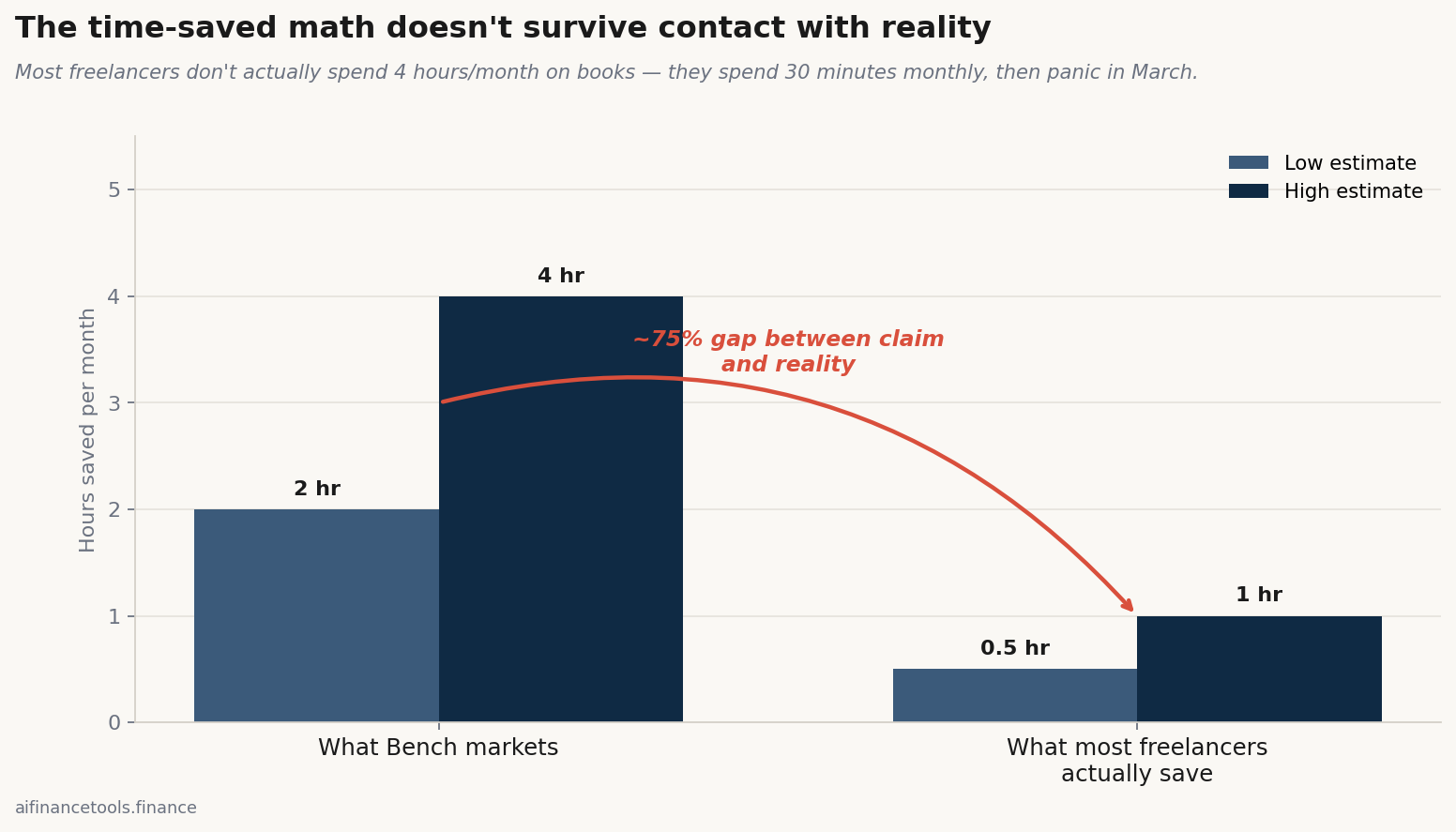
Bench markets that it saves customers 2 to 4 hours per month. At your billable rate of $80 to $150 per hour, that’s $160 to $600 per month of recovered time. On paper that justifies $199 to $399 per month.
The catch: this assumes you’d otherwise spend those 2 to 4 hours doing actual bookkeeping. Most freelancers don’t. They spend 30 minutes a month reviewing transactions in an app like Wave or QuickBooks, then 4 to 6 hours panicking in March. The real time saved is closer to 1 hour per month, not 4.
Tax saved
A bookkeeping service doesn’t directly save you taxes. A good CPA can save you taxes by finding deductions you missed. For most freelancers, the highest-value deductions are home office, vehicle mileage, health insurance premiums, retirement contributions, and the qualified business income deduction. A solo freelancer can capture these with a $35 tax book and an evening of focused reading. They aren’t hidden.
The real tax-saving value of a managed service shows up if you’re considering an S-corp election, have multi-state revenue, or have investment income mixed in with self-employment income. Those situations actually need a CPA, not a bookkeeper.
Confidence at filing time
This is the value that’s hardest to price but often the real reason people hire these services. Walking into April without a knot in your chest is worth something. For some people, it’s worth $200 a month. For others, $20 a month for a good bookkeeping app plus $300 once a year for a CPA review delivers 90% of the same confidence at 12% of the cost.
The decision rule
Skip all three of these services if every line below describes you:
- You’re a sole proprietor or single-member LLC (no S-corp election yet).
- You have no employees and no 1099 contractors you pay regularly.
- You earn from 1 to 5 income sources, all US-based.
- You have fewer than 100 business transactions per month.
- You have a separate business bank account and credit card.
- You don’t need accrual-basis books for any external reason.
- Your time is genuinely freed up by automation, not made worse by it.
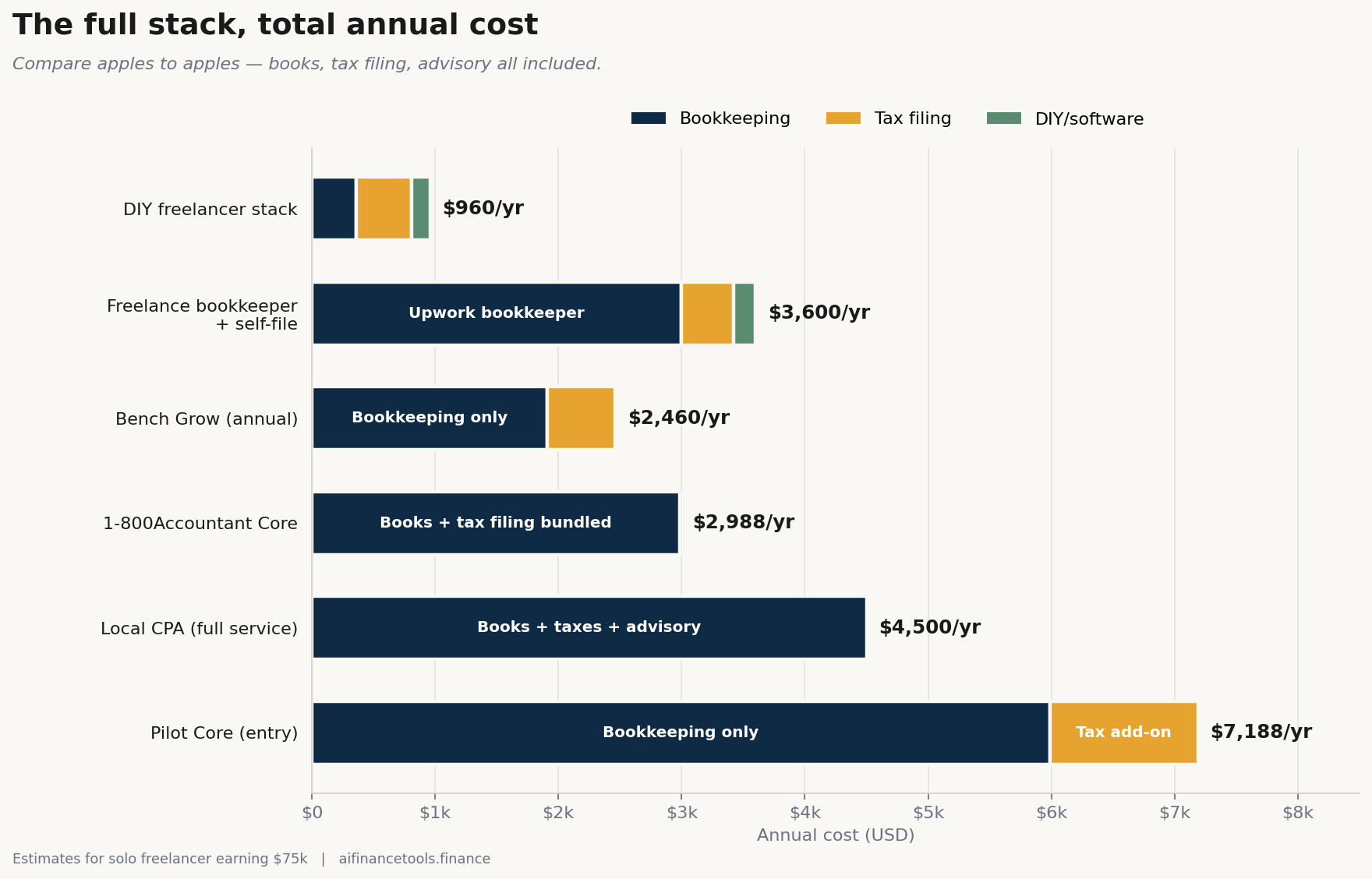
If that’s you, your stack should be a $20 to $50 per month bookkeeping app (FreshBooks, Wave, Zoho Books, or Keeper Tax), one $300 to $600 CPA review in March, and an hour a week reviewing transactions. Total cost: under $1,000 per year. You’re saving roughly $1,000 to $5,000 a year compared to the managed services above.
Consider a managed service if any of these apply:
- You have an S-corp election with payroll requirements.
- You have employees or regular 1099 contractors.
- You have multi-state revenue triggering nexus issues.
- You have 100+ transactions a month across multiple platforms.
- You’ve already tried DIY and burned out on it for two years.
- Your billable rate is over $200 per hour and 2 hours per month of recovered time actually translates to billable work.
Picking between Bench and 1-800Accountant if you’ve decided you need a service
Assuming Pilot is off the table, here’s the head-to-head. Bench and 1-800Accountant are both $2,000 to $5,000 per year services that overlap heavily. Choose Bench if you want hands-off bookkeeping with monthly financials and you’re not filing as an S-corp. Choose 1-800Accountant if you want a CPA relationship more than a bookkeeper, or if you have an S-corp or partnership election that needs ongoing tax planning.
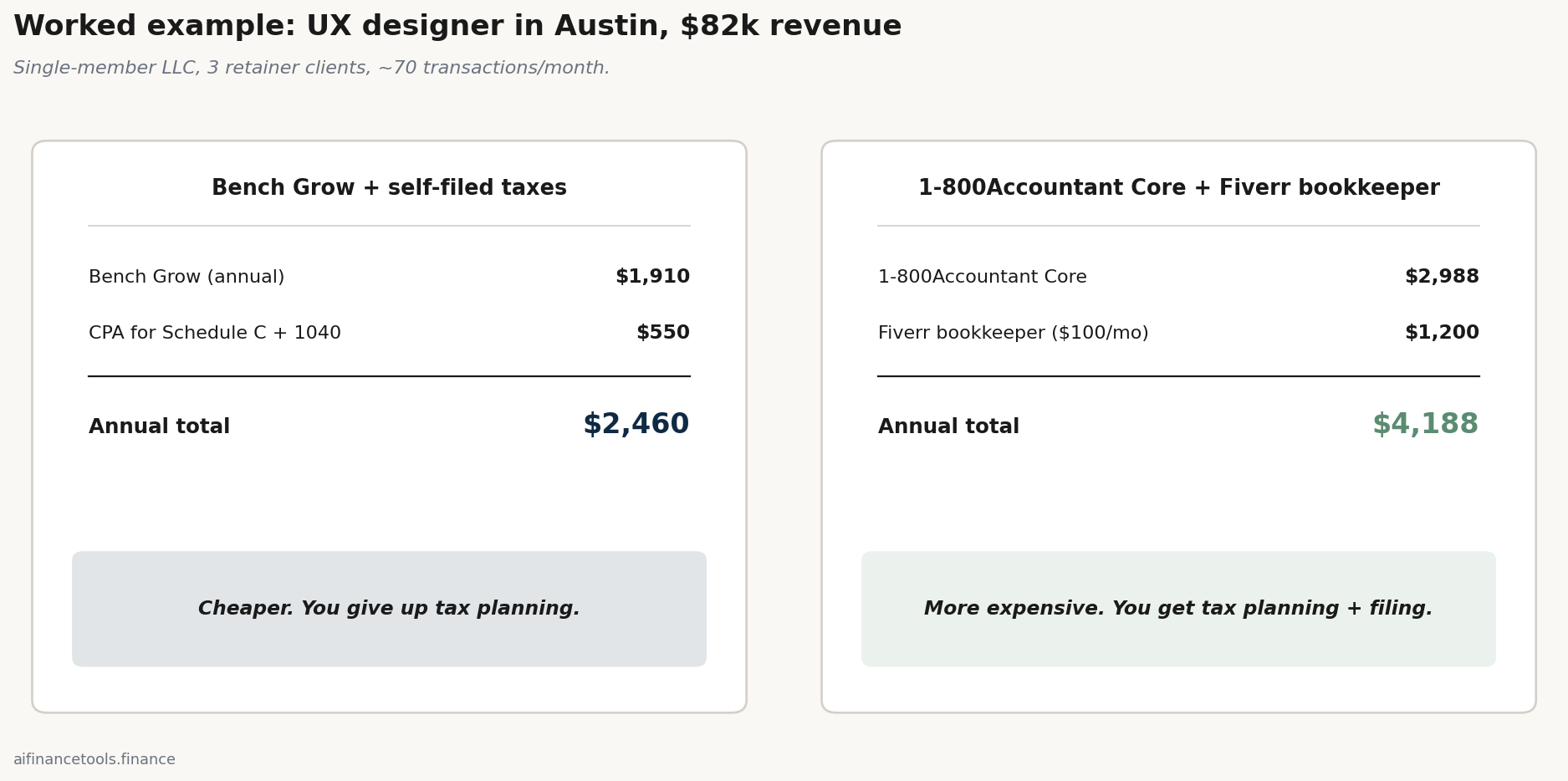
Worked example. You’re a freelance UX designer in Austin making $82,000 a year, mostly from three retainer clients. You operate as a single-member LLC, no S-corp election yet. Income comes through Stripe, plus occasional one-off project work paid through PayPal. You have a separate business checking and a business credit card. Roughly 60 to 80 transactions per month. Two clients send 1099-NECs.
Bench Grow at $199 per month or $1,910 annually gets you cash-basis bookkeeping, monthly P&L, and an end-of-year tax-ready package. You still need to file your own taxes or pay a CPA $400 to $700 for the Schedule C and Form 1040. Total annual cost: $2,310 to $2,610.
1-800Accountant Core Accounting at $249 per month or $2,988 annually gets you tax advisory, quarterly reviews, business and personal tax filing, plus access to bookkeeping software you maintain yourself. You do the bookkeeping (or hire a Fiverr bookkeeper for $100 per month). Total annual cost: $2,988 to $4,188.
If your bookkeeping is genuinely the painful part, Bench is cheaper. If your tax planning is the painful part, 1-800Accountant is the better fit. If both are painful, you’re looking at $5,000+ per year either way, and that’s the point where you should consider hiring a local CPA who knows your industry instead. A good local CPA charges $200 to $300 per hour, will do your books and taxes for $3,500 to $5,500 per year, and you can call them.
A 5-minute decision check
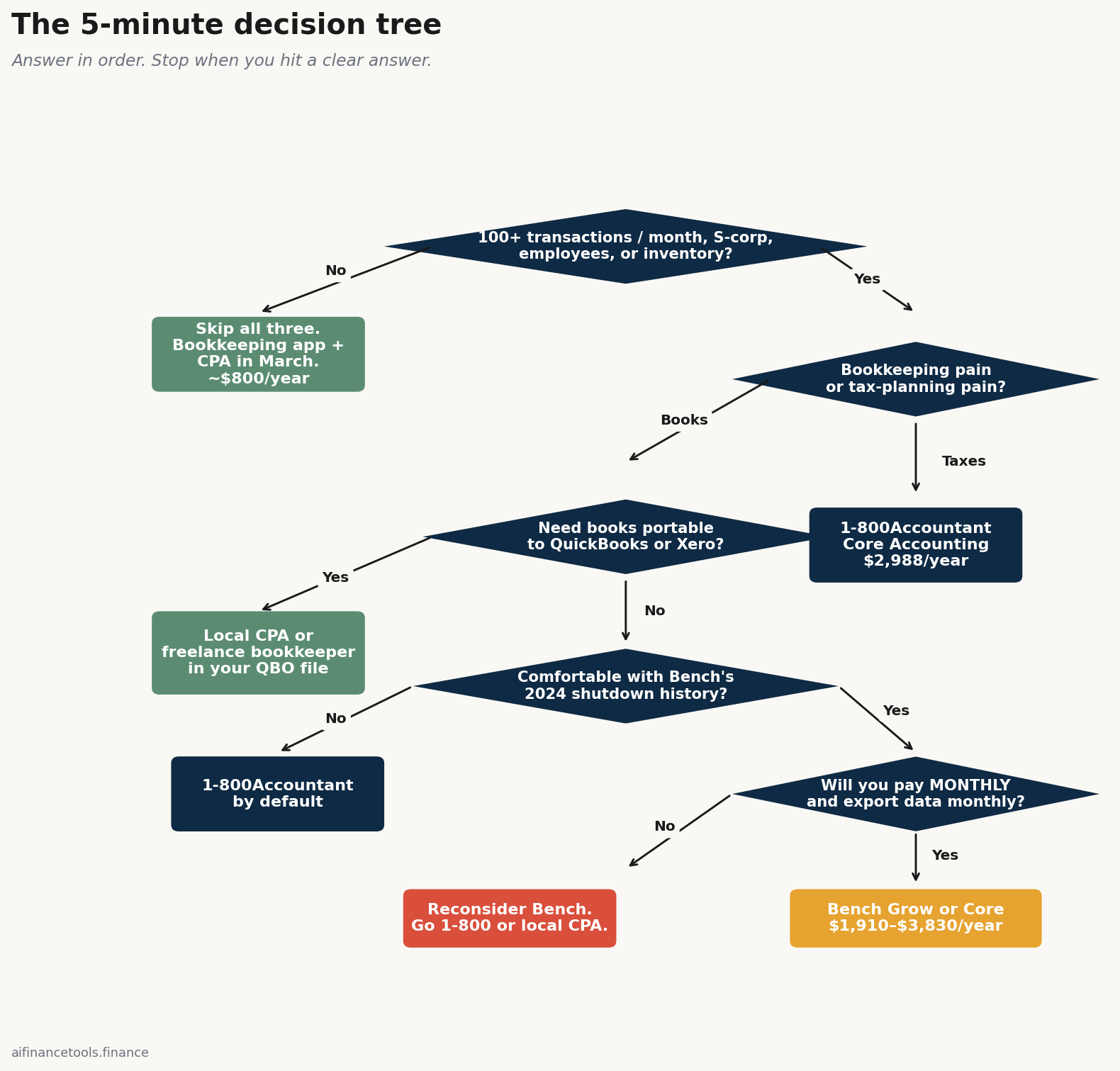
Answer these in order. Stop when you get a hard no.
- Do you have more than 100 business transactions per month, OR an S-corp/partnership election, OR employees, OR inventory? If no, you don’t need any of these. Use a bookkeeping app and a CPA in March. If yes, continue.
- Is your real problem the bookkeeping (tracking transactions, reconciling accounts) or the tax planning (deductions, quarterly estimates, entity structure)? Bookkeeping problem: Bench is the closer fit. Tax planning problem: 1-800Accountant.
- Do you want your books in QuickBooks or Xero so they’re portable? If yes, neither of these is ideal. Look at a local CPA or a freelance bookkeeper on Fiverr or Upwork who works inside your QBO file. If no, continue.
- Are you comfortable with the Bench shutdown history, given they’re operating again under new ownership? If no, 1-800Accountant by default. If yes, Bench Grow or Core depending on whether you need unlimited communication.
- If you go with Bench, can you commit to monthly billing and monthly data exports? If yes, sign up. If you’re tempted by the annual discount, re-read the section above about December 2024.
Alternatives worth knowing about
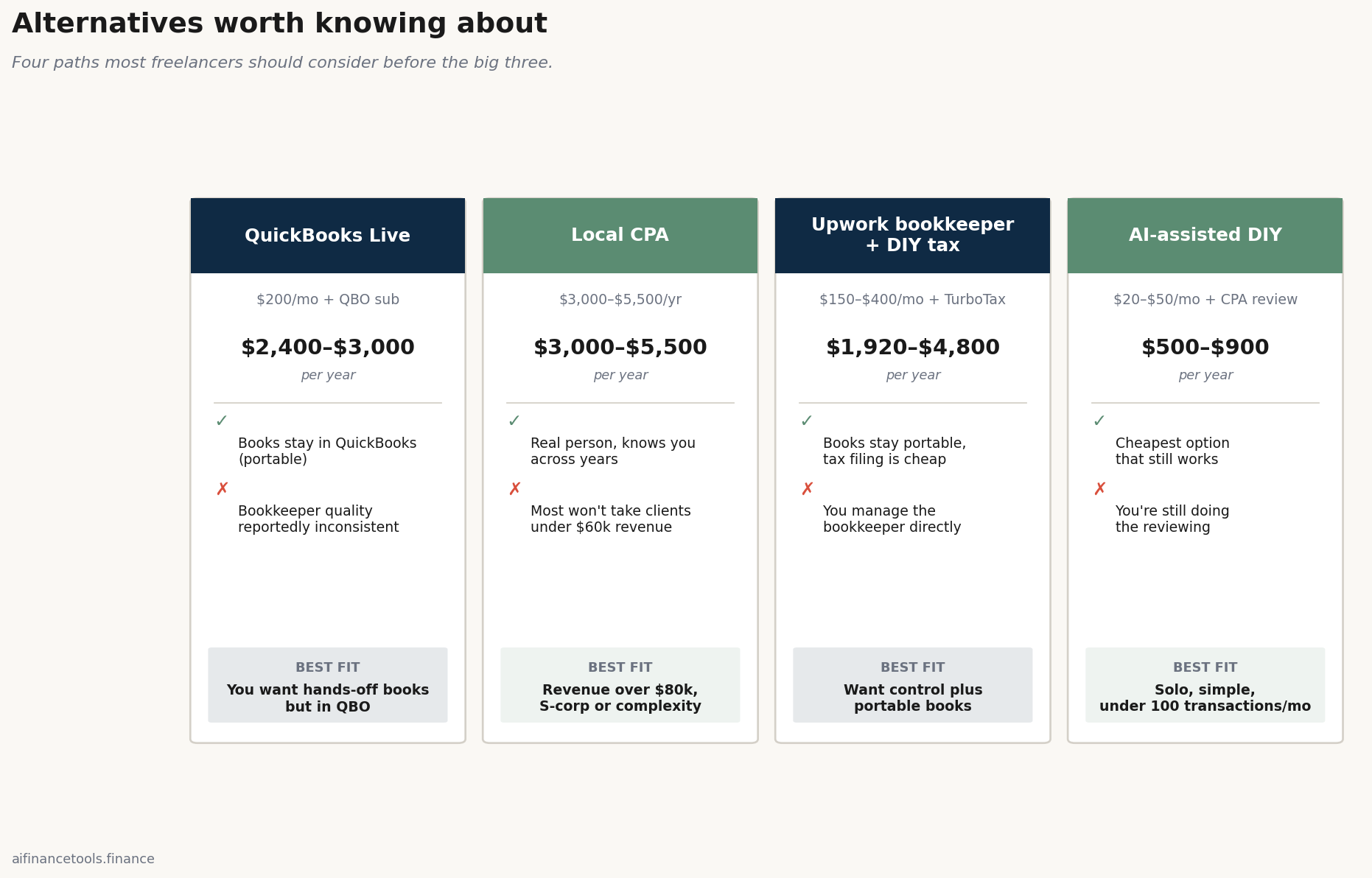
Four options that aren’t in the main comparison but probably should be on your radar.
- QuickBooks Live. Intuit’s own online bookkeeping service, attached to QuickBooks Online. Pricing starts at around $200 per month plus your QBO subscription. The advantage: your books stay in QuickBooks, so they’re portable. The disadvantage: bookkeeper quality is reportedly inconsistent and turnover patterns mirror Bench’s.
- A local CPA who handles small businesses. For $3,000 to $5,500 a year you get books, tax filing, year-round questions, and a real human you can sit down with. Not scalable for the CPA, which is why most won’t take clients under $60k. Worth the phone calls to find one who will.
- Freelance bookkeeper plus self-filed taxes. A solo bookkeeper on Upwork or Belay charges $150 to $400 per month to maintain your QBO or Xero file. You file your own Schedule C through TurboTax Self-Employed or H&R Block Self-Employed for $120 to $200. Total: $1,920 to $4,800 per year, books stay portable.
- DIY with AI-assisted software. Tools like Keeper Tax automate transaction categorization for around $20 per month. Our AI bookkeeping comparison covers the trade-offs. Combined with a CPA for tax filing only, you’re at $500 to $900 per year total.
For comparison-shopping on the software side, FreshBooks vs Xero is the most common decision point for freelancers ready to handle their own books.
Want a worksheet that does the math for you?

I built a free spreadsheet that takes your monthly transaction count, billable hourly rate, current tax-prep cost, and entity type, then tells you whether Bench, 1-800Accountant, a local CPA, or DIY makes the most sense given your specific numbers. It also flags the break-even point where switching providers actually saves money. Drop your email and I’ll send it over.
Frequently Asked Questions
Is Bench Accounting safe to use in 2026 after the December 2024 shutdown?
It’s operating normally under new ownership by Employer.com. Current Trustpilot reviews show ongoing positive customer experiences through March 2026. The risk isn’t that Bench will disappear tomorrow. The risk is that the new owner has limited accounting expertise and the BBB complaint pattern since the acquisition shows late filings and unresponsive support. If you sign up, pay monthly rather than annually, and export your data to Excel every month as backup. The annual discount of around 20% isn’t worth the lock-in risk given the history.
How much does Bench cost in 2026?
Bookkeeping Grow is $199 per month billed monthly, or $1,910 annually (effectively $159 per month). Bookkeeping Core is $399 per month, or $3,830 annually. Bookkeeping Core + Tax, which includes federal and state tax filing, is $599 per month, or $5,750 annually. Bookkeeping Accrual starts at $1,175 per month. There’s also a QBO Certified Bookkeeper option at $55 per hour with a $1,200 onboarding fee. All prices verified on bench.co in May 2026.
How much does 1-800Accountant cost?
Tax Advisory is $209 per month billed annually ($2,508 per year), which gets you year-round CPA access, quarterly reviews, and tax planning but no bookkeeping or tax filing. Core Accounting at $249 per month annually ($2,988 per year) adds personal and business tax preparation. Enterprise Business at $375 per month annually ($4,500 per year) adds a dedicated bookkeeper. Payroll is an add-on at $89 per month for the first employee plus a $200 setup fee. They don’t offer month-to-month billing.
Why is Pilot so much more expensive?
Pilot was built for venture-backed startups, not freelancers. Their Core plan at $499 per month is designed for businesses with $30,000 or more in monthly expenses, accrual-basis accounting requirements, and reporting needs that satisfy investors. Their Essentials plan at $99 per month is software-only with no human bookkeeper. For a solo freelancer earning under $110,000 a year, Pilot is priced for a customer you aren’t. There’s no version of Pilot that makes sense for that profile.
Is Bench better than QuickBooks Online for freelancers?
They solve different problems. QuickBooks Online Simple Start at around $35 per month is software you use yourself. Bench at $199 per month includes a human bookkeeper doing the work for you, plus a different proprietary platform. If you want bookkeeping done for you and don’t care which software the books live in, Bench is the more complete service. If you want your books in QuickBooks so they’re portable and recognized by every lender and CPA in the country, QuickBooks Online plus a freelance bookkeeper on Upwork is the better path. Cost can be similar either way.
Will 1-800Accountant file my Schedule C and personal taxes?
Yes, on the Core Accounting plan ($249 per month annually) and above. Both personal Form 1040 and business returns are included. The Tax Advisory plan at $209 per month doesn’t include filing, only year-round advisory and quarterly reviews. If filing is your main need, don’t sign up for Tax Advisory thinking it covers your return. Make sure the rep confirms which plan includes your specific filing needs in writing before you pay.
What about Bench’s BBB rating of D-?
The D- reflects the fallout from the December 2024 shutdown and the complaints filed during that period. Trustpilot, which has 1,330 reviews including many from after the acquisition, currently averages 4 stars. The two ratings reflect different sampling: BBB tends to capture only customers angry enough to file formal complaints, while Trustpilot includes prompted and unprompted reviews from a broader sample. Both are true. The shutdown caused real damage, and many current customers are still satisfied. You decide which signal carries more weight for your situation.
When is hiring a local CPA better than any of these services?
When your annual revenue is over $80,000 and you have any structural complexity (S-corp, multi-state, employees, inventory, multiple entities). A local CPA who works with freelancers in your industry typically charges $3,000 to $5,500 per year for full-service books and tax filing, you can call them, and they’ll know your situation across years. The hard part is finding one taking new clients under six figures of revenue. Ask other freelancers in your city for referrals, search your state CPA society directory, and budget two to three weeks for the search.
Compare Bench plans on bench.co
See 1-800Accountant plans on 1800accountant.com
This article is for informational purposes only and is not tax, legal, or financial advice. Tax laws and software pricing change frequently. Verify current pricing on each vendor’s website and check IRS.gov for current rules. For decisions specific to your situation, consult a licensed CPA or tax attorney. Pricing in this article was verified the second week of May 2026 and may have changed since publication.

About the author
Gareth is the founder of Freelancer Profit, a Dubai-based entrepreneur with a business consulting and leadership coaching background. He built the site to give freelancers honest, affiliate-free reviews of finance and tax tools, every one researched from official documentation, current pricing, and hundreds of real user reviews across Trustpilot, the BBB, and the app stores. It’s independent research, not professional tax advice, so check your own situation with a CPA.