

If you earn money on a 1099, you pay a tax that W-2 employees never see on their paystub: self-employment tax. It is 15.3% on top of regular income tax, and it catches most new freelancers off guard. The calculator below shows what you owe for the 2026 tax year, what changes when you also have a salaried job, and the single number that matters most: how much to pull from every invoice before you spend it.
What self-employment tax actually is
First 1099 of your life? Start with what to do when you get a 1099-NEC, then come back here to size the bill. Whether or not a client sends you the form, the income is taxable, and the 2026 1099 reporting threshold only changes who files paperwork, not what you owe.
When you work for an employer, you pay 7.65% of your wages toward Social Security and Medicare. Your employer quietly pays a matching 7.65%. You never see that second half.
When you work for yourself, you are both the worker and the employer. So you pay both halves: 15.3% total. You report it on Schedule SE, which attaches to your Schedule C. It breaks into two parts.
- Social Security: 12.4%. This applies only to the first $184,500 of earnings in 2026. Income above that ceiling is free of the Social Security portion.
- Medicare: 2.9%. This has no ceiling. Every dollar of net profit is subject to it. High earners pay an extra 0.9% on income above $200,000 (single) or $250,000 (married filing jointly).
One detail saves you money, and most basic calculators skip it. You do not pay self-employment tax on your full profit. You pay it on 92.35% of your net profit. The math removes the part that represents the employer's share, since a real employer's contribution would not be part of your taxable wages either. On $75,000 of profit, you are taxed on $69,263, not the full amount.
A second detail matters even more. Half of the self-employment tax you pay is deductible. It comes off your income before federal income tax is calculated. The calculator above applies this automatically, which is why the income tax figure it shows is lower than a rough "profit times your bracket" guess would suggest.
Why the W-2 plus 1099 situation changes everything
Here is the gap in almost every free SE tax calculator: they assume freelancing is your only income. For a large share of people, it is not.
If you were laid off and started taking contract work, or you freelance on the side of a full-time job, your freelance income does not get taxed in a vacuum. It stacks on top of your salary. That stacking pushes it into a higher tax bracket than the same income would face on its own.
Run the numbers. A person whose only income is $40,000 of freelance work sets aside about 18% for federal tax. Now take someone earning a $60,000 salary who freelances $40,000 on the side. That same $40,000 of freelance income now needs roughly 29% set aside, not 18%. The dollars are identical. The salary underneath is what moves the rate.
The reason is simple once you see it. Your salary already filled up the low tax brackets. Your freelance income starts where your salary left off, so it gets taxed at your top marginal rate from the first dollar, plus the full 15.3% self-employment tax that your W-2 wages do not carry in the same way.
The calculator handles this. Enter your W-2 wages in the field provided and it calculates the extra tax your freelance income adds on top of your salary. Your employer already withholds tax on the salary, so you only need to reserve money for the freelance portion. That reserve number is what you see. If you freelance on top of a salary, our full guide to side income while employed full-time works through the stacking in detail, and our guide to avoiding a tax liability shock covers what to do if the bill already landed.
What freelancers owe at different income levels
The table below shows a single filer with no other job, taking the standard deduction and the 20% qualified business income deduction, for the 2026 tax year. The figures use the 2026 standard deduction of $16,100 for a single filer and the brackets in IRS Revenue Procedure 2025-32, both locked in by the One Big Beautiful Bill Act signed on 4 July 2025. They match the calculator exactly. Your own result will shift with expenses, filing status, state, and a salaried job, so treat this as the baseline and use the tool for your real situation.
| Net freelance profit | Self-employment tax | Federal income tax | Total to set aside | Effective rate | Set aside per $1,000 |
|---|---|---|---|---|---|
| $30,000 | $4,239 | $942 | $5,181 | 17.3% | $173 |
| $50,000 | $7,065 | $2,667 | $9,732 | 19.5% | $195 |
| $75,000 | $10,597 | $4,898 | $15,495 | 20.7% | $207 |
| $100,000 | $14,130 | $8,235 | $22,365 | 22.4% | $224 |
| $150,000 | $21,194 | $16,413 | $37,608 | 25.1% | $251 |
A few things stand out.
At $30,000, self-employment tax is the whole story. You owe $4,239 in SE tax and under $1,000 in federal income tax, because the standard deduction and QBI deduction wipe out most of your taxable income. The 15.3% is what hurts at this level.
Income tax grows faster than SE tax as you climb. At $50,000, income tax is a quarter of your SE tax. By $150,000, income tax is nearly as large as SE tax. This is why your effective rate rises from 17.3% to 25.1% across the table. Self-employment tax stays roughly flat as a percentage; income tax is what pushes the total up.
The Social Security ceiling has not kicked in yet. None of these examples cross $184,500 in net earnings, so the full 12.4% applies to all of it. Once you pass that line, your marginal SE tax drops from 15.3% to 2.9%, since only Medicare continues above the cap.
How much to set aside per invoice
The "per $1,000" column is the one to remember. It converts an abstract annual tax bill into a habit you can act on the day you get paid.
At $75,000 of profit, you set aside $207 of every $1,000 you invoice. Send a $4,000 invoice, move $828 straight into a separate savings account, and treat the rest as yours. Do this every time and the quarterly tax bill stops being a shock. Our guide on how much to set aside for taxes walks through the same habit with more worked examples.
A blunt rule many freelancers use is "set aside 30%." It works as a rough floor, but it over-reserves at the low end and starves your cash flow, while it can fall short once you have a salary stacked underneath your freelancing. Use the calculator's number for your actual income instead of a one-size figure. If irregular pay is the real problem, the deeper fix is in our piece on managing freelance cash flow.
Open an actual account at a separate bank for taxes. A mental note will not hold. The single most common reason freelancers panic in April is that the tax money was sitting in their checking account and got spent. Money you cannot see is money you will not spend. If you have not split your finances yet, start with the best business bank accounts for freelancers.
Quarterly estimated taxes
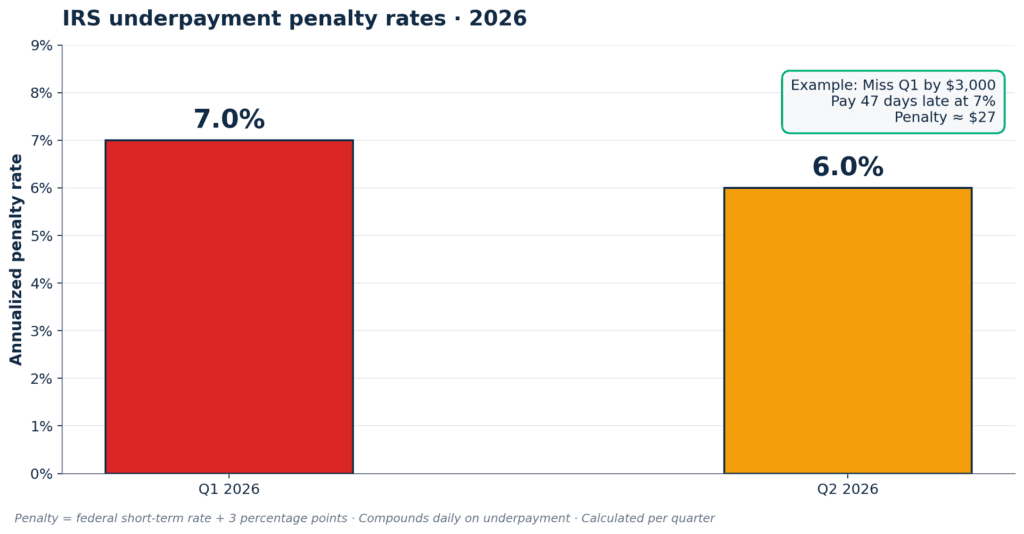
The IRS does not wait until April. If you expect to owe $1,000 or more, you are required to pay estimated taxes four times a year on Form 1040-ES. Miss them and you owe a penalty even if you pay your full balance later.
For income earned in 2026, the payments are due:
- First quarter: April 15, 2026
- Second quarter: June 15, 2026
- Third quarter: September 15, 2026
- Fourth quarter: January 15, 2027
If a date lands on a weekend or holiday, it moves to the next business day. The calculator's "quarterly estimated payment" figure is your annual total divided by four, which works cleanly if your income is steady. If your income is lumpy, pay based on what you actually earned that quarter rather than a flat quarter of a guess.
There is a safe harbor that kills the penalty. Pay at least 90% of what you owe this year, or 100% of what you owed last year (110% if your prior-year adjusted gross income was over $150,000), and the IRS will not charge an underpayment penalty on Form 2210 even if you still owe a balance in April. Our full guide to filing quarterly estimated taxes shows how to set the payments.
You pay through IRS Direct Pay or the Electronic Federal Tax Payment System. Both are free. There is no need to mail a check.
State income tax
Self-employment tax is federal only. It does not change based on where you live. State income tax is separate, and it varies a lot.
Nine states take no income tax on earned income: Alaska, Florida, Nevada, New Hampshire, South Dakota, Tennessee, Texas, Washington, and Wyoming. New Hampshire joined this group on 1 January 2025 when it repealed its interest and dividends tax. If you live in one of these states, the calculator's state field stays at zero and your set-aside is lower.
Everywhere else, you owe state tax on top of federal. Most middle-income freelancers see an effective state rate between 3% and 6%, though high-tax states like California run higher at upper incomes and add the $800 LLC franchise tax on top. Enter your best estimate in the state field and the calculator folds it into your set-aside. If you do not know your rate, your prior year state return shows it: divide the tax you paid by your taxable income. Our state-by-state freelance tax guide for 2026 has the rates by state.
Legal ways to lower the number
The self-employment tax calculator shows your tax under standard assumptions. Several moves can reduce it.
Deduct every legitimate business expense. Your self-employment tax is based on net profit, not gross income. Every dollar of real business cost you record lowers both your SE tax and your income tax. Software subscriptions, your business phone, mileage, professional services, and the like all count. At a roughly 30% combined marginal rate, a $1,000 deduction is worth about $300 to you. The deductions freelancers miss most is the list to work through, and you can only claim what you recorded, so keep a running log of tracked business expenses all year.
Take the home office deduction. If you use part of your home regularly and only for work, you can deduct a share of rent, utilities, and insurance. The simplified method gives you $5 per square foot up to 300 square feet, a $1,500 deduction with almost no paperwork. The full rules are in our home office deduction guide.
Contribute to a retirement account. A SEP-IRA or solo 401(k) lets you put away a large share of your profit pre-tax. It does not reduce your self-employment tax. It cuts your income tax meaningfully and builds the retirement savings that a salaried job would have handled for you. We compare the two in Solo 401k vs SEP IRA.
Deduct self-employed health insurance. If you pay your own health premiums and are not eligible for a spouse's employer plan, you can usually deduct them, which lowers your income tax.
The qualified business income deduction, worth up to 20% of your profit, is applied in the calculator by default. The One Big Beautiful Bill Act made this deduction permanent and added a minimum deduction of $400 for anyone with at least $1,000 of qualified business income who materially participates in their business, which helps freelancers at the low end of the table. Most sole proprietors under the 2026 income limits ($201,750 single, $403,500 joint) qualify for the full 20% regardless of their line of work. It reduces income tax only, never SE tax.
Common mistakes that cost freelancers money
Forgetting the SE tax exists. New freelancers budget for income tax and get blindsided by the extra 15.3%. The two are separate. Plan for both.
Setting aside a flat percentage that does not fit. As the table shows, the right rate ranges from about 17% to over 25% depending on income, and a salary underneath pushes it higher still.
Spending the tax money. Keep it in a separate account from the day each invoice clears.
Skipping quarterly payments. The penalty is avoidable. Pay on the four dates, or hit the safe harbor.
Not tracking expenses all year. You cannot deduct what you did not record. A simple spreadsheet or a bookkeeping app pays for itself in deductions.
Frequently asked questions
Do I owe self-employment tax if I have a regular job too?
Yes. Your W-2 job covers Social Security and Medicare on your salary. Your freelance income owes SE tax on its own. The one interaction: your salary counts toward the $184,500 Social Security ceiling, so if your salary is already near or above it, the Social Security part of your SE tax shrinks or disappears.
At what income do I start owing self-employment tax?
If your net self-employment earnings reach $400 in a year, you owe SE tax and must file a return for it. There is no lower threshold the way there is for income tax.
Is the self-employment tax rate really 15.3%?
Yes, but you apply it to 92.35% of your net profit, up to the Social Security ceiling. That makes the effective rate on your gross profit about 14.1% (15.3% times 0.9235). The deductible half is separate: it lowers your income tax, not your SE tax.
Can I deduct half of my self-employment tax?
Yes. Half of your SE tax comes off your income before income tax is figured. The calculator does this automatically, so the income tax it shows already reflects the deduction.
How is this different from a basic SE tax calculator?
Most tools take income in and give one tax figure out. This self-employment tax calculator handles business expenses, a salaried job stacked under your freelancing, the deductible half, the QBI deduction, state tax, and the per-invoice set-aside that tells you what to do with each payment as it arrives.
About the author
Gareth Noble is the founder of Freelancer Profit. He's not a CPA or a bookkeeper. He spent 20 years coaching teams at companies like Amazon, P&G, and Emirates before building this site, because he couldn't find honest, thorough reviews of finance tools written for freelancers. Every guide is researched from real user reviews, BBB complaints, official documentation, and primary sources.
This page provides general information and a planning estimate for the 2026 tax year based on published IRS and Social Security Administration figures. It is not tax advice. Your situation may include factors this tool does not model. For decisions about your return or payments, consult a CPA or enrolled agent.