


You got a 1099-NEC and your stomach dropped. Here is exactly what it means, what you do next, and why you are almost certainly not in trouble.

Okay. Breathe. A 1099-NEC landing in your inbox or mailbox is not a problem. It is paperwork. A client paid you enough during the year that they had to report it to the IRS, which they are legally required to do. You are not being audited. You did nothing wrong. This is what happens when you earn money as a freelancer, and it happens to just about everyone reading this.
The part that actually deserves your attention is the money, not the form. Nobody withheld tax from those payments during the year. So yes, you owe tax on that income. How much depends on numbers we will get to. The form itself is just the receipt.
The 30-second version
If you read nothing else, read this.
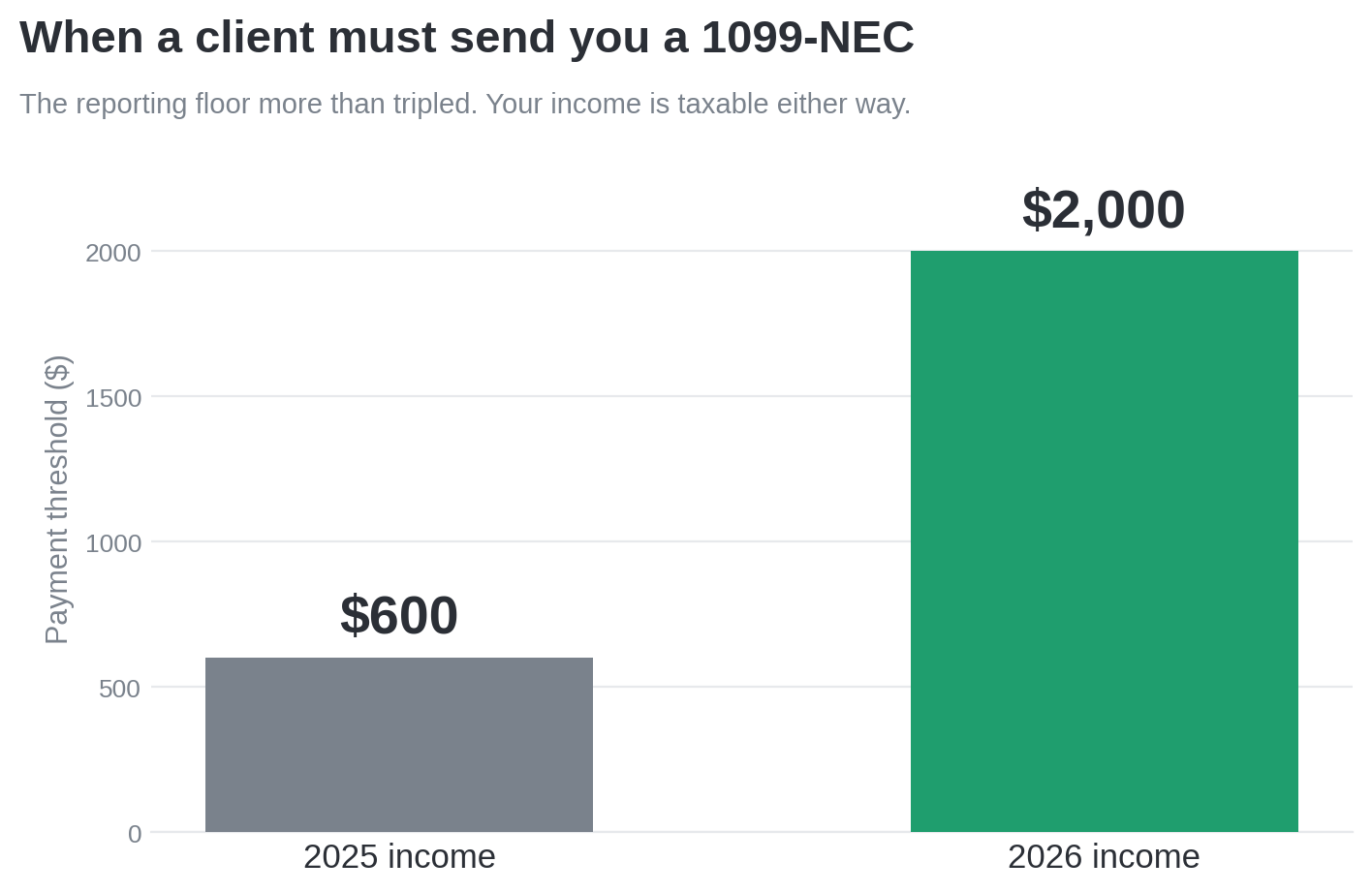
- What it is. A record that a client paid you enough for work that they had to report it, with no tax taken out. For 2025 income the trigger is $600. For 2026 income it rose to $2,000. Box 1 shows the total.
- What you do with it. Report the income on Schedule C, then pay income tax plus 15.3% self-employment tax on the profit.
- Whether you owe. Probably, if no other tax was paid in. A rough first guess: set aside 25% to 30% of the amount in Box 1 until you run the real numbers with the self-employment tax calculator.
- The audit question. Getting a 1099-NEC does not raise your audit odds. Not reporting income the IRS already has on file does.
- The deadline. It goes on your annual return, due April 15, 2026 for the 2025 tax year.
Now the walkthrough, in the order you should actually do it.
What is a 1099-NEC, in plain terms
NEC stands for nonemployee compensation. The form replaced the old 1099-MISC box for contractor pay back in the 2020 tax year, and it now does one job: it tells the IRS how much a business paid you for work when you were not their employee.
The reporting trigger changed for 2026, so the year matters. For payments made in 2025, a client who paid you $600 or more across the year has to file a 1099-NEC and send you a copy by January 31. For payments made in 2026 and later, the One Big Beautiful Bill Act raised that floor to $2,000, indexed for inflation from 2027. So a client who pays you $1,500 in 2026 no longer has to send a form, though you still owe tax on the money. That is the catch worth burning into memory: the form is the client’s paperwork obligation, not the definition of what counts as income. Below the threshold they are not required to file, and you might get a 1099 from one client and nothing from another even though you did similar work for both. The income is taxable either way.
One thing trips people up constantly. The 1099-NEC is separate from the 1099-K, which is what PayPal, Stripe, and similar platforms send when they process payments to you. If a client paid you through PayPal, that money can show up on a 1099-K instead of a 1099-NEC, and sometimes on both, which is where double-counting risk creeps in. We cover the threshold mess in detail in the 2026 1099 reporting threshold guide.
Step 1: Check that the numbers are right
Before you do anything else, look at Box 1 and compare it to your own records. This is the single most useful five minutes you will spend.
Pull up your invoices or your bank deposits from that client for the year. Add them up. The total should match Box 1, or come close. A freelance copywriter who invoiced a client $9,400 across the year should see roughly $9,400 in Box 1. If the form says $12,000, something is wrong, and you want to catch it now, not in April.
Common reasons the number looks off:
- Timing. A client paid a December invoice in January. It may land on this year’s form or next year’s depending on when the payment cleared.
- Reimbursements counted as income. Some clients lump expense reimbursements into the total. That inflates Box 1.
- Platform overlap. The client reported the full amount on a 1099-NEC, but the payment processor also reported it on a 1099-K. Now the IRS sees it twice.
- Wrong client, wrong you. A mismatched Taxpayer Identification Number, or a form meant for someone else.
If the number is wrong, email the client who issued it and ask for a corrected form. They file a corrected 1099-NEC with the box at the top marked CORRECTED. Do this politely and early. Freelancers on r/tax report that chasing a correction in late March, when accounting departments are buried, is far harder than asking in early February.
One detail that surprises people: if you never sent the client a W-9, or the Taxpayer Identification Number on it was wrong, the client may have withheld 24% of your pay as backup withholding and reported a 1099-NEC regardless of the amount. Check Box 4 on the form. If there is a figure there, that is tax already paid in on your behalf, and you claim it on your return. Get a clean W-9 to the client so it does not happen again.
Step 2: What if I lost it or never got one?
This is one of the most common panic-searches in late January, and the answer is reassuring. You do not strictly need the physical form to file. You need the income figure.
The IRS gets its own copy directly from the client. You report your income from your own records whether or not the paper form is in your hand. If you lost a 1099-NEC, check your email for a digital copy, log into the client’s payment portal, or just total your own invoices and bank deposits from that client. That total is what you report.
If a client paid you over the reporting threshold and never sent a form at all, you still report the income. A graphic designer who earned $4,200 from a client that ghosted on the paperwork still owes tax on $4,200. You can request a wage and income transcript from the IRS to see every 1099 filed under your Social Security number, which is the cleanest way to confirm what they already have on you. We walk through reading your full income picture in the line-by-line Schedule C guide.
Step 3: Figure out what you actually owe
Here is the part that causes the real anxiety, so let us be specific instead of vague. The money on a 1099-NEC gets hit by two separate taxes.
- Self-employment tax: 15.3%. This covers Social Security and Medicare. As an employee, your boss paid half of this for you. Now you pay both halves. It applies to your net profit, and it stings the most because it surprises first-timers.
- Income tax. Your federal rate depends on your total income for the year. Plus state income tax in most states.
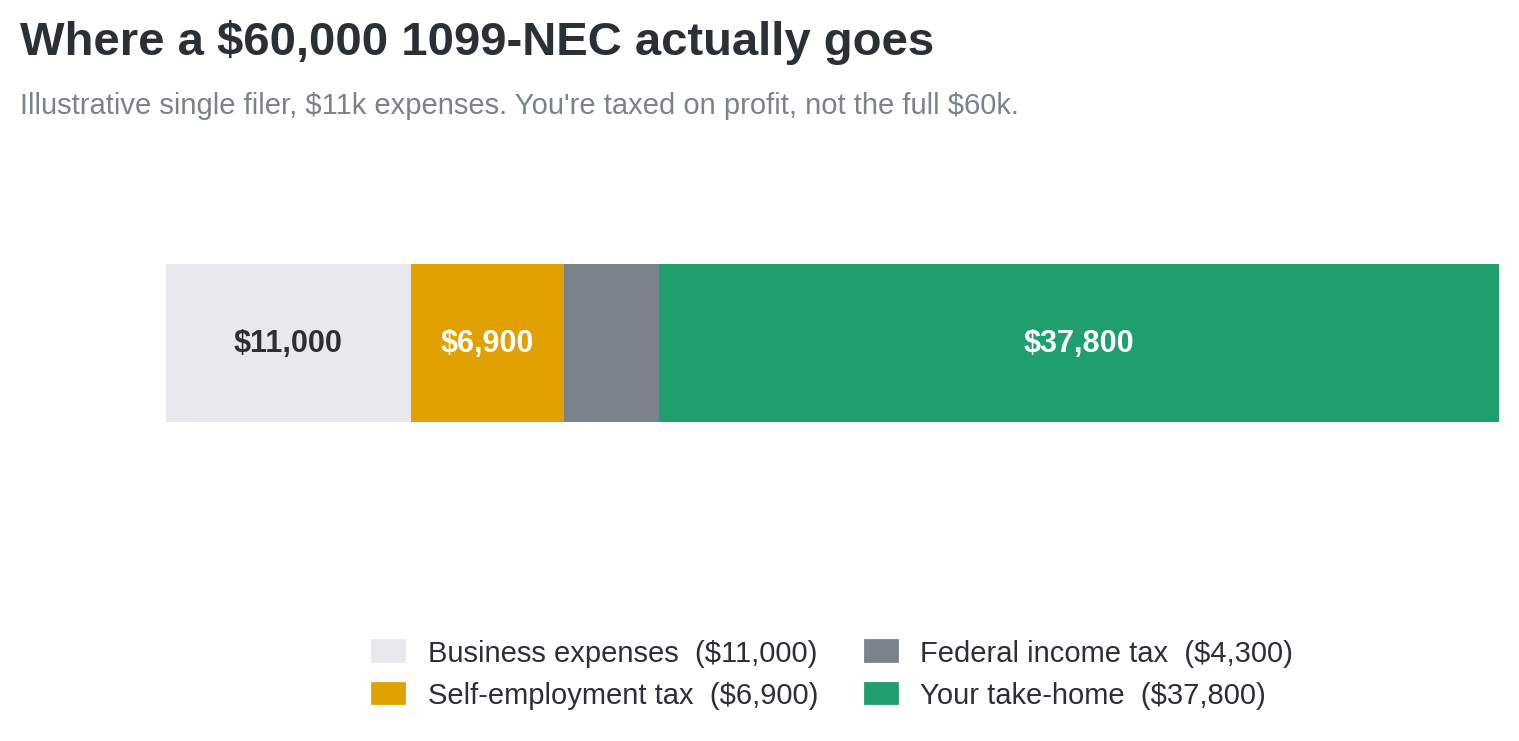
The good news that nobody mentions in the panic moment: you pay tax on profit, not on the gross figure in Box 1. Every legitimate business expense lowers the number you are taxed on. Software subscriptions, a portion of your phone and internet, mileage, a home office, professional fees. A freelancer with $60,000 in Box 1 income and $11,000 in real expenses is taxed on $49,000, not $60,000. That gap is worth thousands. Our guide to tax deductions freelancers miss most walks through the categories that get left on the table.
You also get to deduct half of your self-employment tax against your income tax, which softens the 15.3% a little. Most people never hear this until a CPA mentions it in year three.
A rough number you can use tonight
If you need a figure to stop the spiral right now, take Box 1, subtract your obvious expenses, and set aside 25% to 30% of what is left. For most full-time freelancers earning between $45,000 and $110,000, that lands you in the right neighborhood. It is not exact. It is enough to sleep. Run the real calculation in our tax set-aside guide when you are calmer.
A worked example, start to finish
A freelance UX designer in Texas gets a single 1099-NEC showing $72,000 in Box 1. She tracked $14,000 in expenses: design software, a new monitor, her home office, and her accountant. Her profit is $58,000. Self-employment tax runs 15.3% on 92.35% of that profit, so about $8,200. Her federal income tax depends on her filing status and other income, but on $58,000 of profit, after the standard deduction and the half-SE-tax deduction, a single filer owes roughly $4,500 to $5,500 in federal income tax. Texas has no state income tax, which helps. Add the two together and her total federal liability lands around $13,000 to $14,000. If she set aside nothing during the year, that is the number staring back at her in April.
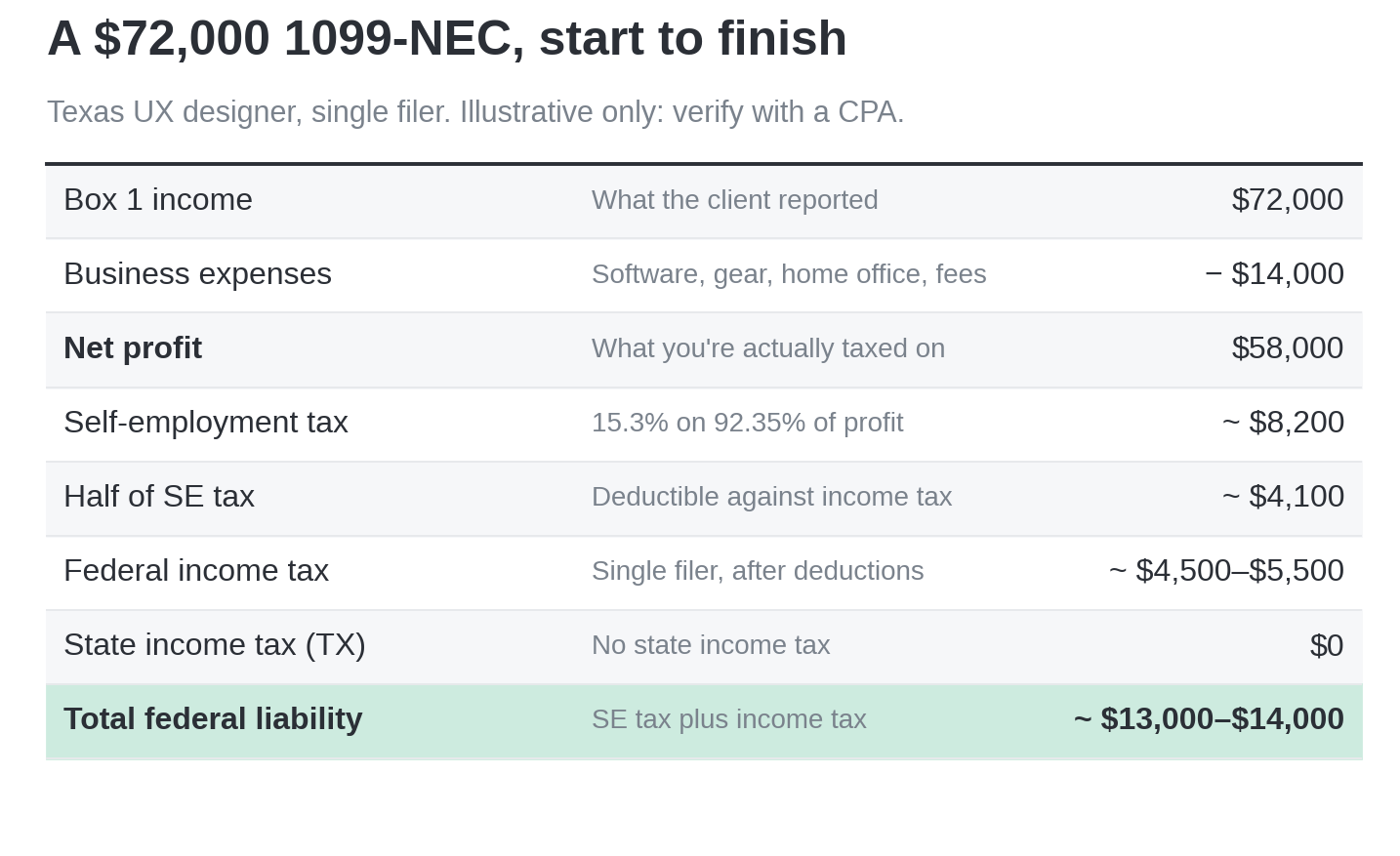
| Step | What it is | The number |
|---|---|---|
| Box 1 income | What the client reported | $72,000 |
| Business expenses | Software, gear, home office, fees | $14,000 |
| Net profit | What you are actually taxed on | $58,000 |
| Self-employment tax | 15.3% on 92.35% of profit | ~$8,200 |
| Half of SE tax | Deductible against income tax | ~$4,100 |
| Federal income tax | Single filer, after deductions | ~$4,500 to $5,500 |
| State income tax (TX) | No state income tax | $0 |
| Total federal liability | SE tax plus income tax | ~$13,000 to $14,000 |
Step 4: Report it on Schedule C
The 1099-NEC does not get filed on its own. The income on it flows onto Schedule C, the form where you report your freelance business profit or loss.
The mechanics are simpler than they sound. You add up all your income, including every 1099-NEC plus any cash or unreported payments. You list your expenses by category. The difference is your net profit, and that number carries to Schedule SE for the self-employment tax calculation and to your Form 1040 for income tax. Tax software does most of this automatically once you type in the Box 1 figure, but you should understand what it is doing. The full breakdown lives in our line-by-line Schedule C walkthrough.
If you have more than one 1099-NEC, they all go on the same Schedule C as long as they are for the same line of work. A freelance writer with five clients and five forms files one Schedule C, not five. The forms are inputs. The Schedule C is the summary.
Step 5: Sort out quarterly taxes going forward
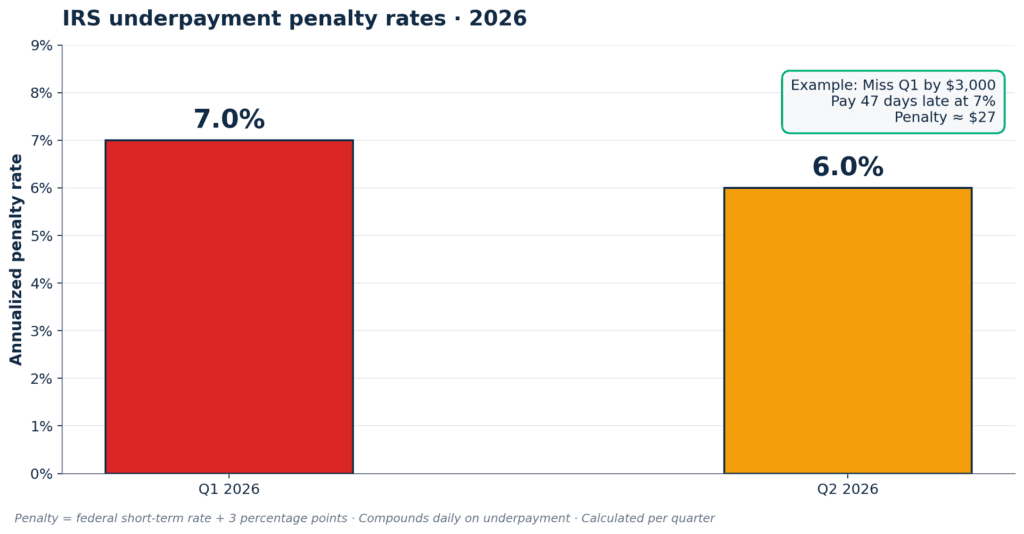
If this is your first 1099-NEC, there is a good chance nobody told you about estimated quarterly taxes, and you may have a small penalty coming. Here is the rule in one line: if you expect to owe $1,000 or more in tax for the year, the IRS wants you to pay it in four chunks through the year, not in one lump in April.
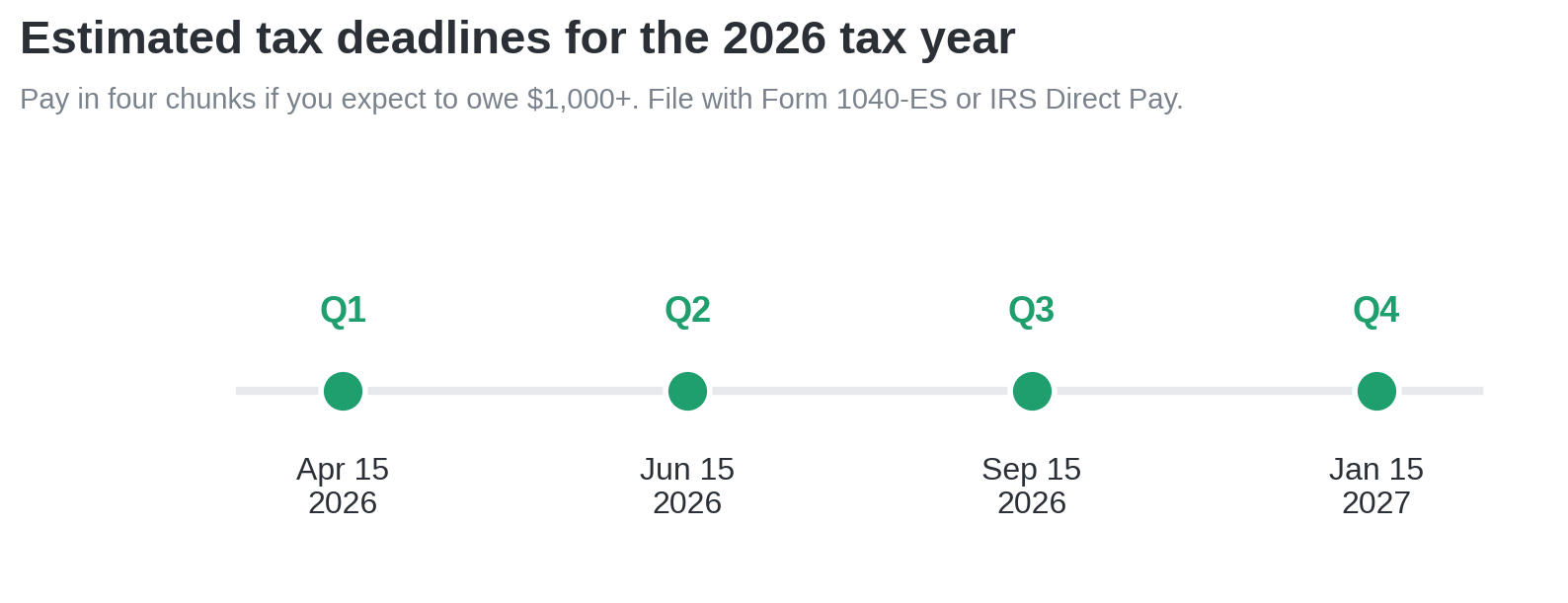
The estimated payment deadlines for the 2026 tax year fall on April 15, 2026, June 15, 2026, September 15, 2026, and January 15, 2027. You pay using Form 1040-ES, either by mail with the voucher or online through IRS Direct Pay. Miss them and the penalty is an interest charge on what you underpaid, not a fine in the punishment sense. For most freelancers it is tens or low hundreds of dollars, not a catastrophe. Annoying, not ruinous.
There is a way to switch the penalty off entirely, and it is the thing nobody tells first-timers. It is called the safe harbor. Pay in 100% of last year’s total tax across your four installments and the IRS cannot penalize you, no matter how much more you end up owing in April. If your adjusted gross income last year was over $150,000, the figure is 110% instead. Take last year’s total tax, divide by four, pay that each quarter, and the underpayment penalty is off the table. You might still owe a balance at filing, but you owe it penalty-free.
The fix for the cash side is boring and effective: open a separate savings account, move 25% to 30% of every payment into it the day it lands, and pay your quarterlies from there. Our quarterly estimated taxes guide covers the exact mechanics, and the tax liability shock guide covers why the first year hits hardest. If you are new to the tax side of freelancing generally, our freelancer tax and finance guides collect the rest in one place.
Will getting a 1099-NEC trigger an audit?
No. This is the fear that keeps people up, so let us kill it directly. Receiving a 1099-NEC is the most normal thing in freelance life. Millions are filed every year. The form itself does not flag you for anything.
What actually raises risk is the opposite move: leaving income off your return that the IRS already has a copy of. Their computers match the 1099s on file against what you report. If a client filed a 1099-NEC for $8,000 and you report nothing, the mismatch can generate an automated notice, usually a CP2000, which is a letter asking you to explain, not an audit. The way to avoid it is to report everything, which you are about to do anyway.
Claiming honest expenses does not make you a target either. Freelancers on r/freelance repeat a myth that deductions invite scrutiny. Reasonable, documented expenses for a real business are exactly what Schedule C exists for. The thing that draws attention is the unexplained gap, not the legitimate deduction.
The first-1099 survival checklist

We built a one-page checklist that walks you from opening the envelope to filing: verify Box 1, total your expenses, set aside the right percentage, file Schedule C, and set up quarterlies so next year does not ambush you. Print it, work down it, breathe easier. Free, no upsell.
Frequently Asked Questions
I got a 1099-NEC, what do I do first?
Check that Box 1 matches your own records of what that client paid you. If it matches, keep the form with your tax documents and report the income on Schedule C when you file. If it is wrong, email the client for a corrected form before tax season gets busy. The form itself needs no action beyond verifying it and reporting the income. You do not mail it anywhere. The IRS already has its copy from the client.
Do I owe taxes on a 1099-NEC?
Yes, if you had net profit. The income on a 1099-NEC had no tax withheld, so you owe both income tax and 15.3% self-employment tax on your profit after expenses. You are taxed on profit, not the gross Box 1 figure, so legitimate business expenses lower the bill. A rough starting estimate is to set aside 25% to 30% of your net income until you run exact numbers or use tax software.
What if my 1099-NEC is wrong?
Contact the client who issued it and ask for a corrected form. They file a new 1099-NEC with the CORRECTED box checked, and the IRS updates its records. Do this early, ideally in February, because finance teams get slammed closer to deadlines. If the client refuses or disappears, report your income based on your own accurate records and keep documentation showing why your figure differs from the form.
What if I lost my 1099-NEC?
You can still file without the physical form. You need the income figure, not the paper. Check your email, log into the client’s payment system, or total your invoices and deposits from that client. You can also request a wage and income transcript from the IRS to see every 1099 filed under your Social Security number. Report the correct income from whichever source you trust most.
Will a 1099-NEC make me more likely to get audited?
No. Receiving a 1099-NEC is routine and does not increase audit risk on its own. What raises risk is failing to report income the IRS already has on file, which can trigger an automated CP2000 notice asking you to explain the gap. Report everything accurately and claim only real, documented expenses, and you have nothing to worry about. The form is not a red flag. The missing income is.
What is the difference between a 1099-NEC and a 1099-K?
A 1099-NEC comes from a client who paid you directly for work. A 1099-K comes from a payment platform like PayPal or Stripe that processed payments to you. If a client paid you through one of those platforms, the same money can appear on both forms, which risks double-counting. Reconcile them carefully so you report the income once. Our 1099 threshold guide breaks down both forms and their current reporting limits.
Did the 1099-NEC threshold change for 2026?
Yes. For 2025 payments, clients had to file a 1099-NEC at $600 or more. The One Big Beautiful Bill Act, signed July 4, 2025, raised that to $2,000 for payments made after December 31, 2025, with inflation adjustments starting in 2027. So in 2026 a client who pays you under $2,000 no longer has to send a form. The money is still fully taxable, and you still report it on Schedule C. The change only affects who has to send paper, not what you owe.
Track every 1099 and expense: see our hands-on Keeper Tax review
Tax laws change, and the figures here reflect the 2025 and 2026 tax years at the time of writing. This is general information, not tax or legal advice. Verify current numbers at IRS.gov and check your specific situation with a qualified CPA before filing.

About the author
Gareth is the founder of Freelancer Profit and a Dubai-based entrepreneur with a business consulting and leadership coaching background. He built the site to give freelancers honest, independent reviews of finance and tax tools, every one researched from official documentation, current pricing, and hundreds of real user reviews across Trustpilot, the BBB, and the app stores. It’s independent research, not professional tax advice, so check your own situation with a CPA.